Overview
Passed by the Parliament of Great Britain in 1773, the Regulating Act marked the first direct attempt by the British government to supervise the East India Company's administration in India. The Company had begun as a trading corporation, but by this time it controlled large territories, maintained an army, and exercised political authority in Bengal. Its expanding responsibilities had outgrown the arrangements designed for commerce.
The measure created the office of Governor-General of Bengal and placed the presidencies of Madras and Bombay under Bengal's control in important matters. It also established a Supreme Council and provided for a Supreme Court at Fort William in Calcutta. Yet the Act did not remove the Company's authority over its territories or fully control its commercial affairs. It was therefore a regulating measure rather than a complete transfer of power.
Background
By 1773, the East India Company faced a serious financial crisis. It had been unable to meet its commitments to the British government since 1768, after losing much of its tea trade in America. Around 85 percent of the tea consumed in America was reportedly smuggled Dutch tea, weakening the Company's legitimate sales. At the same time, about 15 million pounds of tea lay in British warehouses, with more still being shipped from India.
The Company owed money to the Bank of England and to the government. It also paid £40,000 annually to preserve its monopoly over trade in India and the East. Its financial weakness mattered politically because many influential people held Company shares, and the East India Company remained a powerful lobbying group in Parliament.
The Company's territorial expansion created a second problem. Company servants had not been trained to govern, even though the Company now possessed extensive political responsibilities and an army to protect its interests. In Bengal, a dual system had existed since 1765: the Company exercised diwani rights, or revenue-collecting authority, while the Nawab formally retained administrative control. The crisis encouraged Lord North's government to bring the Company's Indian administration under closer supervision.
Prelude
The Act was introduced alongside measures intended to improve the Company's financial position, including a loan of £1.5 million and restrictions connected with dividends. Its principal objective was not to abolish the Company but to make its management more accountable while preserving its territorial possessions and commercial existence.
Company shareholders opposed the intervention. Their resistance reflected the fact that the East India Company remained influential despite its financial troubles. The final legislation therefore combined governmental supervision with continued Company authority, producing an arrangement that was powerful enough to alter administration but limited enough to leave major unresolved questions.
The Event
The Act limited Company dividends to 6 percent until the Company repaid its £1.5 million loan. It also restricted the Court of Directors to four-year terms. More directly, it prohibited Company servants from engaging in private trade or accepting presents and bribes from Indian rulers and other local people. These provisions attempted to address the conflicts of interest associated with Company officials exercising both commercial and political power.
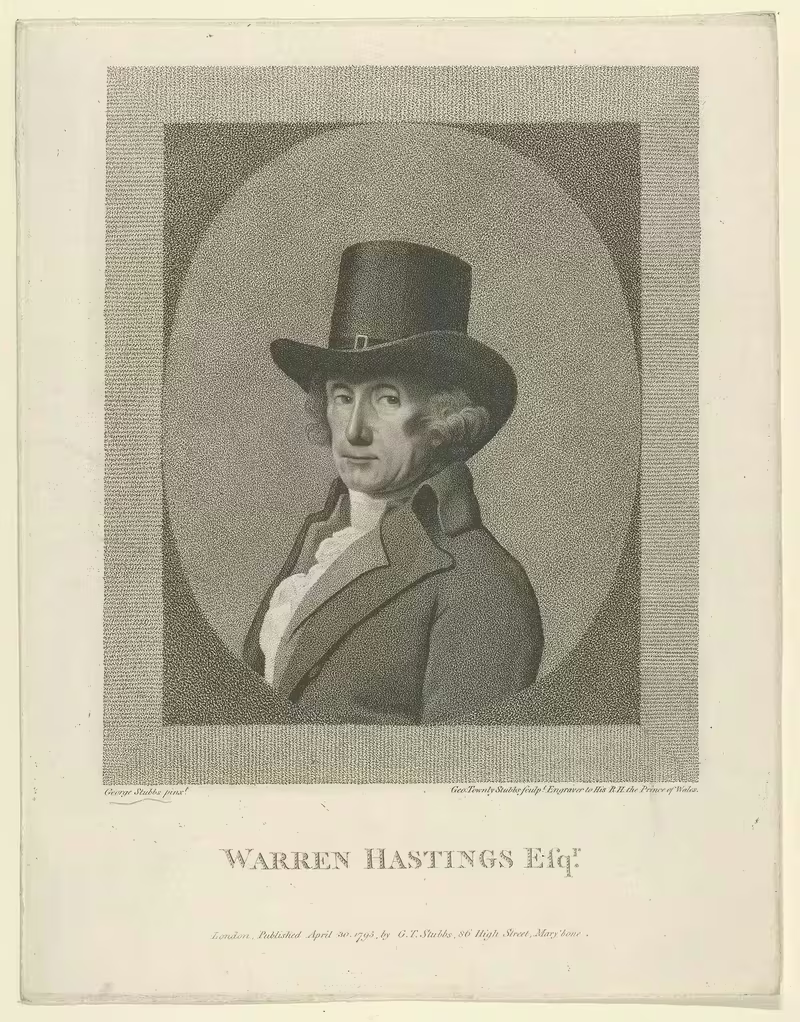
The Act elevated Warren Hastings to the newly defined office of Governor-General of Bengal. The presidencies of Madras and Bombay were brought under Bengal's control, establishing the foundations of a more centralised administrative structure.
Key Phases
The Act created a Supreme Council of Bengal consisting of the Governor-General and four additional members: Lieutenant-General John Clavering, George Monson, Richard Barwell, and Philip Francis. Decisions were to be made by majority vote. The Governor-General could vote only to break a tie, meaning that he did not possess a general veto.
A second institutional change followed in 1774 with the establishment of the Supreme Court of Judicature at Fort William in Calcutta. British judges were sent to India to administer the British legal system. Sir Elijah Impey became its first chief justice. The court possessed civil and criminal jurisdiction, as well as original and appellate jurisdiction.
Turning Points
The most consequential feature of the settlement was the division of authority between the Governor-General and the Supreme Council. Collective decision-making introduced a principle of shared responsibility, but it also meant that the Governor-General could be outvoted. This arrangement later produced serious administrative conflicts during Warren Hastings's tenure.
The creation of the Supreme Court also introduced a formal judicial institution alongside the Company's executive administration. However, the Act did not clearly define the court's jurisdiction. The resulting uncertainty led to conflicts between the Supreme Court and the Supreme Council of Bengal.
Participants
British Parliament and Lord North
Parliament began regulating the Company's affairs because its financial weakness and territorial power had become matters of national importance. Lord North led the governmental overhaul of Company management. The legislation represented the first step toward parliamentary oversight of the Company's administration in India.
The East India Company
The Company retained its territorial possessions and was not stripped of its power. Its commercial autonomy remained substantial, and the Court of Directors continued to play an important role. At the same time, Company servants faced restrictions on private trade and the acceptance of gifts or bribes.
Warren Hastings and the Supreme Council
Warren Hastings became Governor-General of Bengal and worked with the four-member Supreme Council. Since decisions required a majority, the office was not an unchecked executive position. The arrangement introduced centralisation but also created a built-in possibility of disagreement between the Governor-General and his council.
Aftermath
The Act established a framework for centralised administration, but it did not provide a long-term solution to the Company's problems. The Governor-General's lack of veto power, the unclear jurisdiction of the Supreme Court, and the Company's continued autonomy in commercial matters all limited the reform.
The Act also left gaps in the governance of Madras and Bombay outside questions of war, peace, and revenue. These weaknesses helped lead to the more radical Pitt's India Act of 1784, which represented a further movement toward parliamentary control.
Historical Significance
The Regulating Act's constitutional importance lies in the relationship it created between Parliament and the East India Company. It acknowledged that a private trading corporation ruling territory in India could not remain entirely outside governmental supervision. The Governor-General's office laid the foundation for a central administrative structure that would later develop into the Government of India.
The Supreme Council introduced collective responsibility, while the Supreme Court introduced a formal judicial system. The restrictions on Company servants also made them legally accountable for conduct that could compromise public administration. At the same time, the Act's shortcomings demonstrated how difficult it was to combine Company rule, parliamentary oversight, executive authority, and judicial power within one structure.
Legacy
The Act was subsequently superseded by later reforms. Most of it was repealed by the Government of India Act 1915, with sections 42, 43, and 45 initially excluded from that repeal. The remaining provisions were repealed by the Government of India (Amendment) Act 1916.
Its enduring legacy was institutional: it began the process by which the British Parliament assumed responsibility for regulating the East India Company's administration in India.
Historiography
The Act can be understood both as a landmark and as an incomplete reform. Its landmark character came from parliamentary oversight, the Governor-General's office, and the Supreme Court. Its limitations lay in the Company's continued territorial and commercial authority, the Governor-General's inability to overrule his council, and the uncertain boundary between executive and judicial jurisdiction. The passage of Pitt's India Act in 1784 indicates that the 1773 arrangement was treated as an initial step rather than a final settlement.