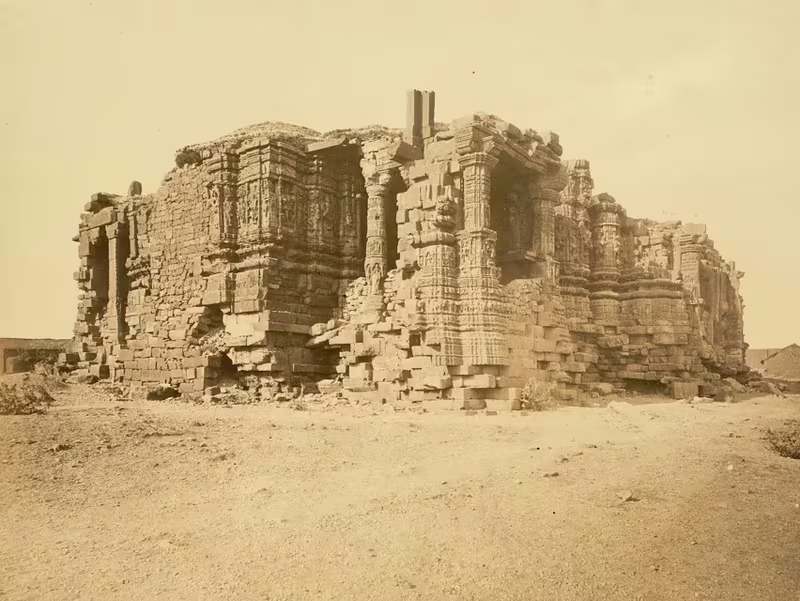
Overview
On 6 January 1026, Mahmud of Ghazni’s army reached Somnath on the southern coast of Kathiawar after crossing the desert from the northwest. The fortified settlement and its celebrated Hindu temple became the destination of what is described as Mahmud’s fifteenth invasion of India. The campaign ended with the defeat of the defenders, the plunder of the temple, and the destruction of its central Shiva linga according to the principal Muslim narratives.
Somnath was not only a religious centre but also a wealthy institution. The temple employed 350 men and women to sing and dance before the linga each day. Its income was said to come from 10,000 villages and from offerings made by pilgrims. Gold, silver, pearls, and precious jewels had accumulated there over many years. These claims help explain why Somnath appeared as an especially valuable objective within Mahmud’s wider pattern of Indian campaigns.
The event also acquired a meaning far beyond the battle itself. Muslim writers celebrated Mahmud’s victory and associated him with the destruction of idols, while later historians have questioned the consistency and reliability of the surviving narratives. The raid therefore belongs both to the military history of early medieval Gujarat and to the history of how the past has been remembered and interpreted.
Background
In 1026, Gujarat was ruled by Bhima I of the Chaulukya dynasty. The political situation around Gujarat was complex. Bhoja had consolidated considerable power and had reduced Bhima of Patan to the position of a vassal, according to the account preserved in the historical tradition. Saurashtra, meanwhile, was ruled by the Abhira king Mandalika and likely functioned as a feudatory under Bhima and, indirectly, under Bhoja.
Mahmud of Ghazni had already established a formidable reputation through repeated campaigns in the Indian subcontinent. He had subordinated the Gurjara-Pratihara dynasty and overthrown the Hindu Shahi dynasty. His attacks on the Chandelas and other Hindu chiefs further strengthened his standing among contemporary rulers. The Somnath expedition was consequently not an isolated raid, but part of a larger military career built on repeated campaigns, strategic captures, and the extraction of wealth.
The temple’s religious importance also shaped the later interpretation of the campaign. Ibn al-Athir stated that Mahmud destroyed idols and temples during his march through Indian kingdoms. In the story he recorded, Hindus argued that Somnath’s deity had allowed the earlier idols to be destroyed because the deity was displeased with them; had Somnath been pleased with those idols, no one could have harmed them. On hearing this, Mahmud supposedly resolved to destroy the Somnath idol. This account presents the attack as both a military operation and a deliberate act of iconoclasm.
Prelude
Mahmud began the march from Ghazni on 18 October 1025. The army was reported to contain 30,000 cavalry and 54,000 irregular infantry. Each soldier was personally supplied with two camels carrying essential provisions such as food and water. Mahmud’s own arrangements required between 20,000 and 30,000 additional camels, underlining the logistical scale of a march across arid country.
After resting at Multan, the army resumed its journey on 26 November and entered the desert. Mahmud first captured the fort of Ludrava near Jaisalmer. He then crossed the territories associated with Jaisalmer and Mallani. By the end of December, the army had reached Anhilwara. Bhima I, fearing for his life when he learned of the Ghaznavid approach, fled to the fort of Kanthkot in Cutch.
Mahmud continued southward. At Mundhera, local chiefs gathered approximately 20,000 warriors to resist the invasion. Their forces were defeated and dispersed. The Ghaznavid army then advanced towards Delvada near Una. The local population, believing that the deity Somnath would intervene and destroy the invaders, offered little resistance. Delvada was therefore captured with minimal opposition.
The next objective was Somnath. On 6 January 1026, Mahmud seized the Somnath fort from Mandalika, the Abhira ruler who oversaw it. The capture brought the invading army directly before the temple complex and began the siege described in the surviving accounts.
The Event
Key Phases
The defenders assembled on the ramparts of the port and, according to the narrative, spent their time in confidence and celebration. They believed that Somnath had drawn the Muslim army to the site in order to destroy it as punishment for earlier attacks on idols. The local leader, however, had fled with his family to a neighbouring island.
Mahmud laid siege to the fort on 6 January. Brahmins and devotees joined the garrison in its defence. Rah Navghan I of the Chudasama dynasty sent a small relief force under his minister Shridhar and his military commander Mahidhar. The force reached the fort the following day, adding to the resistance inside Somnath.
On Friday, 7 January, the Ghaznavids launched a fierce assault. A barrage of arrows forced the defenders to abandon the battlements. By afternoon, during the time of the Jumu'ah prayer, the attackers had climbed the walls and announced their success with the call to prayer. The defenders withdrew towards the temple, prayed before the idol, and then renewed the fight. Their counterattack drove the Ghaznavids from their captured positions before evening.
On the third day, the Ghaznavid army attacked again, recaptured the fortifications, and forced the defenders back towards the shrine gates. Fighting then continued in a close melee. Although the attackers were reportedly surrounded at one stage, they ultimately defeated the defenders and overcame the Chalukya forces. The account gives the defenders’ casualties as 50,000. Many who attempted to escape by boat were killed or drowned after a guard was stationed along the coast.
Turning Points
The first decisive moment was the fall of the battlements on 7 January. The arrow barrage enabled the Ghaznavids to scale the walls and establish positions within the fort. Yet the defenders’ counterattack showed that the capture was not immediately secure. Their retreat to the temple and renewed assault temporarily reversed the Ghaznavid advance.
The final turning point came when Mahmud’s forces recaptured the fortifications on the third day. Once the defenders were driven towards the shrine gates, the fighting moved into the temple’s immediate vicinity. The fall of the fort made the temple vulnerable to plunder.
After entering Somnath, Mahmud looted the temple and shattered the Shiva linga into pieces. The campaign account states that he took wealth valued at 20,000,000 dinars. It further reports that pieces of the linga were carried to Ghazni and used as steps at the gate of the Jami Mosque, where Muslims would walk over them while going to prayer. These events contributed to Mahmud’s later reputation as “the Idol Breaker.”
Participants
The Ghaznavid Forces
Mahmud of Ghazni directed the campaign personally. His army’s size and the elaborate supply arrangements enabled it to cross desert routes and reach Gujarat. The force relied on large numbers of cavalry and irregular infantry, and it used sustained assault, archery, and siege operations against the Somnath fortifications.
Mahmud’s victory was costly. Although the army captured Somnath and its wealth, its return journey was marked by resistance, attacks, and difficult terrain. The account states that only about 2,000 soldiers accompanied Mahmud back to Ghazni on 2 April 1026.
The Defenders and Regional Rulers
Bhima I, the Chaulukya ruler of Gujarat, withdrew to Kanthkot when Mahmud approached Anhilwara. Mandalika, the Abhira ruler responsible for Somnath fort, faced the attack directly. Rah Navghan I of the Chudasama dynasty attempted to reinforce the fort by sending Shridhar and Mahidhar. Brahmins, devotees, and the garrison also took part in the defence.
The defenders fought from the walls and later from the area around the temple. Their initial resistance, counterattack, and attempts to flee by sea indicate that the capture was contested, even though the final result was a Ghaznavid victory.
Aftermath
Mahmud reportedly remained at Somnath for only 18 days. The destruction of the idol caused widespread indignation among the Hindus, and neighbouring chiefs under Raja Paramdeva of Abu blocked the army’s direct route. The Ghaznavids therefore moved through the Aravalli hills and the Rann of Kutch rather than risk a direct confrontation.
Mahmud chose a watery route through Kutch and Sindh. Along the way, he sacked Miyani. When Bhima I heard that Mahmud was approaching, he abandoned Kanthkot. Mahmud captured and plundered the fort before continuing towards Ghazni.
The return journey remained dangerous. At Mansura, Khafif, the Qarmatian ruler, fled across a river and took refuge in a date-palm forest. Ghaznavid officers surrounded his camp and killed many of his followers. Mahmud also faced repeated attacks from the Jats. He finally returned to Ghazni on 2 April 1026 with approximately 2,000 soldiers, according to the account.
Before leaving Somnath, Mahmud instructed the brother of Bhima II that the temple should be rebuilt. After his departure, Rah Navghan, Bhima I, and Bhoja jointly restored it. The following year, in 1027, Mahmud conducted his sixteenth and final military engagement, a naval attack near the Indus against the Jats.
Historical Significance
The victory at Somnath enhanced Mahmud’s reputation across the Muslim world. News of the triumph prompted widespread praise, and Caliph al-Qadir bestowed titles and honours on Mahmud, his sons, and his brother. The episode became a prominent example of the ruler’s military success and his campaign against images and temples.
For Gujarat, the raid demonstrated the vulnerability of wealthy religious institutions and coastal fortifications when confronted by a large, mobile army operating far from its original base. The subsequent restoration of the temple also shows that the sack did not end Somnath’s religious importance.
The reported casualty figures and financial value of the plunder should be treated carefully. The account gives dramatic numbers, but the available historical discussion notes that the reconstruction depends heavily on Muslim authors and that Hindu sources do not provide a parallel account of the raid.
Legacy
Somnath continued to function as a powerful religious symbol after the 1026 campaign. Its restoration by regional rulers preserved the site’s importance, while the story of its destruction became central to later narratives about Mahmud of Ghazni.
The event has also endured because it brings together several themes: the movement of armies across difficult landscapes, the wealth of medieval temples, the political fragmentation of Gujarat, and the religious language used by medieval chroniclers. Its memory has been shaped not only by what happened at Somnath, but also by the ways later writers presented the victory and the destruction of the idol.
Historiography
The traditional account of the raid is drawn primarily from Turko-Persian historical writing. These narratives developed detailed and powerful legends around Mahmud’s attack, and scholar Meenakshi Jain has described their effect as having “electrified” the Muslim world.
Modern historians have questioned aspects of the iconoclastic interpretation and the certainty with which the traditional story is sometimes repeated. Romila Thapar, Richard Eaton, and A. K. Majumdar have all examined the episode critically. Thapar pointed out that Hindu sources provide no information about Mahmud’s raids, meaning that much of the reconstruction rests on Muslim authors. She also argued that Turko-Persian narratives were often accepted as historically valid despite contradictions within those accounts, partly because they seemed closer to European expectations of what history should look like.
Some historians have further noted records of pilgrimages to Somnath in 1038 that do not mention damage to the temple. Such evidence does not erase the raid from the historical record, but it complicates the assumption that every detail of the later narrative can be accepted without examination. The destruction, plunder, restoration, and memory of Somnath must therefore be considered together, with attention to both the medieval accounts and their later interpretation.