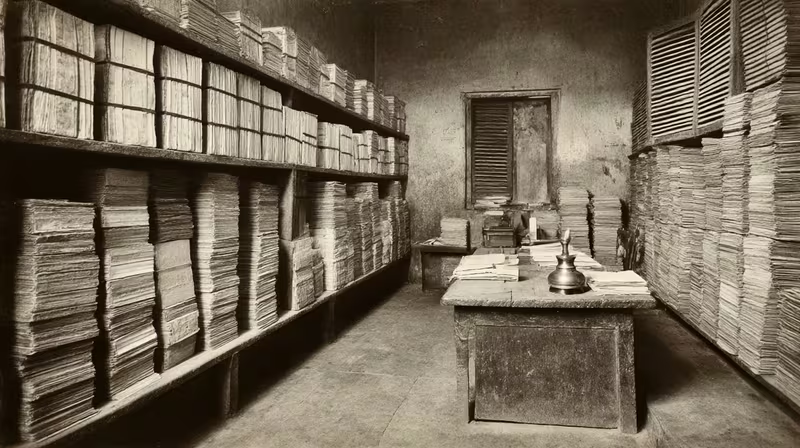
Kaithi: The Record-Keeping Script of North India
In 1854, Kaithi appeared in 77,368 school primers, surpassing the 25,151 primers in Devanagari and the 24,302 in Mahajani. This figure captures the practical reach of a script that was used across regions corresponding to modern Uttar Pradesh, Bihar, and Jharkhand. Kaithi was a Brahmic script employed for legal, administrative, and private records, and it was adapted to write a range of Indo-Aryan languages, including Angika, Awadhi, Bajjika, Bhojpuri, Hindustani, Maithili, Magahi, Nagpuri, and Surjapuri.
Its historical importance came from its everyday usefulness. Kaithi served in royal courts and later in British colonial administration, where members of the Kayastha community maintained revenue records, legal documents, title deeds, and correspondence. Unlike scripts that became associated primarily with religious literature, Kaithi was widely used by both Hindus and Muslims for practical communication, finance, and administration. It was also used in courts: in the 1880s, it was recognised as the official script of the law courts of Bihar, and from 1950 to 1954 it remained the official legal script of Bihar district courts.
Although Devanagari later gained ground, Kaithi remains significant for the study of historical documents, regional languages, scribal practice, and the development of writing in Northern and Eastern India.
Origins and Classification
Linguistic and Script Classification
Kaithi is a Brahmic script rather than a single spoken language. It was adapted for several Indo-Aryan languages and regional varieties. These included Angika, Awadhi, Bajjika, Bhojpuri, Hindustani, Maithili, Magahi, Nagpuri, and Surjapuri.
The script’s historical domain covered much of Northern and Eastern India. Its primary functions were practical: legal records, administration, private correspondence, revenue documentation, title deeds, and other forms of writing connected with daily institutional and commercial life.
Origins
Documents in Kaithi are traceable to at least the sixteenth century. The available historical record identifies no single place of invention, but places the script within the Brahmic writing tradition and connects its established use with regions corresponding to present-day Uttar Pradesh, Bihar, and Jharkhand.
Kaithi was used during the Mughal period and continued to be important under British colonial administration. Its later history is especially well documented through educational statistics, court usage, and official debates over scripts used in education and administration.
Name Etymology
The name Kaithi derives from Kayastha, the name of a socio-professional group historically associated with writing, record-keeping, and administration. Kayasthas served in royal courts and later in British colonial offices. Their work included maintaining revenue records, legal documents, title deeds, and general correspondence.
The script has several other names. These include Kayathi, Kayasthi, Kayastani, and Kaite Lipi. A multilingual stone inscription of King Pratap Malla dated 1654 CE refers to it in Newar as “Kayathināgara Ākhara,” meaning “Kayathinagari script.” In Nepali, it is also known as Kaite Lipi.
Historical Development
Early Documentation and Mughal Use
Kaithi documents are known from at least the sixteenth century, and the script was widely used during the Mughal period. Its spread was connected to the administrative and professional activities for which writing was required. Rather than serving only one language or community, it was adapted for multiple Indo-Aryan languages.
Its practical character also influenced its social position. Among the three scripts widely used in the Hindi Belt—Kaithi, Devanagari, and Mahajani—Kaithi was widely perceived as neutral. Hindus and Muslims used it for day-to-day correspondence, financial activities, and administration. Devanagari was associated with Hindu religious literature, while Persian script was associated with Muslim religious literature and education.
Education and Colonial Administration
The nineteenth century brought both recognition and competition. In 1854, Kaithi was represented in 77,368 school primers. This was considerably more than the 25,151 primers in Devanagari and the 24,302 in Mahajani.
In the late nineteenth century, John Nesfield in Oudh, George Campbell of Inverneill in Bihar, and a committee in Bengal advocated the use of Kaithi in education. Many legal documents were written in the script. During the 1880s, under the British Raj, Kaithi was recognised as the official script of the law courts of Bihar.
Despite this support, Kaithi increasingly became unfavourable to more conservative and religiously inclined groups who insisted on Devanagari-based or Persian-based transcription of Hindi dialects. The wide availability of Devanagari type also helped Devanagari gain ground, especially in the Northwest Provinces, corresponding to present-day Uttar Pradesh. Kaithi’s considerable variability made mechanical printing more difficult in comparison.
Bihar Courts after 1950
Kaithi remained the official legal script of Bihar district courts from 1950 to 1954. Its presence in legal records did not end with the loss of official status. Historical documents continued to survive, and present-day Bihar courts struggle to read old Kaithi documents. This continuing difficulty demonstrates the importance of the script for archival and legal history.
Modern Encoding
Kaithi entered the Unicode Standard in October 2009 with the release of version 5.2. Its Unicode block is U+11080–U+110CF. Unicode encoding makes it possible to represent Kaithi digitally alongside other historic and modern scripts.
Scripts and Writing Systems
Kaithi Script
Kaithi is a Brahmic script written from left to right. It was optimised for rapid transcription by removing the shirorekha, the headline associated with Devanagari. The absence of a continuous headline allowed scribes to write through continuous, rapid strokes.
The script has independent initial forms and dependent vowel diacritics. Kaithi consonants are called Kakahārā, while the formal Sanskrit-based term Vyanjan is also sometimes used. All Kaithi consonants have an inherent /a/ vowel. Diacritics change the meaning or pronunciation of letters, and vowel diacritics are attached to consonants.
Regional Classes
On the basis of local variants, Kaithi is divided into three classes:
- Bhojpuri: Used in Bhojpuri-speaking regions and considered the most legible style.
- Magahi: Native to Magah or Magadh and positioned between Bhojpuri and Tirhuti.
- Tirhuti: Used in Maithili-speaking regions and considered the most elegant style.
These classes show that Kaithi was not a completely uniform writing system. Local writing practices shaped its forms and appearance.
Consonant Ligatures
Conjunct consonant ligatures are called Sanyuktakshar, or Sanyuktachhar. They are generally less complex and less standardised than the conjuncts found in Devanagari. This relates partly to the morphology and phonology of the languages written in Kaithi. In Bhojpuri, Magadhi, Maithili, and Awadhi, consonant clusters are often simplified through metathesis.
For example, the Sanskrit-derived form karma becomes karam in Kaithi. Similarly, Sanyuktakshar becomes Sanyuktachhar. Complex phonemes such as /ksha/ may be replaced by simpler phonemes such as /cha/.
Kaithi’s rapid, continuous writing style also encouraged scribes to avoid complex conjunct forms. Instead, consonants could be written sequentially with an explicit virama to suppress the inherent vowel. Ligated forms nevertheless exist, especially in the Tirhuti class.
Ligatures generally follow two structural patterns. In vertical stacking, the trailing consonant is written below the leading consonant; this is especially common with homorganic nasals and geminates. In half-forms, the right vertical stem of the leading consonant is removed and the remaining left portion joins the following consonant horizontally.
Rhotic Ligation
The consonant /ɾa/ has specialised forms when it occurs in a conjunct. When it precedes another consonant, it is written as a repha: a small curved stroke above and slightly to the right of the following consonant. When /ɾa/ follows another consonant, it is written as a rakar. Its shape and attachment vary according to the form of the preceding consonant.
Kaithi manuscripts contain many geminates, which may be ligated or unligated depending on the scribe. A comprehensive table records 1,225 possible biconsonantal Kaithi conjunct clusters, including the derived characters /ɽ/ and /ɽʱ/, although some combinations may not occur in any language.
Geographic Distribution
Historical Spread
Kaithi was prevalent across parts of Northern and Eastern India, particularly in regions corresponding to modern Uttar Pradesh, Bihar, and Jharkhand. It was described as the most widely used script of North India west of Bengal.
Its use extended across several language areas. Bhojpuri, Magahi, and Maithili each had associated regional styles, while the script was also adapted for Angika, Awadhi, Bajjika, Hindustani, Nagpuri, and Surjapuri.
Administrative Centers
The script flourished wherever record-keeping was necessary: royal courts, colonial offices, law courts, revenue administration, and private correspondence. Bihar was a particularly important administrative center, since Kaithi became the official court script there in the 1880s and remained the legal script of Bihar district courts from 1950 to 1954.
Literary and Documentary Heritage
Legal and Administrative Writing
Kaithi’s strongest documentary heritage lies in legal and administrative records. Many legal documents were written in the script, along with revenue records, title deeds, and general correspondence. Its role was practical rather than restricted to a single literary tradition.
Inscriptions
The script appears in the multilingual stone inscription of King Pratap Malla dated 1654 CE. The inscription refers to Kaithi as “Kayathināgara Ākhara,” or “Kayathinagari script,” in Newar. This provides an early named reference to the script in an inscriptional context.
Educational Texts
The 1854 school-primer figures demonstrate that Kaithi was also used in education. Its 77,368 primers exceeded those printed in Devanagari and Mahajani. In the late nineteenth century, several officials and a Bengal committee advocated its use in education.
Modern Sample Texts
The Universal Declaration of Human Rights, Article 1, has been presented in Kaithi versions of Bhojpuri, Magadhi, Maithili, Angika, and Hindi. These examples demonstrate the script’s ability to represent multiple Indo-Aryan languages and regional varieties.
Influence and Legacy
Languages Written in Kaithi
Kaithi was adapted for Angika, Awadhi, Bajjika, Bhojpuri, Hindustani, Maithili, Magahi, Nagpuri, and Surjapuri. Its legacy therefore belongs not to one language alone, but to a broad multilingual region.
Cultural and Administrative Impact
Kaithi’s distinctive cultural position came from its neutrality in everyday use. Hindus and Muslims alike used it for correspondence, finance, and administration. This practical role contrasted with the stronger religious associations attached to Devanagari and Persian script in the Hindi Belt.
The script’s decline was shaped by social pressure, changing preferences, and the greater availability of Devanagari type. Yet its documentary legacy remains important. Old Kaithi records preserve evidence about courts, administration, education, property, and regional language use.
Royal and Religious Patronage
Mughal Period
Kaithi was widely used during the Mughal period. The record identifies broad use during this era rather than naming a specific ruler as its patron. Its importance was connected primarily with writing, administration, and record-keeping.
Courts and Government
Royal courts and British colonial administration relied on the record-keeping work historically associated with the Kayastha community. Under the British Raj, Bihar’s law courts officially recognised Kaithi in the 1880s. Its later use in Bihar district courts continued until 1954.
Modern Status
Current Use and Recognition
The surviving record does not provide a current number of Kaithi users or identify a present-day official status. It does establish that Kaithi is encoded in Unicode. The script was added to the Unicode Standard in October 2009, and its block extends from U+11080 to U+110CF.
Preservation Challenges
Present-day Bihar courts struggle to read old Kaithi documents. This creates a practical preservation challenge for legal and historical archives. Knowledge of the script remains important for interpreting surviving manuscripts, court records, inscriptions, and administrative documents.
Learning and Study
Academic Study
Kaithi can be studied through its regional classes, historical documents, inscriptions, legal records, and Unicode encoding. Particular attention is required for the Bhojpuri, Magahi, and Tirhuti styles, as well as for vowel diacritics, virama usage, consonant ligatures, geminates, and rhotic forms.
Historical Resources
A major early publication is George Abraham Grierson’s A Handbook to the Kayathi Character, published in Calcutta by Thacker, Spink and Co. in 1881. The script’s Unicode block also provides a foundation for digital study and text representation.
Conclusion
Kaithi developed as a practical Brahmic script for the multilingual societies of Northern and Eastern India. From at least the sixteenth century, it served legal, administrative, educational, and private purposes across regions corresponding to modern Uttar Pradesh, Bihar, and Jharkhand. Its association with Kayastha record-keepers reflects the importance of professional writing in royal courts, colonial offices, and local administration.
Its history also illustrates how scripts can occupy social spaces between religious and linguistic communities. Kaithi was used by Hindus and Muslims for everyday correspondence, financial activities, and official records, giving it a reputation for neutrality. Although Devanagari later displaced it in many settings, Kaithi’s surviving documents, regional forms, inscriptions, and Unicode encoding preserve its importance. It remains an essential script for understanding the documentary history of North India.