Kalinga Script: A Brahmic Tradition of Eastern India
The Hathigumpha inscription at the Udayagiri caves near Bhubaneswar preserves a deep-cut form of Brahmi identified as the Early Kalinga Type. This inscription belongs to the long history of writing in Kalinga, a region corresponding broadly to modern Odisha and extending into northeastern Andhra Pradesh. The Kalinga script, also called Southern Nagari, was primarily used to write the Odia language in inscriptions associated with the kingdom of Kalinga and the early Eastern Ganga dynasty.
The script developed through several regional phases. Its early history is connected with Kalinga Brahmi, while its later forms display a mixture of northern, central, and southern Indian writing traditions. Inscriptions and pottery fragments from Buddhist archaeological sites provide evidence for its early use. By the 12th century, following the defeat of the Somavamshi dynasty by the Eastern Ganga monarch Anantavarman Chodaganga and the reunification of Trikalinga, Kalinga script was replaced by a Siddhaṃ-derived Proto-Oriya script. That Proto-Oriya form became the ancestor of the modern Odia script.
Origins and Classification
Script Tradition
Kalinga script belongs to the Brahmic writing tradition. Its earliest form is described as Early Kalinga Type or Kalinga Brahmi. The surviving evidence does not establish a single inventor or a single moment of creation. The development of writing is presented as a social process shaped by regional contact, trade, political authority, and religious activity.
The Kalinga region occupied an important position in the movement of people and goods along the eastern coast. The historical discussion of the script connects its development with the Kalinga trade system and with Buddhist environments in which inscriptions and inscribed pottery were produced.
Origins
The early history of Kalinga Brahmi is connected with evidence from Odisha and with related forms of Brahmi found farther south. Similar versions of Tamil Brahmi and Kalinga or Northern Brahmi are reported in inscriptions from Salihundam, Arikamedu, Kanchipuram, and Korkai. Excavations around the coastal site of Arikamedu also found combinations of Tamil Brahmi, North Brahmi, and Sinhalese Brahmi.
The relationship among these regional forms remains historically complex. One view discussed in connection with carbon dating from Anuradhapura in Sri Lanka holds that Brahmi came to Tamil from Sinhalese and later developed into Tamil Brahmi. At the same time, Kalinga Brahmi is described as older than Sinhalese and Tamil Brahmi. These comparisons show that the history of Kalinga writing must be considered alongside the wider circulation of Brahmic forms around the eastern and southern coasts.
Name
“Kalinga script” refers to the script used in the Kalinga region. “Southern Nagari” is another name used for the tradition. The terms distinguish this regional form from other Brahmic and Nagari developments.
Historical Development
Early Kalinga Type or Kalinga Brahmi (c. 5th century BCE onward)
The Hathigumpha inscription at Udayagiri is written in a deep-cut Brahmi style identified as the Early Kalinga Type. The early Kalinga Brahmi tradition is also associated with inscriptions and fragments of broken pottery.
Evidence from Odisha includes material from Lalitgiri and from the Radhanagar area. A relationship with the southern Votiprolu script has been identified at Lalitgiri and at the Radhanagar fort. The Buddhist remains at Lalitgiri, including ruined stupas and the discovery of Buddha’s bones, connect this evidence with Buddhist religious activity.
At Kayama, Tarapur, and Radhanagar, an ancient Brahmi inscription was found on broken pottery from a Buddhist shrine. J. S. Jayaprakash, Deputy Superintendent of the Archaeological Survey of India, read the inscription as dating to the 3rd or 2nd centuries BCE. The pottery mentions “Buddha,” “Kesthup,” “Kalingaraja,” and a donation associated with the monk Tapus. The inscription is connected with the tradition that Tapusu and Vallika built a hair stupa at Tarapur with hair of the Buddha.
Regional Development
The Kalinga Brahmi script is described as the childhood form of the Odia script. It was used in the Kalinga region and differed in language and writing style from other forms of Brahmi. The Odia and Telugu scripts developed from Kalinga Brahmi and were initially close to one another.
Inscriptions associated with Kalinga rulers such as Kharavela, Satrubhanja, and the Matharas show forms that were almost identical. Later, the two traditions became more distinct. Political and geographical separation contributed to the emergence of differences in both script and language. By the seventh century, regional isolation had produced clearer distinctions, while by the tenth century the combination of writing and conjugation had an important role in establishing the individuality of the scripts.
Later Kalinga Script (7th–12th centuries CE)
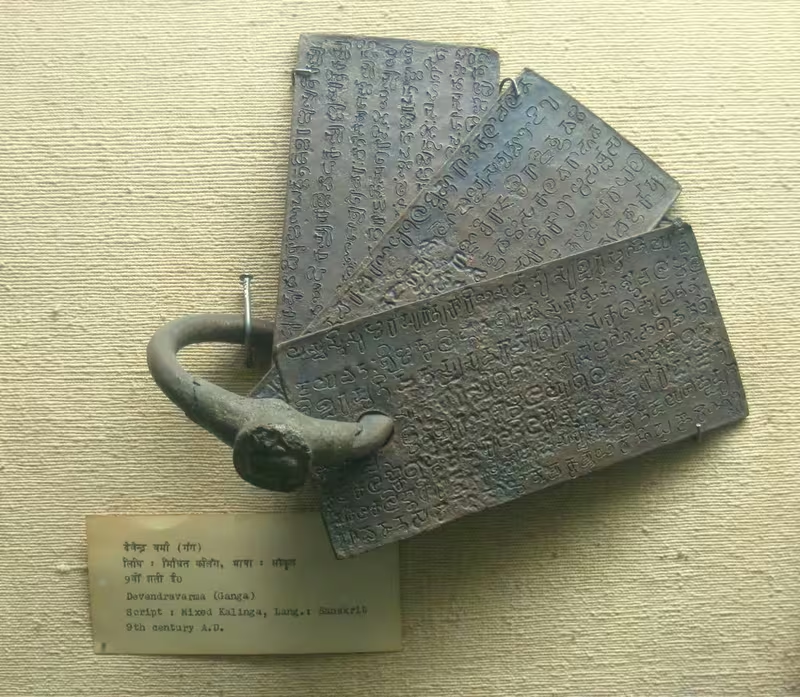
The Later Kalinga script was used in inscriptions from the 7th to the 12th centuries during the period of the early Eastern Ganga dynasty. Its main area included the coastal regions of modern southern Odisha and northeastern Andhra Pradesh.
Earlier forms show a strong mixture with northern and central Indian forms, especially Gupta script. In later forms, the influence of southern Devanagari became stronger. The copper-plate grants of the early Gangas of Kalinganagara display a distinctive style and include borrowings from proto-Kannadi or Rashtrakuta scripts. Canarese influence is visible in several letters, including forms identified as t, ch, n, th, d, dh, n, and bh.
Scripts and Writing Systems
Kalinga Brahmi
Kalinga Brahmi was a regional form of Brahmi used in stone inscriptions and on pottery. Its evidence appears in both royal and Buddhist contexts. The script was related to other Brahmic forms but developed distinctive regional characteristics.
The relationship between Kalinga Brahmi and the Votiprolu script is emphasized by the similarities between inscriptions from Odisha and the Votiprolu stupa. The evidence from Tarapur and Lalitgiri indicates that the script participated in networks connecting Kalinga with Buddhist sites and coastal regions to the south.
Later Kalinga Script
The later form was used especially in inscriptions and copper-plate endowments. According to the paleographic account associated with Hiralal Ojha, Kalinga script was used in Eastern Ganga copper plates from the 7th to the 11th centuries. It first resembled the square-headed styles of central regions, but later became a distinctive mixture of Telugu-Kannada, Nagari, and southern features.
Script Evolution
A study of Indian archives up to the fourth century found that most scripts were broadly similar, with some exceptions. Regional rulers gradually altered the appearance of writing through additions such as loops and tails. By the seventh century, political and economic separation encouraged stronger regional differences.
Kalinga script was ultimately replaced by a Siddhaṃ-derived Proto-Oriya script after the reunification of Trikalinga in the 12th century. The Proto-Oriya script later became the ancestor of the modern Odia script.
Geographic Distribution
Historical Spread
Kalinga script was used in the Kalinga region, corresponding to modern Odisha and extending into northeastern Andhra Pradesh. Related inscriptions and script forms occur at sites in Odisha, Andhra Pradesh, Tamil Nadu, and Sri Lanka, reflecting the wider movement of Brahmic writing traditions.
Archaeological Centers
Important evidence comes from the Hathigumpha inscription at Udayagiri, the Buddhist remains at Lalitgiri, and the pottery inscription from Kayama and Tarapur near Radhanagar. Salihundam and other sites in Andhra Pradesh also preserve related script forms. Arikamedu, Kanchipuram, and Korkai provide comparative evidence for the relationship between Kalinga, Northern, Tamil, and Sinhalese Brahmi.
Literary and Epigraphic Heritage
Kalinga script is represented primarily by inscriptions rather than by named literary works. Its surviving record includes stone inscriptions, copper-plate endowments, Buddhist inscriptions, and writing on broken pottery.
The Hathigumpha inscription is a major example of the Early Kalinga Type. The Tarapur pottery inscription provides evidence of Buddhist terminology, donation, and references to Buddha, a stupa, a monk, and Kalinga. Later Eastern Ganga copper plates document the development of the script and its interaction with other regional writing traditions.
Influence and Legacy
Kalinga Brahmi contributed to the development of both the Odia and Telugu script traditions. These scripts were initially close but later became autonomous. The later Kalinga tradition also demonstrates contact with Gupta, Nagari, Telugu-Kannada, and proto-Kannadi forms.
Its most direct historical legacy is the Proto-Oriya script, which replaced Kalinga script by the 12th century and became the ancestor of modern Odia writing. The script therefore occupies an important position in the transition from regional Brahmi forms to the historical Odia script.
Royal and Religious Context
Regional Rulers
Kalinga script was used in inscriptions associated with Kalinga rulers and the early Eastern Ganga dynasty. The copper-plate grants of the early Gangas show how royal documentation supported the continued use and development of the script.
Buddhist Institutions
Buddhist sites supplied some of the earliest evidence for Kalinga Brahmi. The remains at Lalitgiri, the Tarapur Buddhist shrine, and the related stupa traditions connect the script with Buddhist religious activity. Inscriptions on pottery and references to Buddha, monks, stupas, and donations show how writing functioned in these settings.
Modern Status
Kalinga script is no longer the principal script of the region. Its use ended as the Siddhaṃ-derived Proto-Oriya script became established after the 12th-century reunification of Trikalinga. Its historical continuation can be traced through the development of the modern Odia script.
Learning and Study
Kalinga script is studied through epigraphy, paleography, archaeology, inscriptions, copper plates, and pottery fragments. The Indian Antiquary, established in 1872 under the editorship of James Burgess, encouraged paleographic research. Hiralal Ojha later proposed a historical account in which Brahmi developed without a major break from approximately 500 BCE to 350 CE before dividing into northern and southern branches.
Conclusion
Kalinga script records the development of writing in one of eastern India’s major historical regions. From the Early Kalinga Type visible at Udayagiri to the later script of Eastern Ganga copper plates, it shows how Brahmic writing changed through regional contact and political transformation. Its inscriptions connect Kalinga with Buddhist institutions, coastal exchange, and related writing traditions in Andhra, Tamil regions, and Sri Lanka. The script’s history also explains the deep background of Odia writing: Kalinga Brahmi contributed to the early development of Odia and Telugu forms, while the later Kalinga script was eventually replaced by Proto-Oriya. Through surviving inscriptions, pottery, and copper plates, Kalinga script remains an important record of eastern Indian paleography.