Overview
On the final stage of a journey through the eastern Gangetic world, the eighty-year-old Gautama Buddha crossed the Kakkuttha River—identified with the modern Khanua River—and reached a grove of sala trees at Kushinagar. According to the Mahāparinibbāṇa Sutta, he lay down on his right side, with his head to the north and his feet to the south. There, Buddhist tradition places his parinirvana, the passing beyond the cycle of ordinary existence.
Kushinagar, known in Pali as Kusinārā and in Sanskrit as Kuśinagara, is now a town in Uttar Pradesh’s Kushinagar district. Its sacred landscape includes the Parinirvana Temple and Stupa, the Ramabhar Stupa associated with the Buddha’s cremation, the Matha Kuar Shrine, and the remains of monasteries and votive stupas. These monuments reflect both the long memory of the Buddha’s final days and the changing fortunes of Buddhist institutions in northern India.
The site’s modern importance rests on a combination of religious tradition and archaeology. Ashokan remains, Gupta-period construction, inscriptions, sculptures, and nineteenth-century excavations all contributed to the identification and revival of Kushinagar as a major Buddhist pilgrimage centre.
Etymology and Names
The ancient name appears in two closely related forms: Kusinārā in Pali and Kuśinagara in Sanskrit. Alexander Cunningham proposed that Kushinagara received its name from the abundance of kusha grass in the region. The name is therefore connected, at least in his interpretation, with the vegetation of the local landscape.
In modern usage, Kushinagar is the established name of the town and district. The ancient forms remain important in Buddhist and historical writing because they identify the place described in accounts of the Buddha’s last journey.
Geography and Location
Kushinagar lies in present-day Uttar Pradesh. The ancient account of the Buddha’s final journey places it beyond Pāvā, reached after crossing the Kakkuttha River, now called the Khanua River. The Buddha then entered a grove of sala trees, where he rested before attaining parinirvana.
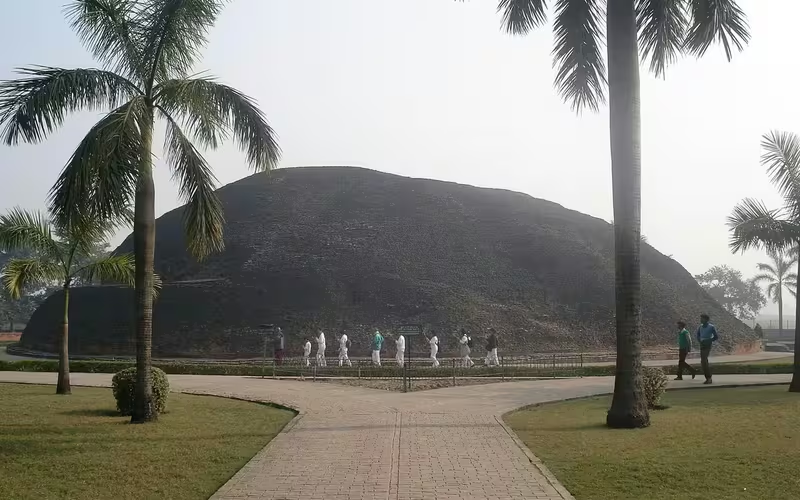
The sacred monuments are distributed across a relatively compact archaeological landscape. The Matha Kuar Shrine stands at the western end of the complex. The Parinirvana Temple and Parinirvana Stupa form its central focus, while the Ramabhar Stupa lies about 1.5 kilometres east of the temple on the Kushinagar–Deoria road. Excavated monasteries, votive stupas, and brick structures surround these principal monuments.
Ancient History
The most important ancient history of Kushinagar is preserved in the account of the Buddha’s death. When he reached his eightieth year, he and several disciples travelled for months from Rājagṛha through Pāṭaliputta, Vesāli, Bhoganagara, and Pāvā. At Pāvā, a resident named Cunda invited the group to a meal that included a food called sūkaramaddava. Soon afterwards, the Buddha suffered a painful illness resembling dysentery. He nevertheless continued towards Kushinagar.
After reaching the sala grove, the Buddha lay down on his right side. The Mahāparinibbāṇa Sutta describes his final instructions and his attainment of parinirvana. Seven days later, his body was cremated at the location associated with Kushinagar.
The distribution of the relics became an important part of the site’s history. The Sakyas, to whom the Buddha belonged, initially expected to receive the ashes. Six other clans and a king also demanded a share. A Brahmin named Drona resolved the dispute by dividing the relics into eight portions. These went to Ajātasattu, king of Magadha; the Licchavis of Vesāli; the Sakyas of Kapilavastu; the Bulis of Allakappa; the Koliyas of Rāmagāma; the Brahmin of Veṭhadīpa; the Mallas of Pāvā; and the Malla king of Kushinagar.
Drona received the vessel used for the cremation, while the Moriyas of Pipphalivana received the remaining ashes from the funeral pyre. Buddhist tradition associates these ten portions with reliquaries and burial mounds. Over time, some of these mounds were enlarged or reconstructed as stupas. The Ramagrama Stupa in Nepal is identified as the only one of these traditionally associated stupas that remains intact.
Historical Timeline
Mauryan Period
Evidence from the third century BCE indicates that Kushinagar had become an established pilgrimage site. Ashoka built a stupa and placed a pillar to mark the location associated with the Buddha’s parinirvana. This act connected the developing Mauryan imperial order with one of the most important places in Buddhist sacred geography.
The Ashokan commemoration also helped preserve the memory of Kushinagar as a specific historical location rather than only a literary setting. The continuing association between the site and the Buddha’s cremation is supported by both the historical record and archaeological evidence.
Gupta Period
During the Gupta period, dated broadly from the fourth to the seventh century CE, Hindu rulers of the Gupta Empire enlarged the stupa and constructed a temple containing a reclining Buddha statue. The architectural remains visible at Kushinagar therefore represent more than one phase of Buddhist activity.
The Gupta-period rebuilding gave the site a monumental form suited to pilgrimage and worship. Monasteries, stupas, and temple structures developed around the central sacred locations. The later ruins preserve evidence of this institutional landscape, including brick buildings and monastic cells.
Medieval Period
Buddhist monks are reported to have abandoned Kushinagar around 1200 CE. They fled in response to an invading Muslim army, after which the site declined during the Islamic rule that followed. Without the continued presence of a resident monastic community, the temples, stupas, and monasteries gradually fell into decay.
The ancient location nevertheless remained in religious memory. Its identification became uncertain in later centuries, and the ruins were interpreted in different ways before archaeological investigation connected them with the Buddha’s final days.
Colonial and Modern Era
The earliest known modern literary mention of the ruins dates to 1837, when D. Liston described them as an object of worship and a pilgrimage site. He misunderstood the remains as the fortress of a powerful divinity called Mata Koonr.
Alexander Cunningham’s excavations in 1861–1862 at the Matha Kuar Shrine and Ramabhar Stupa transformed the interpretation of the site. Cunningham identified the ruins as Kushinagar, the place of the Buddha’s parinirvana. In 1876, Archibald Carlleyle exposed the Mahaparinirvana Stupa and discovered a 6.1-metre reclining Buddha statue.
Further archaeological work continued under J. Ph. Vogel in 1904–1905, 1905–1906, and 1906–1907. These campaigns uncovered a substantial collection of Buddhist materials. In 1901, the Burmese monk Sayadaw U Chandramani sought permission from the English Governor of India for pilgrims to worship the reclining Buddha image.
Kushinagar became part of Deoria district after Indian independence. On 13 May 1994, it was established as a separate district of Uttar Pradesh.
Religious and Cultural Importance
Kushinagar is one of the principal pilgrimage places associated with the life of Gautama Buddha. Its importance comes specifically from the belief that the Buddha attained parinirvana there and that his body was cremated at the same location.
The town also expresses the international character of modern Buddhism. Alongside the ancient remains are the Indo-Japan-Sri Lanka Temple and the Wat Thai Temple, built in architectural traditions associated with different Buddhist communities. Museums, meditation parks, and other temples add to the contemporary pilgrimage landscape.
A Hindu shrine, the Mata Bhagawati Devi Mandir at Buddha Ghat, also forms part of the modern town’s religious environment. Kushinagar is consequently a place where Buddhist heritage and other living religious practices coexist.
Monuments and Architecture
Parinirvana Temple
The Parinirvana Temple houses the famous reclining Buddha. The statue measures 6.10 metres in length and was carved from a single block of red sandstone. It depicts the Buddha lying on his right side, with his head to the north, feet to the south, and face towards the west.
The image rests on a large brick platform with stone posts at the corners. Its form directly recalls the posture traditionally associated with the Buddha’s death and attainment of parinirvana.
Parinirvana Stupa
The Parinirvana Stupa, also called the Nirvana Chaitya, stands behind the temple. Carlleyle excavated it in 1876. During the work, archaeologists discovered a copper plate carrying the text of the Nidānasutta. The inscription states that the plate had been deposited in the Nirvana Chaitya by Haribala, who also installed the reclining Buddha statue in the temple.
Ramabhar Stupa
The Ramabhar Stupa, or Mukutbandhan Chaitya, is associated with the Buddha’s cremation. A large stupa was unearthed here during archaeological work in 1910. The complex also includes votive stupas and the remains of Buddhist viharas. Its position east of the Parinirvana Temple distinguishes the cremation site from the temple and stupa marking parinirvana.
Matha Kuar Shrine
The Matha Kuar Shrine contains a three-metre seated Buddha carved from blue stone from Gaya. The image shows the Buddha seated beneath the Bodhi Tree in the bhumisparsha, or earth-touching, mudra. An inscription at its base is dated to the tenth or eleventh century CE.
The statue was discovered in 1876, restored, and placed within a temple-like structure in 1927. In front of the shrine are excavated remains of a Buddhist vihara. Its central courtyard is surrounded by cells that served as living spaces for monks.
Archaeological Revival and Decline
Kushinagar’s history includes a long interval between ancient prominence and modern rediscovery. The departure of monks around 1200 CE allowed the monastic settlement to deteriorate. By the nineteenth century, the ruins survived as a place of worship but were not securely identified.
The excavations of Cunningham, Carlleyle, and Vogel restored the site’s historical context. Their work brought to light stupas, sculptures, inscriptions, brick structures, and monastic remains. Archaeological evidence, together with the account of the Buddha’s final journey, supported the identification of Kushinagar as the place of parinirvana and cremation.
Modern City
According to the 2011 Census of India, Kushinagar had 3,462 households and a population of 22,214. The town recorded 11,502 males and 10,712 females. Children aged between zero and six numbered 2,897. The recorded literacy rate was 68.2 percent, with male literacy at 73.3 percent and female literacy at 62.7 percent.
Kushinagar today combines a living town with an archaeological and pilgrimage landscape. Visitors encounter ancient stupas and monasteries alongside temples representing Buddhist traditions from India, Thailand, Japan, and Sri Lanka. Its official sister-city relationship with Lumbini, Nepal, established in 2022, reflects the continuing links between major Buddhist heritage sites.