Overview
On the north bank of the Ikkhumati River, Sankissa preserves the memory of a descent from the heavens. Known also as Sankasya, Sankassa, and Sankasia, the ancient city is identified with present-day Sankisa Basantapura in Farrukhabad district, Uttar Pradesh.
Sankissa is counted among the eight great Buddhist pilgrimage sites. Buddhist tradition and the Tipitaka associate it with Gautama Buddha's return to earth after a three-month stay in Tavatimsa heaven, where he taught the Abhidhamma Pitaka to his mother and the gods. The site also contains remains connected with later Buddhist patronage, especially the visit of Ashoka roughly three centuries after the Buddha's Mahaparinirvana.
Etymology and Names
The place appears in different forms, including Sankissa, Sankasia, Sankassa, and Sankasya. The ancient name has been preserved in the modern identification of Sankisa Basantapura. The surviving record does not establish a separate sequence of name changes between the ancient forms and the present settlement.
Geography and Location
Sankissa lies between Kampil and Kannauj, on the north bank of the Ikkhumati, also called the Kalinadi. It is west of Fatehgarh, south of Kaimganj, and north of Kannauj. By road, it is described as about 250 kilometres from Kanpur Airport.
Its position connected it with routes through northern India. In Buddhist accounts, a road passing through Sankissa continued towards Kannauj, Udumbara, and Aggalapura. The city was also associated with a deer park during the Buddha's lifetime.
Ancient History
The central event in Sankissa's history is the Buddha's descent from Tavatimsa heaven. After performing the Twin Miracle at Sravasti, the Buddha travelled to heaven to teach his mother and the gods. As his return approached, Moggallana announced it to the people waiting at Sravasti. They travelled to Sankissa to receive him.
According to the account, Indra constructed three ladders from Mount Meru. A golden ladder stood on the right for the gods, a silver ladder on the left for Maha Brahma and his retinue, and a jewelled central ladder for the Buddha. Sariputta was the first disciple to welcome him, followed by Uppalavanna. The Parosahassa Jataka was taught on this occasion, highlighting Sariputta's wisdom.
Sankissa was regarded as an “unchangeable” place where all Buddhas descend to the human world after teaching the Abhidhamma to their mothers in heaven. From Sankissa, the Buddha continued to Jetavana.
Historical Timeline
- Buddha's lifetime: Sankissa had a deer park, where Suhemanta Thera heard the Buddha preach.
- After the Buddha's heavenly teaching: The Buddha returned to earth at Sankissa during the Mahapavarana festival.
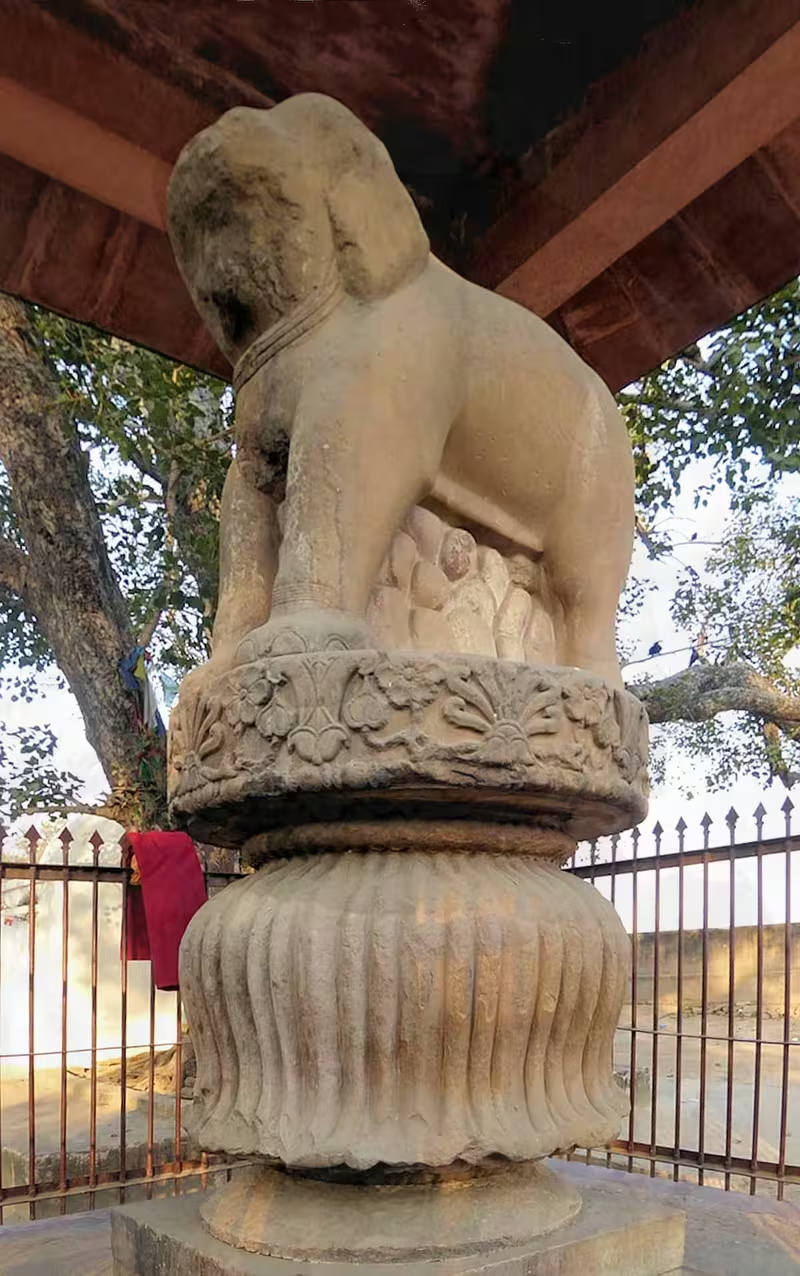
- Around three centuries after the Buddha's Mahaparinirvana: Ashoka visited Sankissa and built a pillar, stupa, and temple commemorating the descent.
- Later centuries: Faxian and Xuanzang saw three brick-and-stone ladders associated with the event.
- 1842: Alexander Cunningham explored the site.
Religious and Cultural Importance
Sankissa's importance rests chiefly on its place in Buddhist sacred geography. The descent story brings together major figures of Buddhist tradition, including Indra, Maha Brahma, Moggallana, Sariputta, Uppalavanna, and Anuruddha. The accounts also use the event to demonstrate different forms of spiritual accomplishment, such as Moggallana's supernatural knowledge, Anuruddha's far-seeing vision, and Punna's teaching ability.
The site also contains monuments connected with Hindu traditions, including the temple of Vishari Devi. This combination makes Sankissa a place where Buddhist and Hindu religious remains stand within the same archaeological landscape.
Monuments and Architecture
A shrine was traditionally erected where the Buddha's right foot first touched the ground. Ashoka is said to have built a stupa and temple at the site, while the ruins of the stupa remain visible. The elephant capital of a Mauryan-period pillar is another important surviving feature.
Faxian and Xuanzang described three ladders built of brick and stone to commemorate the Buddha's descent. By the time of their visits, the ladders had nearly sunk into the earth. Ancient monasteries and an ancient staircase add to the site's remains. Excavations, however, did not reveal artefacts of major importance.
Modern City
Modern Sankisa Basantapura remains an archaeological and pilgrimage site rather than a major urban centre. Its ruins, Ashokan elephant capital, stupa remains, staircase, monasteries, and Vishari Devi temple preserve several layers of religious history. The site was explored by Alexander Cunningham in 1842 and continues to be identified with the ancient Sankissa of Buddhist literature.