Overview
The ancient city of Shravasti stood near the West Rapti River in the southern Himalayan foothills, in what is now Uttar Pradesh. In the age of the Buddha, it was the capital of Kosala, a major kingdom of northern India, and a prosperous urban centre connected to three important trading routes. Its location brought together political authority, commerce and religious life.
For Buddhists, Shravasti is especially associated with the years after the Buddha’s enlightenment. Buddhist tradition remembers him as spending twenty-five rainy seasons in the city. Many sermons preserved in the Buddhist canon are connected with Shravasti, and the city is identified with the Buddha’s conversion of important disciples, his relationship with the lay patron Anathapindada, and the celebrated “Great Miracle” and “Twin Miracle.”
Shravasti was never exclusively Buddhist. Jain texts describe visits by Mahavira and other Tirthankaras, and connect the city with several important Jain teachers and traditions. Hindu literature presents it as an ancient city founded by a Vedic king and preserves legends associated with its rulers and heroes. Archaeological remains include Buddhist, Jain and Hindu monuments, sculpture, inscriptions, terracotta objects and architectural fragments.
Today, the ancient site is generally known as Saheth–Maheth. Saheth contains the remains associated with Jetavana, the monastery most closely connected with the Buddha. Maheth is the larger, fortified urban area, enclosed by the damaged remains of an ancient rampart. Together, they preserve the history of a city that remained active for many centuries before suffering destruction, abandonment and erosion.
Etymology and Names
The Sanskrit name is Śrāvastī, while the Pali Buddhist texts call the city Sāvatthī. The difference reflects the linguistic traditions in which the city was remembered. The name appears in the literature of several Indian religions, although each tradition places its own figures, events and interpretations within the city’s history.
According to the Bhagavata Purana, Shravasti was founded by a king named Shravasta, who descended from the Ikshvaku dynasty. This genealogy connects the city with the wider traditions surrounding Vaivasvata Manu and the ancient royal lineages of northern India. Hindu texts also use the city as a setting for stories in the Ramayana, the Mahabharata, the Harsha-charita and the Kathasarit-sagara.
In Buddhist literature, Sāvatthī appears as the capital of Kosala and as the home of King Prasenajit, a royal patron of the Buddha. The city’s prosperity is reflected in later Buddhist memory. The fifth-century commentator Buddhaghosa claimed that Sāvatthī had 5.7 million residents. Such a population is implausible for the period, but the figure conveys how later Buddhist communities imagined the city: as a vast and wealthy capital.
Jain sources preserve a much larger collection of names. These include Chandrapuri, Savatthi, Savasti, Sharavati, Dharmapuri, Champakpuri, Pushkalavati, Kunalnagar, Chandrikapuri and Arya Kshetra. The city is also associated with the name Saravana in Ajivika and Jain traditions. Saravana is regarded in those traditions as the birthplace of Gosala Mankhaliputta, the founder of the Ajivikas.
In modern archaeological writing, the ancient site is commonly called Saheth–Maheth. The two areas are less than two kilometres apart. Saheth is the smaller area and contains the Jetavana monuments. Maheth is the larger walled complex, situated within the remains of an ancient fortification. The two names are useful because they distinguish the monastic and urban parts of the archaeological site.
Geography and Location
Shravasti lies in the southern foothills of the Himalayas, in the present-day Shravasti district of Uttar Pradesh. The landscape is marked by rivers, smaller watercourses and the plains leading towards the Himalayan foothills. The ancient settlement stood south of the Rapti River, known in older accounts as the Achiravati.
The West Rapti is now seasonal and commonly dries during the summer. Its channel may not be the same as it was two thousand years ago. Archaeological accounts suggest that the river changed course over time, and the shape of the ancient city’s rampart may partly reflect an earlier river line. The seasonal character of the modern river should not obscure its importance in the ancient landscape: watercourses shaped transport, settlement and agriculture, while also exposing the city to periodic floods.
The Nepalese Himalayan foothills are visible to the north. This geographical setting placed Shravasti near routes leading towards the Himalayan region as well as towards the major centres of the Gangetic plains. As the capital of Kosala, it occupied a position that connected different parts of northern India.
Ancient Shravasti was also a commercial junction. The city stood at the meeting point of three major trading routes. These routes connected it to several regions of the subcontinent, helping explain its prosperity and the presence of substantial fortifications, monasteries and public religious structures.
The present site can be approached through the road network linked with Gonda and Lucknow. It is about 50 kilometres from the Gonda railway and bus hub and approximately 170 kilometres from Lucknow airport. National Highways 927, 730 and 330 connect the wider region. Shravasti also has an airport whose flight services were scheduled to resume from 15 July 2025.
Ancient History
The earliest historical picture of Shravasti comes from a combination of literary memory, archaeology and accounts by travellers. Buddhist, Jain and Hindu texts all remember the city, but they do not tell the same story. Their narratives reflect the religious communities that preserved them, and archaeological evidence provides an independent, though incomplete, way to examine the city’s development.
The Japanese excavations of 1986–1996 identified occupation layers extending from the eighth century BCE through the first millennium CE. These dates suggest that the settlement had a long history before the period traditionally associated with the Buddha. The excavated city was surrounded by an earthen rampart with a circumference of about 5.2 kilometres. It had a crescent shape and covered approximately 160 hectares.
The Buddhist period made Shravasti one of the principal urban centres of northern India. The city was the capital of Kosala and the residence of King Prasenajit. It also housed wealthy merchants, Brahmanical teachers, religious specialists and monastic communities. The best-known lay patron was Anathapindada, remembered in Buddhist literature as an exceptionally wealthy donor who offered the Jetavana grove and its residences to the Buddha and his followers.
The remains indicate that Shravasti continued to develop after the Buddha’s lifetime. Excavations found evidence of successive construction, repeated repairs and architectural expansion. Large-scale monastic building increased after the Kushana period. The structures included monasteries, stupas, caityas, shrines, bathing facilities and residential cells.
The city was also exposed to natural damage. Excavated monuments show repeated destruction by floods between the first and tenth centuries CE. In several cases, residents rebuilt or repaired damaged structures. Later monasteries increasingly used symmetrical square plans. One large monastic complex, for example, had a square platform containing twenty-eight cells, each approximately 2.6 metres square.
The history of Shravasti was therefore not a simple rise followed by immediate collapse. It experienced periods of construction, stagnation, repair and renewed expansion. The archaeological layers suggest a period of decline around the fifth century, followed by renewed growth from the seventh through the twelfth centuries.
Historical Timeline
The Kosala Capital
During the Buddha’s lifetime, Shravasti was the capital of Kosala. Buddhist texts associate it with King Prasenajit, who is portrayed as a royal supporter of the Buddha. The city’s political role gave Buddhist communities access to a major court and a large urban population.
The kingdom’s religious environment was diverse. The Kosalan ruler associated with the period of the Buddha is described as supporting Buddhism, Jainism and the Ajivikas, while also performing Vedic rituals and sponsoring Vedic schools. This combination reflects the plural religious environment of ancient northern India.
The Buddha at Shravasti
Shravasti became the place where the Buddha is remembered as giving more teachings than anywhere else. According to one calculation, 871 suttas in the four Nikayas are connected with the city. Buddhist tradition also states that the Buddha spent twenty-five rainy seasons at Shravasti.
These traditions may be understood in more than one way. They could preserve the memory that Shravasti was the Buddha’s principal residence after enlightenment. Alternatively, they may indicate that the oral traditions of early Buddhism were organised and transmitted through the Shravasti community. Some historians consider the first interpretation more likely, but both possibilities underline the city’s importance in the formation of Buddhist tradition.
The city was also associated with the Buddha’s famous miracles. The Mahapratiharya, or Great Miracle, and the Yamakapratiharya, or Twin Miracle, are known in Buddhist art and literature as the “Sravasti miracles.” Representations of these episodes appear in reliefs, sculpture and religious narratives across Asia.
Monastic Expansion
The material remains show that Buddhist institutions continued to grow after the early period. Monasteries and stupas were built, damaged, rebuilt and expanded. The excavated structures are broadly consistent with the locations described by Chinese pilgrims, although the pilgrims’ accounts are not always consistent with one another.
The Buddhist complex at Jetavana remained central to the sacred geography of the city. Other monuments were linked by tradition with Anathapindada, Angulimala and members of the Buddha’s family and monastic community.
Medieval Continuity and Destruction
Shravasti remained an active Buddhist site into at least the twelfth century CE. An inscription found in a vihara complex records the year 1176 in the Vikram era, corresponding to the early twelfth century CE. The inscription established both the continued activity of the site and the identity of one stupa as Jetavana Vihara.
Excavation results indicate that the city expanded again between the seventh and twelfth centuries. After this period, large sections of the site appear to have been burnt. Thick charcoal layers and burnt soil were found over several monastic complexes. Because similar evidence occurred at separated locations and was associated with the same period, archaeologists have suggested that much of the Buddhist monastic area may have been destroyed by fire at roughly the same time.
The city was destroyed and covered by mounds sometime during or after the thirteenth century. This period broadly corresponds with the arrival and consolidation of the Delhi Sultanate in northern India, although the archaeological evidence presented here does not establish a single event or precise cause for the destruction. Other parts of the site fell into disuse and were gradually affected by erosion.
Political Significance
Shravasti’s political importance began with its position as the capital of Kosala. It was not simply a religious settlement but the centre of a kingdom with a royal court, administrative authority and links to major routes. Its urban scale and fortifications reflect the needs of a substantial political centre.
The city’s ruler, Prasenajit, occupies an important place in Buddhist literature. He is portrayed as a patron of the Buddha, and the remains of his palace were later identified and described by the Chinese pilgrim Xuanzang. The relationship between the royal court and religious communities was an important feature of Shravasti’s public life.
The fortifications also reveal the city’s political character. The ruins of Maheth include the remains of a large earthen rampart. Earlier excavations and later archaeological work showed that the rampart was built and repaired in three periods, from approximately the third century BCE to the first century CE. Its scale indicates that the settlement required formal protection and had developed beyond the character of a small religious centre.
The city’s political importance was reinforced by geography. A capital located at the junction of three trading routes could collect revenue, support merchants and maintain links with other regions. The same routes that brought commercial prosperity also carried travellers, religious teachers, texts and artistic traditions.
Religious and Cultural Importance
Buddhism
Shravasti is most closely associated with the Buddha’s teaching career. Jetavana, the monastery offered by Anathapindada, was one of the principal places where the Buddha and his followers lived. The site’s sacred landscape includes the Gandhakuti, remembered as the Buddha’s hut, and the Anandabodhi tree, where pilgrims gather for meditation and chanting.
Buddhist tradition connects Shravasti with the conversion of important disciples and with numerous sermons. The city’s importance was preserved not only through local monuments but also through the Buddhist canon, pilgrimage accounts and the artistic traditions of South, Central and Southeast Asia.
The Great Miracle and Twin Miracle became especially influential subjects in Buddhist art. Their association with Shravasti explains why scenes connected with the city appear in reliefs, statues and literary works far beyond Uttar Pradesh. The “Miracle of Sravasti” became a recognised theme in Buddhist visual culture.
Jainism
Jain traditions give Shravasti an equally complex religious identity. Jain texts state that Sambhavanatha, the third Tirthankara, and Chandraprabha, the eighth Tirthankara, were born there in the distant prehistoric past. The city is also associated with the kingdom of Kunala and with the sons of Rama, Lava and Kusha.
Mahavira is said to have visited Shravasti several times and spent his tenth rainy season there before attaining omniscience. He was hosted by the wealthy merchant Nandinipriya. Jain texts describe debates, disputes and important encounters involving Mahavira, Gosala Mankhaliputta and other religious figures.
The city is also linked with Jamali, Mahavira’s son-in-law, and with two of Mahavira’s eleven chief disciples. Jain scholars such as Maghavan and Keshi are said to have studied there. The discussion between Keshiśramanacharya and Gautama Swami, Mahavira’s first disciple, is also placed at Shravasti in Jain tradition.
Archaeology confirms the presence of Jain activity. The site now called the Shobhanatha temple has been identified with Jain remains. Excavations recovered images of the Tirthankaras from different periods, including two idols dated to around 300 BCE. A saptatrithi twin image showing Tirthankaras in the kayotsarga posture was also found.
Jain communities continued to treat Shravasti as a pilgrimage centre in the medieval and early modern periods. Jain texts record the renovation of a temple dedicated to Sambhavanatha, although the temple was eventually desecrated during the reign of Alauddin Khilji according to the account of Jinaprabhasuri. Seventeen temple ruins survive at the site. Restoration work between 1975 and 1987 brought several temples and images back into use.
Hinduism and Vedic Traditions
Hindu traditions connect Shravasti with ancient royal genealogies and epic literature. The city is mentioned in the Ramayana and the Mahabharata, and later works place legends in its setting. The association with the Ikshvaku lineage helped connect Shravasti to the broader sacred geography of northern India.
The city also supported Brahmanical teachers and Vedic schools. Buddhist and Jain sources refer to debates with Brahmanas and Vedic scholars. These accounts are sectarian in presentation: Buddhist texts portray the Buddha’s teachings as superior, while Jain texts give the Tirthankaras the central position. Nevertheless, together they show that Shravasti was a place of sustained intellectual and religious interaction.
Excavations have yielded Hindu artistic remains, including deity images and numerous panels depicting scenes from the Ramayana. Terracotta figures of a mother goddess, a Naga and Mithuna figures were found in layers near the fort walls. These objects point to a religious landscape more varied than the surviving Buddhist monuments alone would suggest.
Islamicate Remains
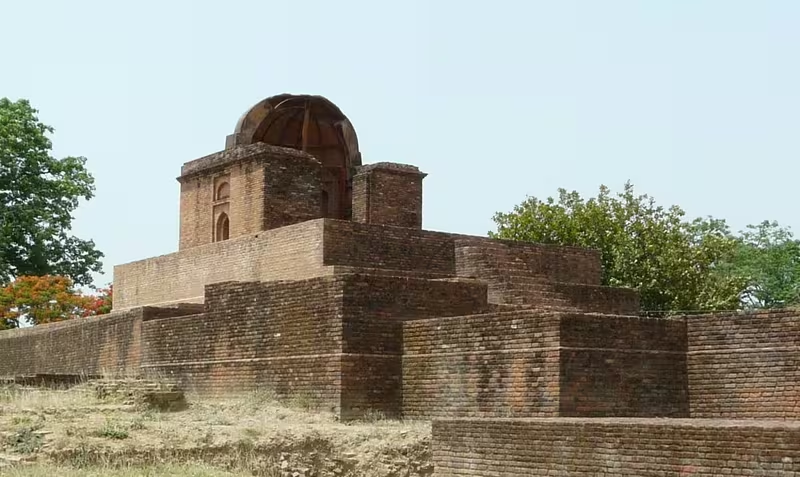
Medieval Islamic tombs stand northwest of Maheth. They belong to a later phase of the site’s history and demonstrate that the wider settlement continued to be used after the decline of the ancient Buddhist city.
Economic Role
Shravasti’s economy rested partly on its location. As the junction of three major trading routes, it connected the Kosalan capital to different regions of the subcontinent. Merchants, travellers and religious communities moved through the city, creating demand for accommodation, food, transport, craft production and ritual services.
The city’s prosperity is reflected in the prominence of wealthy donors in Buddhist tradition. Anathapindada is remembered as the richest early donor to the Buddha. His ability to offer the Jetavana grove and construct residences for the monastic community indicates the presence of considerable private wealth.
The archaeological record also reflects a developed urban economy. Excavations have recovered coins, seals, terracottas, jewellery and decorated objects. Inscribed slabs and statues show that patrons funded religious construction and images. Monasteries themselves would have required regular support from urban residents, merchants and political authorities.
The proximity of the Rapti and the wider network of smaller watercourses helped shape settlement and movement, though the same waterways repeatedly damaged buildings. Flooding between the first and tenth centuries required repairs and reconstruction. The city’s history thus shows the relationship between economic strength and environmental vulnerability: a river-connected settlement could prosper as a trading centre but also face repeated destruction.
Monuments and Architecture
Saheth and Maheth
The archaeological site is divided into Saheth and Maheth. Saheth is the smaller monastic area, containing the Jetavana monuments. Maheth is the larger urban complex within the remains of the ancient fortification. The two areas are separated by less than two kilometres.
The walls around Maheth were described as massive ruins rising to approximately 60 feet in places. They were probably built in stages, and excavations indicate three periods of construction and repair between the third century BCE and the first century CE. Their remains are visible from a distance as one approaches the site.
Jetavana
Jetavana is the best-known monument complex at Shravasti. It was the grove and monastic residence offered by Anathapindada to the Buddha. The site includes structures associated with the Buddha’s hut, known as the Gandhakuti, as well as the Anandabodhi tree.
The excavated remains include stupas, monasteries, shrines and other structures. A stupa identified through an inscription as Jetavana Vihara confirmed the connection between the archaeological site and the Buddhist literary tradition.
Stupas and Shrines
Several monuments are associated by tradition with figures connected with the Buddha. These include the Angulimala stupa and the Anathapindika stupa. Another stupa outside Shravasti is identified as the place where the Twin Miracle was performed.
Xuanzang recorded several stupas and religious buildings. He described the remains of Prasenajit’s palace, the Great Dhamma Hall stupa, a temple associated with the Buddha’s maternal aunt and the stupa of Angulimala. At Jetavana, he saw two pillars, each approximately 70 feet high, standing before a damaged monastery. One pillar had a wheel carved at its top and the other a bull.
He also described a Buddhist temple about 60 feet high with a seated Buddha image. A deva temple of similar height stood nearby and was reportedly in good condition. More than 60 li northwest of the capital, Xuanzang saw a series of stupas attributed to Ashoka and associated with Kasyapa Buddha.
Jain Monuments
The Shobhanatha temple and other Jain remains form an important part of the archaeological landscape. The site associated with Sambhavanatha contains the remains of several temples. Its architecture includes features described as showing Iranian influence and is dated to a rebuilding in the twelfth century CE.
Five images dating to the eleventh century CE were discovered there. Excavators also found images of all twenty-four Tirthankaras from different periods. These remains demonstrate that Jain religious activity continued alongside the Buddhist institutions of the site.
Fortifications and Urban Structures
Maheth’s rampart enclosed a large settlement. The Japanese excavations identified the ancient city as a crescent-shaped area of roughly 160 hectares. Within it were public, residential and religious structures, although much of the city remains buried or damaged.
The discovery of a large bathing tank, almost square and about 25 metres on each side, illustrates the scale of urban infrastructure. Four previously unknown stupas and another large caitya complex were also uncovered. The combination of fortifications, bathing facilities, monasteries and religious monuments shows that Shravasti was a fully developed city rather than an isolated pilgrimage site.
Famous Personalities
The Buddha
Shravasti is one of the principal places associated with Siddhartha Gautama, the Buddha. Buddhist tradition remembers him as spending twenty-five rainy seasons there and delivering a large number of sermons. The city is also the setting for the Great Miracle and Twin Miracle.
King Prasenajit
Prasenajit was the ruler of Kosala and the royal patron most closely associated with Shravasti in Buddhist literature. His court represents the political environment in which Buddhist, Jain, Ajivika and Vedic communities interacted.
Anathapindada
Anathapindada, also known as Sudatta in Buddhist tradition, was a wealthy lay supporter of the Buddha. He offered the Jetavana grove and residences to the monastic community. His name remains attached to one of the major stupas at the site.
Mahavira
Mahavira, the twenty-fourth Jain Tirthankara, is said to have visited Shravasti several times. Jain tradition places his tenth rainy season there and describes his encounter with Gosala Mankhaliputta.
Gosala Mankhaliputta
Gosala Mankhaliputta was the founder of the Ajivikas. Jain sources describe Shravasti as the place where he and Mahavira met in bitter dispute. The city is also associated with Gosala’s birth under the name Saravana.
Faxian and Xuanzang
The Chinese pilgrims Faxian and Xuanzang preserved valuable descriptions of Shravasti. Faxian travelled in India in the late fourth and early fifth centuries CE and recorded routes connecting Shravasti with Kapilavastu. Xuanzang visited in the seventh century and described the capital, Jetavana, stupas, temples and the condition of the surrounding settlements.
Xuanzang found much of the country deserted and dilapidated, although some residents remained. He recorded more than one hundred monasteries, many of them in ruins, and noted that monks in the region studied forms of Buddhist doctrine associated with the Sravakayana tradition.
Rediscovery and Archaeology
The ancient location of Shravasti was debated during the nineteenth century. Scholars compared Buddhist texts with the travel accounts of Chinese pilgrims and considered several possible locations in India and Nepal.
The British archaeologist Alexander Cunningham identified the Saheth–Maheth site in 1863. At that time, the remains appeared as two major mounds and scattered monuments whose bricks and stones were partly hidden by vegetation. Cunningham connected the site with a colossal Bodhisattva image bearing an early Kushana inscription. He also mapped both Saheth and Maheth.
Cunningham carried out a first clean-up and partial excavation in 1876. The work revealed stupas and small shrines, but the apparent late date of some monuments revived debate over whether the site was truly ancient Shravasti.
In 1885, Hoey undertook a more extensive excavation. His most important discovery was a vihara complex containing an inscription dated to year 1176 in the Vikram era, corresponding to the early twelfth century CE. The inscription demonstrated that the site remained active at that time and helped identify one of the stupas as Jetavana Vihara.
Around 1908, Vogel conducted more thorough excavations. These provided the first strong archaeological confirmation that Saheth–Maheth was the Shravasti described in Buddhist texts. Further excavation led by Marshall and Sahni in 1910 uncovered additional monuments, sculptures, inscriptions, coins, seals and terracottas.
The early excavations revealed many monuments corresponding to the records of Chinese pilgrims. However, most of the structures and artefacts first uncovered dated from the first century CE or later, leaving the earliest history of the city less visible.
In 1959, Sinha directed excavations near the fort walls. These established that the walls had been constructed and repaired in three periods between approximately the third century BCE and the first century CE. The deeper layers contained pottery with graffiti, jewellery, short Brahmi inscriptions, mother-goddess terracottas, a Naga figure and Mithuna plaques.
Between 1986 and 1996, Japanese archaeologists led by Yoshinori Aboshi conducted nine seasons of excavation. Their work extended across the site and reached deeper layers than earlier investigations. Carbon dating and stratigraphic evidence indicated occupation from the eighth century BCE through the first millennium CE.
The Japanese excavations uncovered the large bathing tank, another caitya complex, four stupas and evidence of repeated rebuilding. They also documented thick charcoal layers above a large monastery and another caitya complex. The structures appeared to have been burnt and then abandoned because the combustion remains had not been disturbed.
These discoveries changed the understanding of Shravasti. The city was not destroyed in a single simple sequence. It experienced floods, repairs, new construction, periods of stagnation, renewed expansion and finally widespread damage by fire and erosion.
Decline and Revival
The decline of Shravasti unfolded over several centuries. Archaeological layers suggest stagnation around the fifth century CE, followed by renewed growth from the seventh century through the twelfth century. During this later period, monasteries and religious buildings continued to be constructed or enlarged.
Flooding caused repeated damage between the first and tenth centuries. The residents repaired some monuments, but environmental pressure gradually weakened the urban landscape. In the later phase, many structures were built with combinations of brick and wood. The discovery of charcoal above them indicates that fire caused extensive destruction.
By the thirteenth century or later, the ancient city had been destroyed and covered by mounds. Sections went out of use and were affected by erosion. The decline of Buddhist institutions in the region also contributed to the abandonment of the monastic complex, although the evidence does not permit a single explanation for every part of the site.
The memory of Shravasti survived through Buddhist, Jain and Hindu texts, as well as through pilgrimage traditions. Jain monks continued to describe the city as a sacred destination in the seventeenth and eighteenth centuries. Between 1975 and 1987, restoration under the Jain monk Acharya Bhadrankarasuri brought several Jain temples and images back into use.
In the modern period, archaeological conservation has made the ancient site accessible to visitors. The Archaeological Survey of India manages important portions of the complex, including the remains associated with Jain and Buddhist monuments.
Modern Shravasti
Modern Shravasti is a small town and a centre of heritage tourism and religious pilgrimage. The ancient Saheth–Maheth site attracts Buddhist pilgrims from across Asia and visitors interested in the archaeology of northern India.
Jetavana remains the principal destination. Pilgrims meditate and chant near the Gandhakuti and the Anandabodhi tree. Monasteries representing Buddhist communities from Thailand, South Korea, Sri Lanka, Myanmar, Tibet and China have been established in the area. Their presence reflects the international reach of Shravasti’s Buddhist legacy.
The archaeological landscape is broader than the Buddhist pilgrimage circuit. Visitors can also encounter the remains associated with Jain traditions, including the Shobhanatha temple and the Sambhavanatha birthplace complex. The fortifications and urban mounds at Maheth provide a different perspective, showing the scale of the former capital.
Shravasti’s modern identity therefore rests on several overlapping histories. It is a Buddhist pilgrimage centre, a Jain sacred site, an archaeological city, a place remembered in Hindu literature and a regional destination linked to the Rapti landscape. Its significance lies not in a single monument but in the way its remains preserve the interaction of political, commercial and religious life over more than a millennium.
Timeline
Early settlement
Archaeological layers identified by later excavations indicate occupation from approximately the eighth century BCE.
Capital of Kosala
Shravasti functioned as the capital of Kosala during the period associated with the Buddha.
The Buddha at Shravasti
Buddhist tradition associates the city with twenty-five rainy seasons of the Buddha and hundreds of remembered teachings.
Fortification phases
Excavated evidence places construction and repair of the city walls between approximately the third century BCE and the first century CE.
Urban and monastic development
The city continued to receive stupas, monasteries, shrines and religious artwork.
Faxian’s journey
The Chinese pilgrim Faxian recorded Shravasti and the route connecting it with Kapilavastu.
Xuanzang’s account
Xuanzang described the ruined capital, Jetavana, stupas, temples and monasteries in the region.
Late expansion
Archaeological evidence indicates renewed construction and growth from approximately the seventh through the twelfth centuries.
Active religious centre
An inscription from a vihara records activity at the site in the early twelfth century CE.
Destruction and abandonment
Large sections of the site were burnt, abandoned or eroded during or after the thirteenth century.
Archaeological identification
Alexander Cunningham identified Saheth–Maheth as the likely site of ancient Shravasti.
Jain restoration begins
Major restoration of Jain temples and images began under Acharya Bhadrankarasuri and continued through 1987.
Japanese excavations
A series of nine excavation seasons began under Yoshinori Aboshi, continuing through 1996.