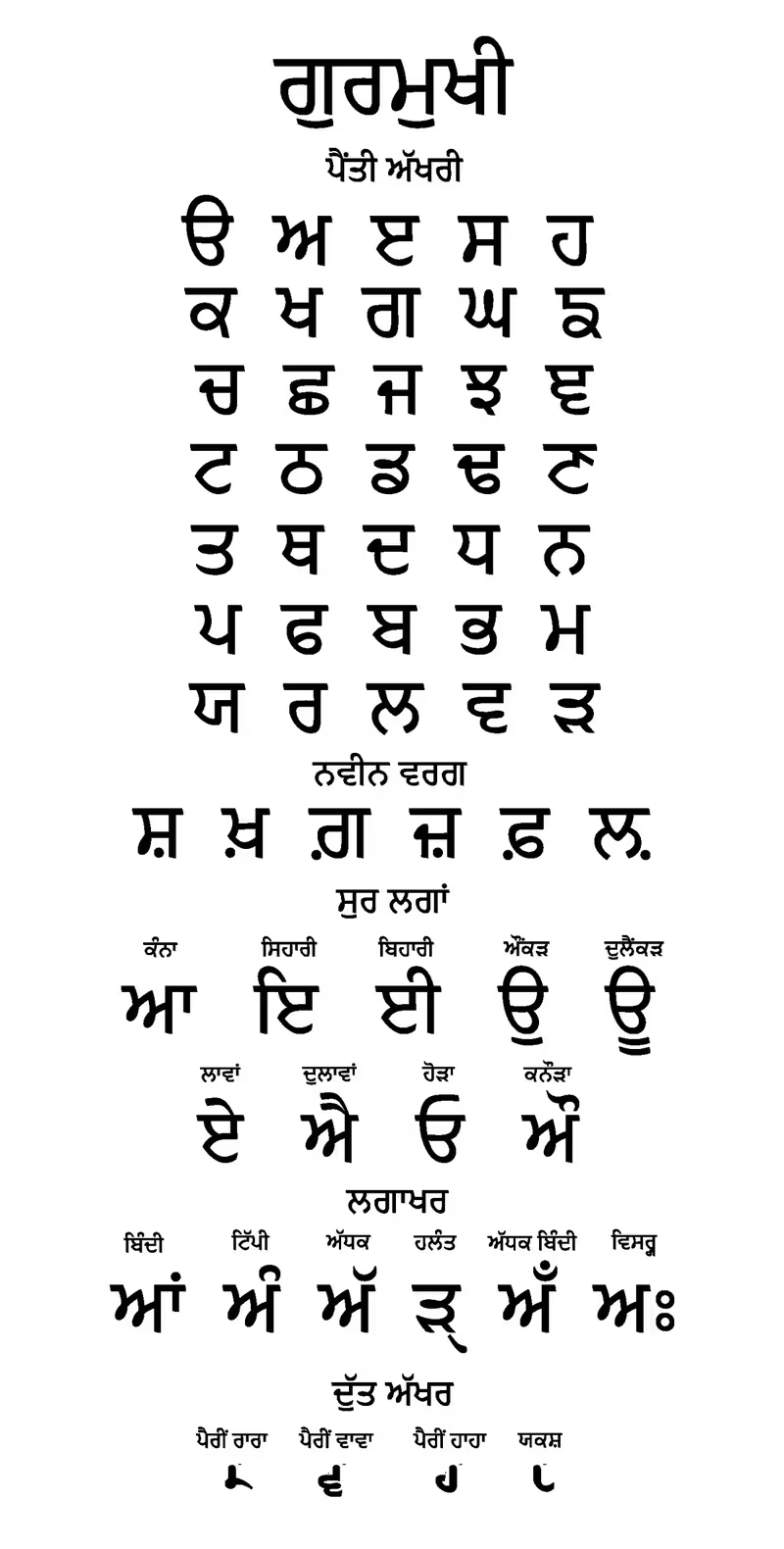
Gurmukhi: The Script of Punjabi and Sikh Scripture
In Punjab, the history of Gurmukhi is inseparable from the history of Sikh scripture, Punjabi literacy, and the formation of a distinct literary culture. The script is popularly believed to have been standardized and used by Guru Angad, the second Sikh guru, although several scholars trace its development to before his time. Its use by Sikhs is attested from the early sixteenth century onward. Today, Gurmukhi is the official script of Punjabi in Punjab, India, where it is used in culture, education, administration, the arts, and publishing.
Gurmukhi developed from the Northwestern branch of the Brahmi-derived writing traditions, particularly the Sharada family, while also being associated with the Laṇḍā scripts used by merchants and scribal communities in Punjab. Unlike Laṇḍā, which generally lacked vowel symbols, Gurmukhi made vowel notation obligatory. This feature helped make Punjabi writing more accurate and easier to interpret. The script also developed ways to represent Punjabi’s three-tone system, its consonant length, nasalization, and vernacular sounds.
The primary scripture of Sikhism, the Guru Granth Sahib, is written in Gurmukhi. Its contents include several dialects and languages often grouped under the name Sant Bhasha, or “saint language,” alongside Persian and several phases of Indo-Aryan languages. Through this script, the pronunciation and grammar of Old Punjabi were preserved for modern philologists. Gurmukhi therefore functions not only as a writing system but also as a central vehicle of religious memory, Punjabi literary history, and Sikh identity.
Origins and Classification
Linguistic Family
Gurmukhi is a script, not a separate spoken language. Its principal modern use is to write Punjabi, an Indo-Aryan language. The script was shaped in circumstances that differed from those of several other regional writing systems. Its development was closely connected with the recording of Sikh scriptures and with a cultural tradition described as less Sanskritized than many others of the subcontinent.
This setting allowed Gurmukhi to develop orthographic features suited to the Punjabi language as it existed during the period of its formation. It reduced the number and importance of conjunct characters, preserved letters for sounds present in the spoken language of the time, added signs for vernacular sounds, and developed a system for representing Punjabi tones.
Gurmukhi is generally classified as an abugida. In an abugida, consonants carry an inherent vowel, while diacritics modify that vowel. In Gurmukhi, the inherent vowel is a schwa, represented phonetically as [ə]. Vowel signs can be placed above, below, before, or after the consonant to which they apply.
Origins
The deeper ancestry of Gurmukhi is generally traced to the Proto-Sinaitic alphabet through the Brahmi script. Brahmi developed into several broad groups, including the Northwestern group based on Sharada, the Central group based on Nagari, and the Eastern group based on Siddhaṃ. These traditions also influenced several writing systems in Southeast Asia and scripts historically used in Central Asia for languages such as Saka and Tocharian.
Gurmukhi derives from Sharada in the Northwestern group. It is described as the only major surviving member of that group with full modern currency. The precise intermediary between Sharada and Gurmukhi remains debated. Proposed explanations connect Gurmukhi with:
- Devāśeṣa, as argued by Tarlochan Singh Bedi;
- Ardhanagari, associated with Bathinda, Sindh, and Western Punjab, as argued by G. B. Singh;
- the Laṇḍā scripts;
- the Takri scripts;
- Devanagari and Siddham or Siddhamatrika traditions.
These theories differ about the immediate ancestor of the script, but they generally place Gurmukhi within the wider development of Northwestern Brahmi-derived writing systems.
Name Etymology
The prevalent interpretation among Punjabi linguists connects the name Gurmukhī with gurmukhs, literally people who face or follow the Guru. In the early stages of the script, its letters were primarily used by the Guru’s followers, and the script consequently became known as “the script of those guided by the Guru.”
Another explanation connects the name with the script’s sacred use. Gurmukhs revered the script and meditated on the glyphs used to write Waheguru, especially ਵ, ਹ, ਗ, and ਰ. According to this explanation, these four characters were originally called Gurmukhi, and the term later expanded to refer to the entire script.
The expression has also been understood in relation to the words of the Sikh Gurus. Since the Sikh Gurus’ utterances were recorded in the script and were often referred to as coming from the mukhă, or face or mouth, of the Gurus, the script used to record them could receive the same designation. Although Gurmukhī is commonly translated as “from the mouth of the Guru,” its use for the Punjabi script carries these wider associations.
The name Shahmukhi, used for the Perso-Arabic alphabet employed for Punjabi, was modeled on the term Gurmukhī.
Historical Development
Sharada in Punjab and the Northwestern Tradition (10th–13th Centuries)
From the tenth century onward, regional differences began to emerge in the Sharada script used in Punjab, the Hill States, and Kashmir. Sharada proper eventually became restricted to limited ceremonial use in Kashmir because it was increasingly unsuitable for writing the Kashmiri language.
The last known inscription in Sharada dates to 1204 CE. The early thirteenth century therefore marks an important point in the development of the script. The regional variety in Punjab continued to evolve from this stage. By the fourteenth century, it began to appear in forms closely resembling Gurmukhi and other Laṇḍā scripts.
By the fifteenth century, Sharada had changed sufficiently that epigraphists used the special name Dēvāśēṣa for the script at that stage. Tarlochan Singh Bedi instead preferred the term prithamă gurmukhī, or Proto-Gurmukhi. These names reflect the continuing development of a regional script rather than a single moment of invention.
Laṇḍā and Mercantile Writing
The Laṇḍā scripts of Punjab were mercantile scripts used for household and trade purposes. At least ten different scripts were classified as Laṇḍā, with Mahajani being the most popular. The word Laṇḍā means “without tail” and implies that these scripts did not have vowel symbols.
Laṇḍā scripts were normally not used for literary purposes. Their limited vowel notation could make words difficult to decipher. Gurmukhi differed in making vowel diacritics obligatory, thereby increasing accuracy and precision. This change was especially important when the script was used for scripture and other literary writing.
Several Gurmukhi glyphs underwent small orthographic changes before 1610. These included ਅ, ਹ, ਚ, ਦ, ਣ, and ਲ. More substantial changes involved ਙ and ਞ, while ਬ was a later invention. Such changes show that the script continued to be adjusted after its early formation.
Proto-Gurmukhi and Sikh Adoption (16th Century)
The Sikh tradition popularly credits Guru Angad with creating and standardizing Gurmukhi from earlier Śāradā-descended scripts native to the region. Guru Angad lived from 1504 to 1552. The adoption of Gurmukhi by the Sikhs is attested from the early sixteenth century.
The dating and authorship of this development are not entirely uniform in historical interpretation. According to Mangat Bhardwaj, Gurmukhi or its antecedents predated Sikhism by several centuries. Sikh scholars including Kahn Singh of Nabha, G. B. Singh, Piara Singh Padam, and G. S. Sidhu documented evidence for Gurmukhi before the rise of Sikhism. The glyphs and symbols used in the script also predate Sikhism. On this interpretation, Guru Angad more likely standardized pre-existing scripts around 1530–1535, creating the standard Gurmukhi script under the authority of Guru Nanak.
The Sikh adoption of a distinct script had religious and cultural significance. The original Sikh scriptures and most historic Sikh literature were written in Gurmukhi, and the script became revered by Sikhs. As part of this adoption, the characters ਸ and ਹ were shifted to the first line of the alphabet, while ੳ was made the first letter.
Expansion Under Sikh Literary and Political Culture
Gurmukhi became the primary script for the literary writings of the Sikhs. It played a major role in the Sikh faith and tradition and developed its own orthographic rules. Under the Sikh Empire, it spread beyond its original use for Sikh scriptures and was used by Sikh kings and chiefs for administrative purposes.
In seventeenth- and eighteenth-century Punjab, Gurmukhi was also used for scientific and poetic literature. This included works from Sanskritic and Persian traditions written in the Braj language. The script thus supported literary activity across religious, linguistic, and intellectual domains.
Gurmukhi helped foster a distinct Sikh culture and contributed to the consolidation of the Sikh religion. Its importance expanded from its original role as a vehicle of Sikh religious literature. It became a principal medium of literacy in Punjab and adjoining areas for centuries, particularly because the earliest schools were attached to gurdwaras.
A related development occurred in Jammu Division. Takri had developed through the Dēvāśēṣa stage of Sharada between the fourteenth and eighteenth centuries and later developed into Dogri. During the late nineteenth century, Dogri was consciously influenced in part by Gurmukhi, possibly to give it an appearance of authority by resembling scripts already established in official and literary roles. This influence did not displace Takri.
Further changes involving the characters ਅ, ਹ, and ਲ took place during the first half of the nineteenth century.
Colonial Period
Early British writers on Punjab, including John Malcolm, linked Gurmukhi with Punjabi and the Sikhs. Punjab administration reports from 1851–54 described Gurmukhi as sacred to the Sikhs while also claiming that its influence and use were declining. The reports characterized it as having once been a courtly and priestly language during Sikh supremacy but as falling into disuse under changed political circumstances.
Christian missionary organizations helped sustain and expand the script. The Serampore Mission Press and especially the Ludhiana Mission Press used Gurmukhi in their publications. They produced Gurmukhi translations, grammars, and dictionaries. The first grammars of Punjabi produced locally were written in Gurmukhi during the 1860s.
The Singh Sabha movement of the late nineteenth century sought to revitalize Sikh institutions that had declined after the fall of the Sikh Empire and during colonial rule. It also advocated the use of Gurmukhi in mass media. Print publications and Punjabi-language newspapers using the script were established during the 1880s.
In 1882, the Lahore Singh Sabha petitioned Charles Aitchison, Governor of Punjab, to adopt Gurmukhi as a medium of instruction in schools, at least for Sikhs. The proposal was declined. In 1895, however, Gurmukhi was adopted as a school script for Punjabi at the first-grade level at an Amritsari school. The Oriental College in Lahore offered Punjabi courses in both Romanization and Gurmukhi through Vidwan, Budhiman, and Gyani courses.
Modern Period
Gurmukhi’s official political status in India developed during the twentieth century. In the 1940s, the Akali Dal made official recognition of Gurmukhi a prerequisite for political partnership in the years leading to the partition of India. This position was also part of failed talks with the Muslim League.
After the Punjabi Suba movement in the 1960s, Gurmukhi received authority as the official state script of Punjab, India. The Panjab Official Language Act of 1967 made Punjabi, written in Gurmukhi, the official language of the state. It required legislative documents within Punjab to be published in Punjabi.
Official adoption of the script took place on 18 April 1968. Since then, Gurmukhi has been used across Punjab’s culture, arts, education, and administration. Its character has become firmly established as common and secular, extending beyond its earlier association with Sikh religious literature.
Technological changes also helped expand its use. During the 1970s, the spread of computers and offset printing contributed to the growth of Gurmukhi in news media. Gurmukhi is currently one of the official scripts of the Indian Republic and is described as the fourteenth most used script in the world.
Scripts and Writing Systems
The Gurmukhi Abugida
Gurmukhi is an abugida in which each consonant has an inherent vowel, [ə]. Dependent vowel signs, or diacritics, modify this vowel. These signs may appear above, below, before, or after the consonant to which they belong.
When a vowel occurs at the beginning of a syllable, it is written with an independent vowel letter. Independent vowels are constructed through three vowel-bearing characters: ੳ ūṛā, ਅ aiṛā, and ੲ īṛī. Except for aiṛā, which represents [ə] in isolation, these bearer letters are not normally used without an additional vowel diacritic.
Vowels are pronounced after the consonant to which their signs are attached. A vowel sign written to the left of a consonant is therefore pronounced after that consonant. In the construction of the independent vowel [oː], ūṛā takes an irregular form instead of using the usual hōṛā.
The Thirty-Five Letters
The traditional Gurmukhi alphabet contains thirty-five base letters, known as akkhară. They are conventionally arranged in seven rows of five letters. The first three letters are mātarā vāhakă, or “vowel bearers.” They form the basis of independent vowels and are distinct from the consonants that follow.
The remaining letters are consonants, or vianjană. The pair of fricatives, called the mūlă vargă, or “base class,” shares a row. The remaining rows contain groups of consonants arranged from the back of the mouth toward the front, beginning with velars and ending with labials. Within each row, the consonants are arranged according to place and manner of articulation.
The traditional arrangement is called the varṇămāllā. It diverges in significant ways from the Sanskritic or vargiya ordering. Vowels and fricatives are placed toward the front, and the overall order reflects the independent development of the script.
The thirty-five original letters account for the common alternative name paintī, meaning “the thirty-five.” Modern Gurmukhi supplements these with six additional consonants, nine vowel diacritics, two nasal diacritics, a gemination mark, and subscript characters.
Supplementary Letters
Six supplementary consonants are used in official modern Gurmukhi. They are called the navīnă ṭollī or navīnă vargă, meaning “new group.” Each is created by placing a dot, or bindī, at the foot of an existing consonant. These are called pairĭ bindī consonants.
The supplementary letters are used particularly for loanwords, although not exclusively. Their use is not always obligatory. The letter ਸ਼ was already in use by the time of the earliest Punjabi grammars. Together with ਜ਼ and ਲ਼, it helped mark the distinction between /s/ and the established /ʃ/ sound. The latter also occurs in native echo doublets such as ਰੋਟੀ-ਸ਼ੋਟੀ, “stuff to eat.”
The sounds [f], [z], [x], and [ɣ] are less firmly established as distinct phonemes, in descending order. Their use often depends on exposure to Hindi-Urdu norms. The character ਲ਼, representing /lə/ and /ɭə/ distinctions not traditionally reflected in the script, was officially added only recently. Its use is still not universal.
Other characters, including ਕ਼ for /qə/, are occasionally used unofficially, chiefly when transliterating older Persian and Urdu writings. Such uses are less relevant in modern contexts.
Subscript Letters and Consonant Clusters
One of Gurmukhi’s most distinctive features is its treatment of consonant clusters. Instead of using the true conjunct symbols found in several other Brahmi-derived scripts, Gurmukhi places subscript letters beneath standard characters.
Three subscript letters are used in modern Gurmukhi. They are called duttă akkhară, or “joint letters,” and pairī̃ akkhară, or “letters at the feet.” These are forms of ਹ ha, ਰ ra, and ਵ va.
The subscript ਰ ra and ਵ va form consonant clusters. The subjoined ਹ ha introduces tone. The subjoined /ɾə/ and /hə/ remain the most commonly used. The subjoined /ʋə/ and conjoined forms of /jə/ are increasingly uncommon in modern contexts.
A further subscript character represents /j/. Known as yakaśă or pairī̃ yayyā, ੵ is used specifically in archaized sahaskritī-style writings in Sikh scripture. It occurs 268 times in word forms and inflections from older phases of Indo-Aryan. Examples include:
- ਰਖੵਾ, “to be protected”;
- ਮਿਥੵੰਤ, “deceiving”;
- ਸੰਸਾਰਸੵ, “of the world”;
- ਭਿਖੵਾ, “act of begging.”
A conjunct form of yayyā, ਯ→੍ਯ, is a later form used for Sanskrit borrowings and is rare even in that context. Miniaturized forms of ਚ, ਟ, ਤ, and ਨ also occur as subscript letters in limited use in Sikh scripture.
Vowel Diacritics
Gurmukhi’s vowel signs are called lagā̃. Their use is obligatory for expressing vowels. Every consonant has an inherent schwa, and dependent vowel signs replace that inherent vowel.
At the beginning of a word or syllable, dependent vowel signs cannot be used by themselves. An independent vowel character must then be constructed using one of the vowel bearers. This system differs from writing systems that use distinctly separate characters for each independent vowel.
The script’s three basic bearer vowels are integrated into its traditional character set. This arrangement is one of the features that developed independently from more Sanskritic models. It allows independent vowels to be built with diacritics rather than requiring a fully separate character for every vowel.
Gemination
The áddakă mark, ੱ, indicates that the following consonant is geminated. It is placed above the consonant preceding the geminated consonant. Because consonant length is distinctive in Punjabi, the presence or absence of this mark can alter the meaning of a word.
The mark is not written in every instance of gemination. In rural dialects, consonants following long vowels are also often geminated, a pattern that can trigger shortening of the long vowel. Examples include:
- ਔਖਾ, “difficult”;
- ਕੀਤੀ, “did”;
- ਪੋਤਾ, “grandson”;
- ਪੰਜਾਬੀ, “Punjabi”;
- ਹਾਕ, “call” or “shout”;
- ਹਾਕਾਂ, “calls” or “shouts.”
Except in this type of context, where unmarked gemination is often historically rooted and has become phonotactically regular, the use of áddakă is obligatory. The mark may also indicate stress on the second syllable, as in ਬੱਚਾ, “save.”
Nasalization
The two principal nasalization signs are ṭippī, ੰ, and bindī, ਂ. They produce a nasal phoneme according to the following obstruent or indicate a nasal vowel at the end of a word.
All short vowels are nasalized with ṭippī. Long vowels generally use bindī, except for the dulaiṅkaṛă vowel sign, ੂ, which uses ṭippī. Older texts may follow different conventions.
Vowel Suppression
The halantă, or halandă, mark, ੍, suppresses the inherent vowel. It is not used in ordinary Punjabi writing in Gurmukhi, although it may appear in Sanskritized texts or dictionaries to provide additional phonetic information.
The contrast can be illustrated as:
- ਕ — kə
- ਕ੍ — k
Punctuation and Numerals
The ḍaṇḍī, ।, marks the end of a sentence. A doubled ḍaṇḍī, or doḍaṇḍī, ॥, marks the end of a verse.
The visarga symbol, ਃ, is used only occasionally. It may represent an abbreviation, although modern Gurmukhi freely uses the period, commas, exclamation points, and other Western punctuation marks. In recent usage, full stops have increasingly replaced the traditional ḍaṇḍī at the ends of sentences.
Gurmukhi has its own set of digits, known as aṅgăṛē. They function like other forms of the Hindu-Arabic numeral system and occur extensively in older texts. Modern writing sometimes replaces them with standard Western Arabic numerals.
The Sikh scriptural symbol ੴ, representing ikku ōaṅkāru, is formed from ੧, “1,” and ਓ, “ō.”
Script Evolution
Orthographic Independence
Gurmukhi’s independence from Sanskritic models is visible in several features. It has three basic bearer vowels and uses vowel diacritics to construct independent vowels. It drastically reduced the number and importance of conjunct characters. This makes its treatment of consonant clusters closer in some respects to Brahmi than to later Nagari forms.
The script also omits characters representing the sibilants [ʃ] and [ʂ], reflecting the phonological history of Indo-Aryan and the sounds present in the spoken language during the script’s development. In many modern Indo-Aryan languages, these sibilants were naturally lost, although their characters were often retained as placeholders or archaisms and then mispronounced.
The [ʃ] sound was later reintroduced into Gurmukhi, requiring a new glyph. The script also developed a distinct letter for [ɽ]. In addition, a sound change merged Sanskrit [ʂ] and /kʰ/ into Punjabi /kʰ/. The gemination diacritic provided a way to represent the preserved Middle Indo-Aryan consonant length distinctions that remain important in Punjabi.
Tone Orthography
Punjabi is a tonal language with three tones: rising, neutral, and falling. Gurmukhi has no independent tone mark. Instead, tones correspond to consonants that historically represented voiced aspirates, such as gh, dh, and bh, as well as to the historical and intervocalic use of h.
The consonants घ-like, झ-like, ढ-like, ध-like, and भ-like members of the fourth column are represented in Gurmukhi by ਘ, ਝ, ਢ, ਧ, and ਭ. They are often transliterated as gha, jha, ḍha, dha, and bha even though Punjabi does not possess these voiced aspirated sounds in the same way. In modern pronunciation, these letters represent unaspirated consonants and are unvoiced in onset positions but voiced elsewhere.
Tone depends on the position of the tonal letter:
- In onset position, the letter produces a falling tone on the syllable nucleus.
- In syllabic coda position, it produces a rising tone.
- Between vowels, after a short vowel and before a long vowel, it gives the following vowel a falling tone.
- Between two short vowels, it produces a rising tone on the preceding vowel.
This system allows Gurmukhi to preserve historical consonant distinctions while representing Punjabi’s modern tonal contrasts.
Vowel Sequences
Gurmukhi orthography prefers vowel sequences over intervocalic semivowels such as “y” or “w,” and it also prefers vowels in syllable nuclei. Thus, ਦਿਸਾਇਆ, disāiā, “caused to be visible,” is preferred to disāyā. Likewise, ਦਿਆਰ, diāră, “cedar,” is preferred to dyāră, and ਸੁਆਦ, suādă, “taste,” is preferred to swādă.
The orthography also records tonal effects involving short vowels and h. The sequences /ɪh/ and /ʊh/ represent [é] and [ó] with high tones. Examples include:
- ਕਿਹੜਾ, kihṛā, “which?”;
- ਦੁਹਰਾ, duhrā, “repeat, reiterate, double.”
The combination of [əɦ] with [ɪ] or [ʊ] produces [ɛ́ː] and [ɔ́ː]. Examples include:
- ਮਹਿੰਗਾ, mahingā, “expensive”;
- ਵਹੁਟੀ, vahuṭṭī, “bride.”
Geographic Distribution
Historical Spread
Gurmukhi developed in the Punjab region and became the principal script of Sikh literary culture. Its use spread through religious writing, education, administration, and print. During the period of Sikh political hegemony, Sikh kings and chiefs used it for administrative purposes.
The script also served as a major medium of literacy in Punjab and adjoining areas for centuries. Its close relationship with Punjabi made it particularly useful for recording the language as it was spoken and written in the region.
Historically, Gurmukhi was also used for Sindhi. In Jammu Division, Dogri was later influenced in part by Gurmukhi, although Gurmukhi did not displace Takri there.
Centers of Learning
The earliest schools connected with Gurmukhi were attached to gurdwaras. These institutions helped make the script the principal medium of literacy in Punjab and adjoining areas. Religious institutions therefore played an important role in preserving and extending the script beyond the direct copying of scripture.
During the colonial period, Amritsar and Lahore became important centers for Gurmukhi education and publication. An Amritsari school adopted Gurmukhi as a first-grade school script for Punjabi in 1895. The Oriental College in Lahore offered Punjabi courses in both Romanization and Gurmukhi. The Lahore Singh Sabha also campaigned for Gurmukhi as a school medium in 1882.
Missionary presses added another network of publication. The Serampore Mission Press and Ludhiana Mission Press produced translations, grammars, and dictionaries in Gurmukhi. Newspapers and other Punjabi-language print publications using the script were established during the 1880s.
Modern Distribution
Modern Gurmukhi is used in Punjab, India, as the official script of Punjabi. It is used in all major spheres of public and cultural life, including administration, education, literature, the arts, and news media.
In Pakistan, some Punjabi writers advocated the use of Gurmukhi after independence. P. D. Raphael argued that it was more phonetically accurate than the Perso-Arabic script and that its use could preserve sociocultural connections between Pakistani and Indian Punjabis. Other writers, including Sardar Muhammad Khan, opposed this position and advocated Perso-Arabic writing for Punjabi.
Literary Heritage
Sikh Scripture
The Guru Granth Sahib, the primary scripture of Sikhism, is written in Gurmukhi. Its contents include a range of dialects and languages often grouped under the broad title Sant Bhasha, or “saint language.” Persian and various phases of Indo-Aryan languages also occur in the scripture.
The use of Gurmukhi for this text gave the script a central position in Sikh religious life. The original Sikh scriptures and most historic Sikh literature were written in Gurmukhi. As a result, the script is revered by Sikhs and remains closely tied to the reading, copying, study, and public recitation of Sikh scripture.
Laṛīvāră and Padă Chēdă
Until before the 1970s, Gurbani and other Sikh scriptures were written in a continuous form known as laṛīvāră. In this style, words are not separated by spaces. The more recent spaced form is known as padă chēdă, or “verse perforation.”
The opening of the Guru Granth Sahib, the Mul Mantar, can be presented in both forms:
Laṛīvāră:
ੴਸਤਿਨਾਮੁਕਰਤਾਪੁਰਖੁਨਿਰਭਉਨਿਰਵੈਰੁਅਕਾਲਮੂਰਤਿਅਜੂਨੀਸੈਭੰਗੁਰਪ੍ਰਸਾਦਿ॥
Padă chēdă:
ੴ ਸਤਿ ਨਾਮੁ ਕਰਤਾ ਪੁਰਖੁ ਨਿਰਭਉ ਨਿਰਵੈਰੁ ਅਕਾਲ ਮੂਰਤਿ ਅਜੂਨੀ ਸੈਭੰ ਗੁਰ ਪ੍ਰਸਾਦਿ ॥
This distinction is important in the history of Gurmukhi reading practices. The continuous form reflects an older manuscript and scriptural tradition, while the spaced form supports more explicit word division for modern readers.
Poetry and Literary Writing
Gurmukhi became the main script for Sikh literary writing and was also employed for poetic works from Sanskritic and Persian traditions in Braj. During the seventeenth and eighteenth centuries, it was used for scientific and poetic literature as well as religious texts.
Its literary role expanded alongside the growth of Sikh institutions and political authority. The script helped consolidate a distinct Sikh culture and provided a common written medium for religious, poetic, administrative, and educational works.
Scientific and Philosophical Works
The source material records that Gurmukhi was used in the seventeenth and eighteenth centuries for scientific literature as well as poetry. This demonstrates that its historical function was broader than the recording of devotional texts.
The script’s importance for scholarship also appears in the preservation of Old Punjabi. Its use in Sikh scripture preserved evidence for the pronunciation and grammar of Old Punjabi, conventionally dated to approximately the tenth through sixteenth centuries. Modern philologists use this record in studying the language’s historical development.
Grammar and Phonology
Key Features
Because Gurmukhi is a script rather than a language, its grammatical characteristics are primarily those of the Punjabi it records. The writing system nevertheless has several features that directly reflect Punjabi phonology and orthographic practice.
Its inherent vowel is [ə]. Dependent vowel signs replace this vowel, and independent vowels are created through three bearer characters. Consonant clusters are represented using subscript letters instead of full conjunct symbols. The script uses a special gemination sign because consonant length is distinctive in Punjabi. Nasal vowels and nasal consonants are represented with dedicated diacritics.
Gurmukhi orthography favors vowel sequences over semivowels in intervocalic positions and in syllable nuclei. It also reflects sound changes in Indo-Aryan and represents vernacular sounds that were important during its development.
Sound System
Punjabi has three tones: rising, neutral, and falling. Gurmukhi indicates these tones through consonants that historically represented voiced aspirates and through intervocalic h. The script does not have a separate tone mark.
Consonants in the fourth column of the traditional arrangement—ਘ, ਝ, ਢ, ਧ, and ਭ—are often transliterated using voiced aspirate forms. Punjabi lacks those sounds as independent voiced aspirates in the older sense, and the letters now represent unaspirated consonants whose voicing varies by position.
The nasal letters ਙ and ਞ have become marginal as independent consonants in modern Gurmukhi. Their sounds most often appear as allophones of [n] in clusters with velar and palatal consonants.
The pronunciation of ਵ varies allophonically. It can range between [ʋ] and [β] before front vowels and [w] elsewhere.
Gurmukhi also represents consonant length, nasalization, and the phonetic effects of h. In words such as ਕਿਹੜਾ and ਦੁਹਰਾ, short vowels combined with h produce high-toned vowels. In ਮਹਿੰਗਾ and ਵਹੁਟੀ, the combination of [əɦ] with a following short vowel produces long, high-toned vowels.
Influence and Legacy
Languages and Writing Traditions
Gurmukhi’s primary legacy is its role in writing Punjabi. In Punjab, India, it became the standard writing script for Punjabi and received official state recognition. It has also historically been used for Sindhi and influenced the appearance of Dogri in Jammu Division during the late nineteenth century.
The script’s development illustrates the way writing systems can adapt to vernacular phonology. Rather than preserving the full inventory and conjunct practices of a Sanskritic model, Gurmukhi omitted or reduced features that were less useful for the Punjabi of its period. It added signs for sounds and distinctions important in the spoken language.
Persian, Urdu, and Shahmukhi
Gurmukhi developed alongside other writing traditions used in Punjab. The Laṇḍā scripts served mercantile and household purposes, while Perso-Arabic, Nagari, and Gurmukhi were all in use in seventeenth-century Punjab.
The Perso-Arabic alphabet used for Punjabi is called Shahmukhi, a name modeled on Gurmukhi. After the independence of Pakistan, debates over Punjabi writing included arguments for and against the use of Gurmukhi. Supporters emphasized its phonetic accuracy and its capacity to preserve sociocultural ties between Punjabis on both sides of the border. Opponents argued that its phonetic character could produce spelling variation and that Perso-Arabic was more compatible with Urdu and with established usage in Pakistan.
Cultural Impact
Gurmukhi became central to the formation of a distinct Sikh cultural identity. Its use for scripture made it a visible marker of Sikh religious tradition, while its later expansion into schools, newspapers, administration, and literature gave it a common and secular character in Punjab, India.
The script also supported the standardization and consolidation of Punjabi. For centuries, it served as a principal medium of literacy in Punjab and neighboring areas. Its historical importance therefore extends from religious manuscripts to schoolbooks, dictionaries, grammars, newspapers, government documents, and modern digital text.
Royal and Religious Patronage
Sikh Political Culture
During the Sikh Empire, Gurmukhi expanded beyond religious writing. Sikh kings and chiefs used it for administrative purposes, and the script became more closely connected with the political and literary culture of Punjab.
This administrative role strengthened the position of Gurmukhi at a time when Sikh political authority extended across Punjab and Kashmir. Its use in both religious and official contexts helped establish it as a major regional script.
Religious Institutions
The Sikh gurus adopted Proto-Gurmukhi for writing the Guru Granth Sahib and other religious scriptures. The script’s association with the Gurus and their utterances helped establish its sacred status among Sikhs.
Gurdwaras were also associated with the earliest schools in which Gurmukhi was taught. These institutions made the script a practical medium of literacy and ensured that its use extended beyond specialists and manuscript copyists.
The Singh Sabha movement later advocated Gurmukhi for mass media and education. Its campaigns took place during a period when Sikh institutions had declined under colonial rule. By supporting Gurmukhi publishing, newspapers, and educational use, the movement contributed to the script’s modern revival and public visibility.
Modern Status
Current Use
Gurmukhi remains a living script used for Punjabi in India. Its official status is concentrated in Punjab, where it is employed in education, administration, culture, arts, and public communication. It is also used in religious life wherever Sikh scripture is read and studied.
The number of speakers who use Gurmukhi is not specified here, since the script is a writing system rather than a spoken language. Its continuing vitality is demonstrated by its official status, its use in news media, its presence in modern publishing, and its incorporation into digital standards.
Official Recognition
The Panjab Official Language Act of 1967 made Punjabi written in Gurmukhi the official language of Punjab state. The script was adopted as the official state script on 18 April 1968. Legislative documents within the state were required to be published in Punjabi.
Gurmukhi is also one of the official scripts of the Indian Republic. Its status is therefore supported both by its cultural role in Punjab and by formal state and national recognition.
Print and Digital Preservation
Missionary presses played an early role in printing Gurmukhi translations, grammars, and dictionaries. Newspapers and Punjabi-language print media using Gurmukhi appeared in the 1880s. In the 1970s, computers and offset printing introduced technological changes that helped Gurmukhi usage flourish in news media.
Gurmukhi was added to the Unicode Standard in October 1991 with the release of version 1.0. The Unicode block for Gurmukhi extends from U+0A00 to U+0A7F. Despite Unicode’s adoption, many websites have continued to use proprietary fonts that convert Latin ASCII codes into Gurmukhi glyphs.
The Panjab Digital Library has undertaken the digitization of available Gurmukhi manuscripts. The script has been in formal use since the 1500s, and much literature from this period remains traceable. The library has digitized more than 45 million pages from different manuscripts, with most available online.
Punjabi University Patiala has developed label-generation rules for validating international internet domain names in Gurmukhi. This work extends the script’s use into contemporary online communication.
Learning and Study
Academic Study
Gurmukhi has been studied by scholars and institutions in India. Notable researchers include Mohan Singh Diwana, Duni Chandra, Sant Singh Sekhon, Prem Prakash Singh, G. B. Singh, Vidya Bhaskar Arun, P. P. Singh, K. S. Bedi, and the Languages Department at Patiala.
Duni Chandra’s works from 1959 and 1964 addressed topics including voiced aspirate symbols. The Linguistic Atlas of the Punjab, published in 1973, examined Gurmukhi orthography. Punjabi grammatical and historical studies have also used Gurmukhi evidence to examine the pronunciation and grammar of Old Punjabi.
Research into the script’s origin remains active. Publications have debated connections with Devāśeṣa, Ardhanagari, Laṇḍā, Takri, Devanagari, and Siddham or Siddhamatrika. These discussions reflect the complex development of writing systems in the Northwestern subcontinent.
Manuscripts and Reference Works
Gurmukhi can be studied through Sikh manuscripts, printed grammars, dictionaries, newspapers, and digital collections. The Serampore and Ludhiana Mission Press traditions produced early printed resources. The first locally produced Punjabi grammars were written in Gurmukhi in the 1860s.
The Panjab Digital Library’s manuscript digitization program provides access to a large body of Gurmukhi material. Unicode support enables the script to be represented digitally without depending solely on proprietary fonts. Punjabi University Patiala’s work on international domain-name rules further supports online use.
Students also encounter several historical styles and fonts, including purātana, or “old,” ardha śikastā, or “half-broken,” śikastā, or “broken,” the Kashmiri style, and the Damdamī style. These styles reflect the script’s varied manuscript and calligraphic history.
Conclusion
Gurmukhi emerged from the Northwestern Brahmi-derived traditions of Punjab and developed through regional Sharada forms, Proto-Gurmukhi, and the Laṇḍā environment of mercantile writing. Although Sikh tradition associates its creation and standardization with Guru Angad, historical scholarship also records evidence that its antecedents predated Sikhism. Its decisive historical role came through its adoption for Sikh scripture and its subsequent expansion into literature, education, administration, and print.
The script’s design closely reflects Punjabi. It uses obligatory vowel signs, subscript letters for consonant clusters, special marking for gemination and nasalization, and historical consonant distinctions to represent tone. Through the Guru Granth Sahib, Gurmukhi became central to Sikh religious identity. Through schools, presses, newspapers, legislation, Unicode, and manuscript digitization, it also became the standard public script of Punjabi in Punjab, India. Its history is therefore both religious and secular, regional and modern, manuscript-based and digital.