Overview
On the southern bank of the Yamuna, about 56 kilometres southwest of its confluence with the Ganges at Prayaga, stood the ancient city of Kosambi, or Kaushambi. Its position connected the river routes of the Ganges Plain with traffic moving from the northwest and south. This geography helped the city become the capital of the Vatsa Kingdom and one of the major urban centres of northern India.
Kosambi’s history stretches from the late Vedic period into the Gupta age. Archaeological investigations suggest that the site may have been occupied as early as the 12th century BCE, while written and archaeological evidence shows that it became a powerful fortified city by the first millennium BCE. Its ramparts, gates, bastions, moats, brick structures, palace complex, and monumental remains reveal an urban centre of considerable scale.
The city also occupies an exceptional place in the histories of Buddhism and Jainism. Buddhist traditions connect it with the Buddha’s preaching, four monasteries, the reign of King Udena, and a major dispute within the monastic community. Jain texts associate it with Mahavira, Padmaprabha, Jain ascetics, religious donations, and a long tradition of pilgrimage. Kosambi was therefore not only a royal capital and trading town, but also a place where political power, commerce, monastic life, and competing religious communities met.
Etymology and Names
The city is called Kosambī in Pali and Kauśāmbī in Sanskrit. Buddhist commentarial texts preserve two explanations for the name. The more widely favoured explanation connects it with the hermitage of the sage Kusumba, or Kusumbha, which was believed to have existed at or near the site before the city was founded. A second explanation derives the name from the large neem trees, called Kosammarukkhā, that were said to grow around the settlement.
The name appears in Buddhist, Jain, and Brahmanical historical traditions, though the details of these traditions do not always belong to the same period. Jain literature identifies Kauśāmbī as an ancient city on the Yamuna and remembers it as the capital of the Vatsa Kingdom after the Kuru dynasty moved away from Hastinapur. Buddhist literature uses Kosambī in accounts of the Buddha, its rulers, monasteries, merchants, and the dispute among its monks.
Geography and Location
Kosambi occupied a strategic position on the Yamuna River. The city lay southwest of Prayaga, the ancient settlement at the confluence of the Ganges and Yamuna. This location placed it within the wider network of riverine and overland routes that crossed the Ganges Plain.
Its river access was especially important for trade. Kosambi is described as an entrepôt for goods and passengers arriving from the northwest and the south. Buddhist accounts also describe it as a major halt for traffic travelling from southern and western regions toward Kosala and Magadha. The river route connected Kosambi with Varanasi, while overland routes linked it with settlements such as Ujjeni, Vidisa, Saketa, Shravasti, and Rajagaha.
The city’s position offered more than commercial advantages. Its location near the Yamuna and the Ganges-Yamuna corridor supported communication with several powerful kingdoms. It also provided a strong setting for a fortified settlement. Archaeological remains show that Kosambi was enclosed by substantial defences, including ramparts, brick revetments, bastions, gates, and moats.
Ancient History
Early occupation and Kuru traditions
During the second millennium BCE, Ochre Coloured Pottery culture spread through the region. Excavations at Kosambi have suggested occupation as early as the 12th century BCE, although the precise form and extent of the earliest settlement remain matters for archaeological interpretation.
Later tradition describes Kosambi as a new capital of the Kuru rulers. Hastinapur, the earlier Kuru capital, was believed to have been destroyed by floods. The Kuru king is then said to have moved the court and its subjects to a new capital near the Ganga-Yamuna confluence. This settlement became Kosambi, located about 56 kilometres from the southernmost part of the Kuru kingdom.
The traditional account should be distinguished from the archaeological evidence. The excavations establish a long sequence of occupation, while the story of the Kuru migration belongs to literary and dynastic memory. Together, they explain why Kosambi was remembered as both an old settlement and a political successor to Hastinapur.
Vatsa and the rise of an urban centre
Before the Mauryan Empire, Kosambi served as the capital of the independent Vatsa Kingdom, one of the sixteen mahajanapadas. The city was already prosperous by the time of Gautama Buddha. Wealthy merchants lived there, and its commercial importance gave it connections extending well beyond the immediate region.
The Vatsa capital was not simply a royal residence. It was a dense urban settlement, a trading centre, a fortified town, and a religious landscape containing monasteries and parks. Its rulers and wealthy citizens appear in Buddhist traditions, while Jain texts remember the city as a centre of trade and spiritual activity.
King Parantapa is identified as the ruler of Kosambi during the Buddha’s time. He was followed by his son Udena, known in Sanskrit as Udayana. Udena is central to several Buddhist narratives, including stories involving the Buddha’s followers and the women of the royal palace.
Historical Timeline
Late Vedic and early urban period
Kosambi may have been occupied from around the 12th century BCE. According to one archaeological reconstruction, a rampart with brick revetment was built between approximately 1025 and 955 BCE, while the earliest moat may have been excavated between approximately 855 and 815 BCE. Another interpretation places the construction of a large piled-mud rampart in the seventh to fifth centuries BCE, later strengthened with brick walls and bastions.
These differing dates indicate that the city’s defences developed through several stages. They should not be treated as a single uncontested construction date. The evidence does, however, point to a long process of fortification and urban growth.
Vatsa period
By the period of the mahajanapadas, Kosambi had become the capital of Vatsa. Its river position and fortified layout supported both political authority and commercial activity. Buddhist texts portray it as a city of merchants, royal establishments, parks, and monastic residences.
The city’s importance is reflected in the number of routes associated with it. A route from Mahissati to Rajagaha passed through Kosambi, alongside Ujjeni, Vidisa, Saketa, Shravasti, Kapilavastu, Kushinara, Pava, Bhoganagara, and Vesali. River travel also connected Kosambi with Varanasi.
Mauryan Period
Kosambi remained an important urban and strategic centre after the rise of the Mauryan Empire. A pillar of Ashoka survives within the ruins of the fort, and its location has been interpreted as evidence of Mauryan military presence in the region.
The Allahabad, or Prayagraj, pillar is also closely connected with Kosambi. Its edict is addressed to the Mahamatras of Kosambi, leading to the conclusion that the pillar was originally located there before being moved to Prayaga. The inscriptional connection demonstrates that Kosambi was important enough to receive direct administrative attention under Ashoka.
The Schism Edict of Kaushambi, also known as Minor Pillar Edict 2, warns officials to protect the unity of the Buddhist Sangha. It states that those who broke the unity of the Sangha, whether monks or nuns, would be compelled to wear white garments and live outside the Sangha. The inscription shows the Mauryan state engaging with disputes within the Buddhist monastic community.
Post-Mauryan Period
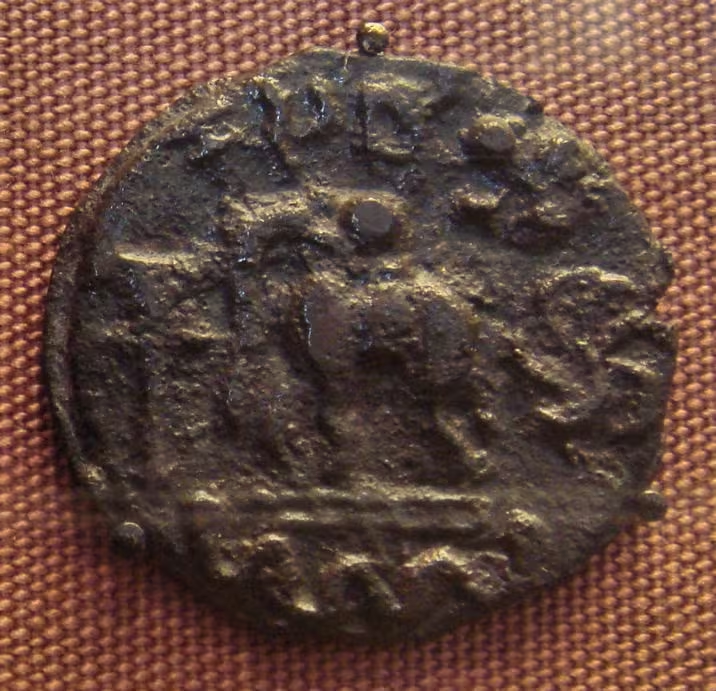
After the Mauryan period, Kosambi continued to function as an urban centre. Local or regional communities produced cast copper coins, both with and without punchmarks. These coins resemble the shape of a damaru, or small drum, and have been attributed to Kosambi. Examples are held in Indian museums, including the National Museum.
It is possible that Pushyamitra Shunga shifted his capital from Pataliputra to Kaushambi, but this remains a possibility rather than a firmly established fact. After Pushyamitra’s death, his empire was divided, perhaps among his sons, and several Mitra dynasties emerged. The Kaushambi dynasty is credited with exercising influence over a broad area that included Magadha and possibly Kannauj.
Kosambi and nearby ancient sites have produced more than three thousand stone sculptures. These finds come not only from Kosambi itself but also from Mainhai, Bhita, Mankunwar, and Deoria. They are now preserved in collections including the Prof. G. R. Sharma Memorial Museum of the University of Allahabad, the Allahabad Museum, and the State Museum in Lucknow.
Gupta period and later occupation
Kosambi remained a substantial urban centre during the Gupta period. Carbon dating of charcoal and the presence of Northern Black Polished Ware have been used to place continued occupation between approximately 390 BCE and 600 CE. The city therefore survived for centuries after the Mauryan Empire and remained occupied into the Gupta age.
The evidence does not indicate a single moment when Kosambi ceased to exist. Instead, it suggests a long history of changing political control, continued settlement, religious activity, and gradual transformation.
Political Significance
Kosambi’s political importance began with its role as a Kuru capital and reached a major stage when it became the capital of Vatsa. As the seat of one of the sixteen mahajanapadas, it belonged to the political world that shaped the early historic states of northern India.
Its fortifications were a visible expression of that political role. The city had an irregular oblong plan and extended across approximately 6.5 kilometres. Gates were identified on the eastern, western, and northern sides, while the southern gate cannot be precisely located because of water erosion. The city was enclosed on three sides by a moat, still discernible in places on the northern side. Some locations appear to have had more than one moat.
The Mauryan pillar and administrative edict further demonstrate the city’s continuing importance. Kosambi was not merely absorbed into an empire as an ordinary settlement; it retained enough strategic and administrative weight to be associated with military presence and official communications.
Religious and Cultural Importance
Buddhism
Kosambi is prominent in accounts of the Buddha’s life. Buddhist tradition identifies four establishments of the Order in the city: Kukkutārāma, Ghositārāma, Pāvārika-ambavana, and Badarikārāma. The first three were associated with leading citizens named Kukkuta, Ghosita, and Pāvārika.
The Buddha is said to have visited Kosambi several times and stayed at these residences. He also stayed in the Simsapāvana, or Simsapa woodland. Near the city was Udayana’s park, the Udakavana, where Ananda and Pindola Bharadvaja preached to the women of the royal palace on two occasions.
Kosambi was also associated with the Buddha’s ninth rainy season. Buddhist tradition states that he was travelling there when he diverted to Kammassadamma, where the Brahmin Māgandiya offered him his daughter Māgandiyā in marriage. After the Buddha refused, Māgandiyā later married King Udena and became hostile toward the Buddha and Udena’s wife Sāmavatī, who was his follower.
The city also appears in discussions of the Buddha’s final passing. Ananda is said to have named Kosambi among the places suitable for the Buddha’s Parinibbāna. Mahā Kaccāna, meanwhile, is associated with a woodland near Kosambi after the First Buddhist Council.
The Buddhist schism
One of the best-known Buddhist narratives connected with Kosambi concerns a dispute among monks. The quarrel began when one monk was accused of leaving water in a bathroom dipper, an act that could allow mosquitoes to breed. The monk rejected the charge and argued his position using his knowledge of monastic discipline.
The disagreement became a wider conflict. The monk was eventually excommunicated, and supporters of both sides formed opposing groups. When the Buddha was informed, he advised the monks to end their dispute. They refused, and the conflict became so serious that physical blows were exchanged.
The people of Kosambi grew angry at the monks’ conduct. The Buddha made another attempt to restore harmony, including by telling the story of King Dīghiti of Kosala, but the quarrelling continued. One monk even asked the Buddha to leave them to settle the matter themselves. The Buddha then departed, travelling through other settlements and spending a retreat alone in the Pārileyyaka forest.
Pressure from lay followers eventually helped bring the monks to their senses. The two groups later approached the Buddha at Shravasti, asked his forgiveness, and resolved their dispute. A separate Mauryan inscription, the Schism Edict of Kaushambi, gives the city a lasting place in the history of Buddhist institutional unity.
Jainism
Jain traditions preserve a separate and equally rich history of Kauśāmbī. According to early canonical and later Śvetāmbara literature, four of the five Kalyanakas of Padmaprabha, the sixth Tirthankara, took place there: conception, birth, initiation, and attainment of omniscience.
Mahavira is said to have visited Kauśāmbī five times. The Āvaśyaka Sūtra, one of the principal Jain canonical texts, places the city on the banks of the Yamuna and records Mahavira’s visit. The 10th-century Triṣaṣṭiśalākāpuruṣacaritra adds that Mahavira broke a fast lasting 175 days by accepting his first alms from Candanbālā at Kauśāmbī. It also associates the city with his Samavasarana after attaining omniscience and with the initiation of Queen Mṛgāvatī as a Jain nun.
Other Jain texts remember Kauśāmbī as a centre of trade and religious life. They mention visits by important ascetics, the activity of local devotees, and traditions concerning Emperor Samprati’s construction of a pillar. A 2nd-century BCE inscription from Pabhosha refers to “Kassyapiya Arhats,” which has been interpreted by some scholars as a Jain reference connected with Mahavira’s Kaśyapa lineage.
Excavations produced a Jain ayāgapata, a votive tablet, dating to approximately 2,000 years ago. Its inscription mentions King Sivamitra and Sthavira Baladasa, a Śvetāmbara Jain ascetic. More than twelve heads of Tirthankara images and around six headless seated Tirthankara figures in Padmasana were also recovered.
Economic Role
Kosambi’s economic strength rested on its position within regional networks. It was an important entrepôt for goods and passengers travelling from the northwest and the south. River transport along the Yamuna connected it with the Ganges system, while overland routes carried merchants and travellers toward Kosala, Magadha, Varanasi, and western India.
The prosperity described in Buddhist accounts is consistent with the scale of the archaeological settlement. The city contained extensive brick construction, suggesting a dense built environment. Its fortified perimeter, multiple gateways, internal structures, and royal complex required considerable organisation and resources.
The cast copper coins attributed to Kosambi provide additional evidence of local economic activity in the post-Mauryan period. These coins, with and without punchmarks, show that the city participated in systems of regional exchange and monetary production.
Monuments and Architecture
Fortifications
Kosambi was a fortified town with an irregular oblong layout. Excavations revealed gates on the east, west, and north. The southern entrance cannot be securely identified because erosion has damaged the relevant area.
The city’s defences included ramparts, brick walls, bastions, towers, battlements, sub-gates, and moats. One interpretation describes an early mud rampart later strengthened with brick walls and bastions. Another attributes brick revetment and the earliest moat to earlier dates. The varying archaeological interpretations point to successive building phases rather than a single act of construction.
Palace complex
Excavations conducted by the Archaeological Survey of India revealed a palace whose foundations extended from the eighth century BCE to the second century CE. The final phase, dated to the first or second century CE, included an extensive structure divided into three blocks and enclosed by two galleries.
The central block contained a central hall, probably an audience hall, surrounded by rooms interpreted as residential spaces for the ruler. Bricks and stones formed the structure, and two layers of lime plaster covered parts of it. Underground chambers formed a large network beneath the palace.
The galleries and superstructure used different forms of arches. Four-centred pointed arches spanned narrow passageways, while segmental arches were used for wider spaces. The central and eastern blocks may have supported a dome. The entire superstructure had collapsed beneath a layer of ash approximately five centimetres thick, indicating destruction by fire.
Pillars and sculpture
An Ashokan pillar remains within the fort ruins. The Allahabad pillar, now at Prayaga, is linked to Kosambi through its edict addressed to the Mahamatras of the city. Together, these pillars preserve evidence of the city’s administrative and political connections under the Mauryan Empire.
The wider Kosambi region has produced a large body of stone sculpture. More than three thousand pieces have been recovered from Kosambi and neighbouring sites. Buddhist and Jain images are among the most important remains, reflecting the religious diversity of the ancient urban landscape.
Famous Personalities
Kosambi is associated with several rulers and religious figures. King Parantapa and his son Udena ruled the city in the period of the Buddha. Udena appears in Buddhist narratives concerning the Buddha’s followers, palace women, and the parks around the city.
Chandrapradyota is said to have built a grand fort at Kauśāmbī, though the relationship between this literary tradition and the excavated fortifications requires careful interpretation. Mahavira visited the city repeatedly, while the Buddha preached there and intervened in the dispute among its monks.
The modern archaeological understanding of Kosambi is strongly associated with G. R. Sharma of Allahabad University. Excavations began in 1949 and continued from 1951 to 1956 after authorisation by Sir Mortimer Wheeler in March 1948.
Decline and Revival
Kosambi’s history was not defined by a single recorded destruction or abandonment. Archaeological evidence indicates continued occupation from the early historic period through the Gupta age. Its political importance may have changed as larger kingdoms and empires reorganised northern India, but the settlement remained a substantial urban centre for many centuries.
The history of its Jain institutions shows a later pattern of decline and restoration. Visitors in 1500 recorded 64 Jain idols. Records from 1605 and 1608 mention two prominent Jain temples, while by 1691 only one temple survived, and it was in a dilapidated condition. By the 18th century, the last two temples had also fallen into ruins.
Restoration efforts began in 1978 under Acharya Prabhacandrasuri, when an image of Padmaprabha was installed. A second phase of renovation was led by Acharya Nayavardhanasuri in 2018. Two major Śvetāmbara Jain temples currently exist at Kauśāmbī.
Modern City
The ancient site lies in present-day Prayagraj district of Uttar Pradesh and is associated with modern Kosam. Its historical importance is represented by excavated fortifications, the palace complex, the Ashokan pillar, sculptures, coins, and religious remains.
The site is especially valuable because several aspects of ancient urban life can be studied together. Its fortifications reveal military planning; its palace shows elite architecture; its coins indicate economic activity; its sculptures document religious patronage; and Buddhist and Jain traditions preserve memories of monastic communities, rulers, merchants, and pilgrims.
Kosambi’s remains also connect several neighbouring archaeological locations, including Mainhai, Bhita, Mankunwar, Deoria, and Pabhosha. Collections from these sites are preserved in museums in and around Prayagraj and Lucknow, allowing the material history of the wider region to be studied beyond the city walls.
Timeline
Early occupation
Archaeological evidence suggests that the site may have been occupied as early as the 12th century BCE.
Early fortification phases
One archaeological interpretation places brick revetment on the rampart between approximately 1025 and 955 BCE.
Vatsa capital
Kosambi served as the capital of the Vatsa Kingdom, one of the sixteen mahajanapadas.
Buddhist and commercial centre
By the time of the Buddha, Kosambi was a prosperous city of merchants and a major route centre.
Mauryan administration
The city was associated with Ashokan pillars, a Mauryan military presence, and the Schism Edict of Kaushambi.
Palace complex
The final phase of the excavated palace is dated to the first or second century CE.
Gupta-period occupation
Urban occupation continued into the Gupta period.
Modern excavations
G. R. Sharma began archaeological excavations at the site.
Jain restoration
The first phase of modern Jain restoration began, including the installation of an image of Padmaprabha.
Temple renovation
A second phase of Jain temple renovation was led by Acharya Nayavardhanasuri.