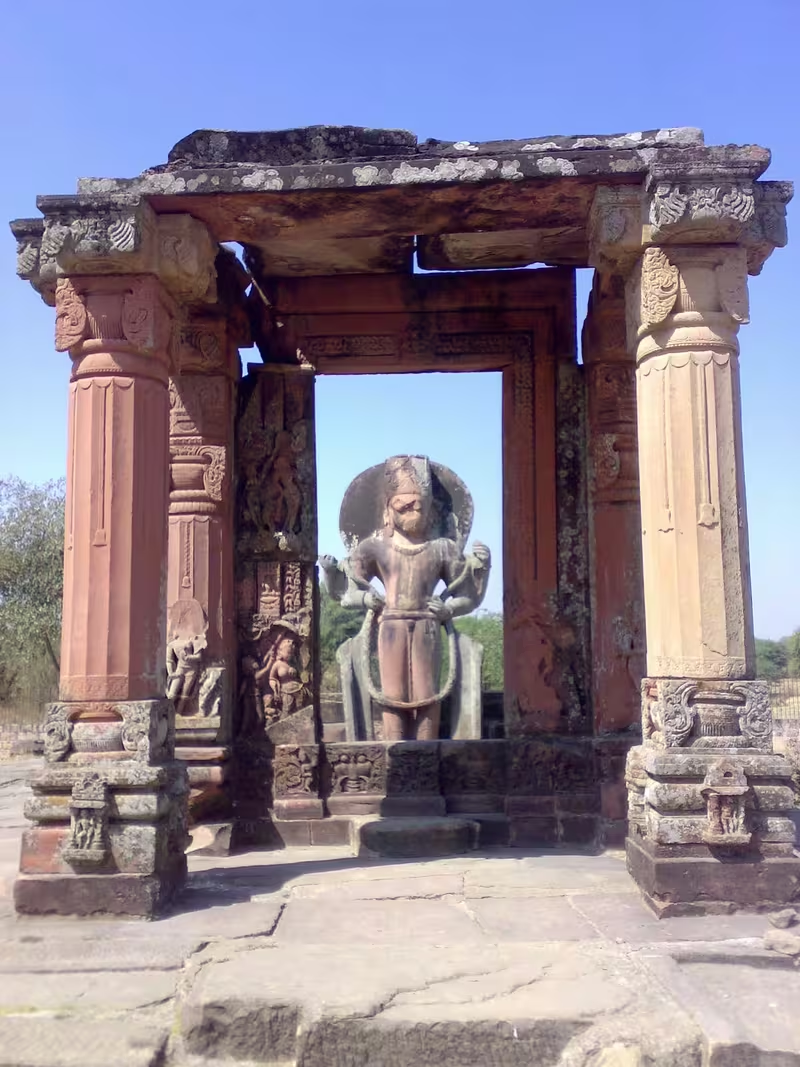
Eran Archaeological Site: Gupta Temples, Coins, and the Colossal Varaha
The colossal stone Varaha at Eran measures 4.22 metres in length and is covered with an extraordinary visual narrative. The boar's body carries carved sages, celestial musicians, miniature figures, and a pattern of 28 roundels; the goddess Earth hangs from its right tusk, while a small goddess stands upon its tongue. At its feet, carved serpents and aquatic creatures evoke the ocean. This remarkable sculpture is part of the Eran archaeological site in the Sagar district of Madhya Pradesh, an ancient town on the south bank of the Bina River.
Eran was both a religious center and an ancient mint. Its excavated remains include Gupta-era temples dedicated to Vishnu, Varaha, and Narasimha, a 13-metre Garuda pillar, numerous inscriptions, and thousands of coins. The site was the capital of Erakina, also called Airikina Pradesha or Airkina Vishaya, an administrative division of the Gupta Empire. Its inscription stones are important for reconstructing the chronology of Gupta rule and the transition to Huna authority in central India.
The archaeological sequence at Eran extends from the Chalcolithic period to the late medieval era. Its monuments preserve changing forms of religious architecture, sculpture, writing, political commemoration, and monetary practice. Together, they make Eran a concentrated record of ancient Indian history.
Discovery and Provenance
Discovery
Eran is now a small town surrounded by many mounds that are likely archaeological remains of its distant past. The site has a museum containing archaeological relics. The first systematic archaeological report was written by Alexander Cunningham, who documented the temples, pillars, sculptures, coins, and inscriptions at the site.
The remains indicate that Eran was once more extensive and architecturally complex than the surviving ruins suggest. The Varaha temple, for example, is now represented by the sculpture, foundations, wall remnants, pillar stumps, and fragments of an entrance gateway. Cunningham identified the remains of a mandapa in front of the shrine and recorded two carved pillars, each about 10 feet high, which he described as especially fine examples of Hindu decorative art.
The archaeological excavations also established a long sequence of occupation:
- Period I: Chalcolithic, 1800–700 BCE
- Period II: Early historic, 700 BCE–2nd century BCE
- Period IIB, 2nd century BCE–1st century CE
- Period III, 1st–600 CE
- Period IV: Late medieval, 16th–18th century CE
These periods show that the Gupta remains were part of a much older settlement and landscape.
Journey Through History
The ancient name of Eran appears in several forms, including Erakaina, Erakanya, Erakina, Airikina, and Erikina. The name is derived from eraka, probably referring to the tall grass known as elephant cattail, or Typha elephantina, which grows abundantly at Eran.
The settlement is mentioned in Buddhist and Hindu texts, on ancient coins, and in inscriptions found at Eran and other places, including Sanchi. During the Gupta period, Eran served as the capital of an administrative division. The site therefore combined local religious importance with a formal political and administrative role.
The inscriptions preserve evidence of several rulers and periods. The Saka king Sridharavarman, who ruled in central India around 339–368 CE, placed a small pillar inscription at Eran together with his Naga military commander. The Gupta ruler Samudragupta later established a monument and inscription at the site, apparently to increase his fame. This sequence suggests that Samudragupta may have displaced Sridharavarman during campaigns to the west.
The Gupta presence continued in later inscriptions. A column inscription dated to 484–485 CE records the raising of a pillar in honour of Janardana, a name of Vishnu. It describes Gupta authority as extending from the Kalindi River to the Narmada River.
The Toramana inscription on the Varaha records a later political transformation. It names Toramana, an Alchon Hun ruler, as governing Malwa and states that Dhanyavishnu dedicated a stone temple to Narayana. The inscription confirms that Huna authority had displaced Gupta power in the northwest and that Huna rule over the northwest and central India began in the early sixth century.
A further inscription, associated with Bhanugupta and dated to 510 CE, records the death of the chieftain or noble Goparaja in battle. It also records the cremation of Goparaja and his wife, who cremated herself on his funeral pyre. This is generally regarded as one of the earliest recorded instances of sati.
Current Home
The archaeological remains remain at Eran, where the ruined temples, platforms, pillars, and sculptures form the principal historic landscape. The town also has a museum containing archaeological relics. The Varaha currently stands in the open, although its foundations and surrounding stumps show that it originally stood inside a sanctum within a larger temple complex.
The Samudragupta inscription is presently stored in the Indian Museum in Kolkata. One copper coin bearing the name Dharmapala is displayed in the British Museum in London.
Physical Description
Materials and Construction
The monuments at Eran are principally made of stone, including red sandstone used for major sculptures and inscriptions. The colossal Varaha was carved as a single monumental stone image with an intricately worked surface. Its body, tusks, ears, tongue, eyes, ornaments, and surrounding imagery all contribute to the narrative.
The Garuda pillar is a monolithic stone column. Its lower section is square in cross-section, the middle section is octagonal, and the upper portion incorporates a reeded bell-shaped capital, an abacus, a cube, and a double Garuda image.
The site also preserves copper and lead coins. Coins were produced by several methods, including punching, casting, die striking, and inscription. Eran's square coins are particularly characteristic of its minting tradition.
Dimensions and Form
The Garuda pillar stands 43 feet, or approximately 13 metres, high on a square platform measuring 13 feet, or about 4 metres, on each side. It stands exactly 75 feet, or approximately 23 metres, in front of the line of temples.
The pillar's lower 20 feet, approximately 6.1 metres, have a square cross-section measuring 2.85 feet on each side. The next 8 feet, about 2.4 metres, are octagonal. Above this is a reeded bell capital 3.5 feet high and 3 feet in diameter. An abacus 1.5 feet high supports a cube 3 feet high. At the top is a 5-foot, or 1.5-metre, double statue of Garuda holding a snake in his hands.
The colossal Varaha is 13.83 feet, or 4.22 metres, long; 11.17 feet, or 3.40 metres, high; and 5.125 feet, or 1.562 metres, wide. It stood inside the sanctum of its temple.
The Vishnu temple contained a damaged colossal Vishnu approximately 13.17 feet, or 4.01 metres, high. The Narasimha temple had a statue about 7 feet, or 2.1 metres, high. The shrine itself was a single room measuring 12.5 by 8.75 feet, with a mandapa supported by four pillars.
Condition
The Eran complex is in ruins. The broken pillars and missing architectural elements suggest that some structures were destroyed rather than lost through gradual natural erosion. The Varaha temple has lost its enclosing walls and mandapa, although the foundations and pillar stumps preserve evidence of its original plan.
The Vishnu and Narasimha temples are also substantially ruined. Parts of the Vishnu temple's door jamb survive, including reliefs of the river goddesses Ganga and Yamuna. The Narasimha temple retains its plinth and evidence of the former pillar arrangement, but its mandapa pillars are missing.
An entrance stone approximately 6 by 3.5 feet lies about 33 feet in front of the present Varaha platform. It carries a large shell-script inscription that remains undeciphered. A ruined torana, or arched gateway, stood approximately 15 feet in front of this entrance stone. One of its decorated pillars survives.
Artistic Details
The temples are arranged in a row and follow rectangular or square plans. They are not aligned with the cardinal directions but are oriented at approximately 76 degrees, around 14 degrees north of east. Cunningham suggested that this deliberate shift may correspond to one nakshatra measure, or one twenty-seventh of 360 degrees, reflecting the apparent movement of the Moon in one day.
The Garuda at the top of the pillar is shown as two fused figures sharing a back. Each looks across a 180-degree space: one faces the temples and the other faces the town. Garuda, the vehicle of Vishnu, thus visually connects the religious complex with the settlement.
The Varaha's surface is densely carved. The goddess Earth hangs from the boar's right tusk. She has a calm face, a tidy hair bun, and a bejeweled turban. Sages and saints cover the boar's body. They wear simple robes, have pointed beards and knotted hair, and hold water pots called kamandalus while making yoga gestures.
The boar's tongue projects slightly, and a small goddess stands on it. She has been interpreted as Saraswati or the Vedic goddess Vac. Celestial musicians appear in the ears. A garland of roundels lies across the shoulders and neck. There are 28 roundels, corresponding to the fifth-century astronomical use of 28 major stars to divide the night sky into constellations. Each roundel contains miniature male and female figures.
The artists gave the boar humanlike teeth and eyes that express compassion. Beneath the Toramana inscription on the chest are further sages. A ruined fragment below may once have shown Vishnu in anthropomorphic form, making the connection between the boar and Vishnu explicit.
Historical Context
The Era
Eran's most substantial monuments belong to the Gupta period and the centuries immediately around it. The site preserves evidence of Gupta administrative power, Vaishnava religious practice, and the political changes that followed the weakening of Gupta authority.
The inscriptions provide a chronological sequence. Sridharavarman's inscription belongs to the fourth century CE. Samudragupta's inscription follows it. The Budhagupta inscription dates to 484–485 CE. The Toramana inscription belongs to the early sixth century, and the Bhanugupta inscription is dated to 510 CE.
This sequence makes Eran valuable for understanding political change in central India. The site records the movement from Saka and local authority to Gupta power and then to the rule of the Alchon Huns.
Purpose and Function
Eran served several functions. It was an administrative capital, a center of Vaishnava worship, and an important mint. The complex initially consisted of a twin temple dedicated to Vāsudeva and Saṃkarṣaṇa, guarded by the Garuda pillar.
The Varaha temple presented Vishnu's boar avatar in monumental form. The narrative shows Varaha returning after killing the oppressive demon Hiranyaksha and rescuing the goddess Earth. The Vishnu temple and Narasimha temple extended the site's focus on Vishnu and his avatars. A later Hanuman temple, dated to about 750 CE, demonstrates the continued religious use of the area.
Commissioning and Creation
The Varaha temple was built by Dhyana Vishnu. The Toramana inscription records Dhanyavishnu's dedication of a stone temple to Narayana, although the relationship between the names and the precise stages of construction is presented through the inscriptional record rather than a complete surviving architectural history.
The artists of the Varaha are not named. Their work demonstrates a sophisticated integration of sculpture, religious narrative, astronomy, and ornament. The monumental scale of the boar and the density of its imagery suggest that the sculpture was designed not merely as an isolated image but as the central focus of a complete temple.
Significance and Symbolism
Historical Importance
Eran is significant because its monuments and inscriptions illuminate the chronology of central Indian political history. The inscriptions of Samudragupta, Budhagupta, Toramana, and Bhanugupta document shifts in authority and provide evidence for the history of the Gupta Empire and the arrival of Huna rule.
The Bhanugupta inscription is especially important for the history of sati. It records the cremation of Goparaja's wife on his funeral pyre, although it does not use the word sati or an equivalent expression. Eran also yielded later sati stones, including examples dated to 1304, 1664, and 1774 CE.
The coins make Eran equally important for economic history. More than 3,000 coins discovered at the site have been dated between 300 BCE and 100 CE. Additional coins extend across the final centuries of the first millennium BCE through the seventh century CE.
Artistic Significance
The Colossal Varaha is described as the earliest known completely theriomorphic iconography of Vishnu's Varaha avatar. Instead of presenting Varaha as a man with a boar's head, the sculpture takes the form of a complete boar. Catherine Becker has called this an iconographic innovation.
The image is also notable for the way it combines monumental form with miniature detail. The sages, musicians, goddesses, aquatic creatures, ornaments, and astronomical roundels transform the boar's body into a symbolic surface. The sculpture is therefore both an image of a divine animal and a narrative representation of cosmic rescue.
The surrounding temples demonstrate the development of Gupta-period Hindu architecture. Their plans, carved pillars, mandapas, door jambs, and gateway remains show that the surviving sculptures once belonged to structured sacred spaces rather than standing alone.
Religious and Cultural Meaning
The Varaha represents Vishnu's rescue of the Earth goddess after the demon Hiranyaksha's attack. The goddess hangs safely from the boar's tusk, while the ocean at the sculpture's base recalls the setting of the legend. The serpents and aquatic life carved into the floor evoke the cosmic waters.
The sages carved on the boar symbolize knowledge requiring protection and divine benevolence in the face of oppression. The small goddess on the tongue has been interpreted as Saraswati or Vac, linking speech and sacred knowledge to the image.
Garuda, the vehicle of Vishnu, reinforces the Vaishnava character of the complex. The dedication of the pillar to Vishnu-Janardana and the Budhagupta inscription's reference to Janardana further connect the site to Vishnu worship.
Inscriptions and Text
Eran's inscriptions are central to the site's historical importance.
The Sridharavarman inscription was placed on a small pillar by the Saka king Sridharavarman and his Naga military commander around 339–368 CE. The same pillar later received the Bhanugupta inscription.
The inscription of Samudragupta, carved on red sandstone and now preserved in the Indian Museum in Kolkata, was found west of the ruined Varaha temple. It is damaged, but several numeral signs remain, including 2, 3, 4, 5, 6, and 7.
The Budhagupta inscription is dated to 484–485 CE. It is Vaishnava in character and records the raising of a column in honour of Janardana. It states that Gupta territory extended from the Kalindi River to the Narmada River.
The Toramana inscription consists of eight lines of Sanskrit. The first three lines are metrical and the remainder are in prose. Carved on the chest of the red sandstone Varaha, it names Toramana as ruler over Malwa and records Dhanyavishnu's dedication of a stone temple to Narayana.
The Bhanugupta inscription, dated to 510 CE, appears on the reverse of the Sridharavarman pillar. It records Goparaja's death in battle and the cremation of Goparaja and his wife. The inscription does not use the term sati, and its interpretation has been discussed in relation to the history of the practice.
The site also contains a large undeciphered shell-script inscription on an entrance stone near the Varaha temple. Coins provide additional written evidence. A copper coin bearing the name Dharmapala is written in Brahmi and has been assigned on paleographic grounds to the late third century BCE. A circular lead piece bears the name Indragupta, and other copper coins carry the names Erakannya or Erakana.
Coins and the Ancient Mint
Eran was probably one of the ancient mints of the Indian kingdoms, alongside Vidisha, Ujjain, and Tripuri. The excavated coins vary in style, shape, and inscription and span several centuries.
Square coins predominate and appear to have been an Eran specialty. The coins have been grouped into four types:
- Punch-marked coins
- Cast coins
- Die-struck coins
- Inscribed coins
The motifs include Lakshmi seated between two elephants, horses, elephants, bulls, trees probably representing the Bodhi tree, lotus flowers, swastikas, rivers, dharmachakras, and tri-ratna symbols. Almost all the coins display an unusual cross-like sign divided into four sections by a circle.
Cunningham regarded Eran's copper coins as among the finest examples he had found in India. He also noted the great range of sizes: the largest measured about 28 millimetres in diameter, while the smallest measured approximately 5.1 millimetres.
A bronze coin of Eran from the third century BCE was found at Sulur in Tamil Nadu. This discovery shows that coins associated with Eran circulated beyond the immediate region.
Scholarly Study
Key Research
Alexander Cunningham's archaeological survey remains central to the early documentation of Eran. He recorded the layout of the temples, the Garuda pillar, the Varaha shrine, the Vishnu and Narasimha temples, gateways, coins, and inscriptions.
Later scholarship has examined the Varaha as an innovative form of religious iconography. Catherine Becker's interpretation emphasizes the sculpture's full-body symbolism and suggests that the temple may have been larger and more elaborate than Cunningham's proposed rectangular shrine. Becker compared the possible arrangement with a Varaha shrine at Khajuraho.
The inscriptions have allowed scholars to reconstruct a sequence of political authority. The relationship between the Sridharavarman, Samudragupta, Budhagupta, Toramana, and Bhanugupta records provides a framework for understanding the changing political history of central India.
Debates and Controversies
The original shape of the Varaha temple remains debated. Cunningham proposed a rectangular shrine based on the surviving remains. Later scholars have suggested a larger structure, possibly more comparable to the Varaha shrine at Khajuraho.
The Bhanugupta inscription is also subject to interpretation. It records a widow's cremation on her husband's funeral pyre but does not use the word sati. The inscription was interpolated by Fleet in a first edition and revised in a second edition.
The alignment of the temples has also attracted interpretation. Their orientation at about 76 degrees rather than directly east may have been intended to correspond to a nakshatra measure, although this explanation is presented as a proposal associated with Cunningham.
Legacy and Influence
Impact on Art History
Eran's Varaha is a landmark in the history of Indian religious sculpture because it presents the avatar in fully theriomorphic form. Its combination of monumental scale, narrative carving, astronomical symbolism, and Vaishnava theology makes it an especially rich example of Gupta-era artistic thought.
The site also illustrates how temple sculpture could integrate multiple forms of knowledge. Sages represent learning and spiritual practice; aquatic creatures evoke the cosmic ocean; the roundels correspond to the stars; and the figure of the rescued Earth goddess anchors the central myth.
Eran's coins contribute to the history of Indian monetary technology. The site's square coins, cast pieces, die-struck examples, and inscriptions document changing approaches to the production and identification of currency.
Modern Recognition
Eran is recognized through its surviving temples, sculptures, coins, and inscriptions. The site is particularly associated with the Colossal Varaha, the Garuda pillar, and the early evidence for sati in the Bhanugupta inscription.
The town's museum preserves archaeological relics, while major inscriptions and coins are also held in collections outside Eran, including the Indian Museum in Kolkata and the British Museum in London.
Viewing Today
Visitors encounter Eran as a ruined archaeological complex near the town in Madhya Pradesh. The site lies on the south bank of the Bina River, where the river makes an inverted U-shaped turn and surrounds the settlement on three sides. Forested and hilly terrain, with high ground to the south, forms the setting of the ancient town.
The surviving remains include the colossal Varaha, the Garuda pillar, the ruins of the Varaha, Vishnu, and Narasimha temples, platforms of lost shrines, gateways, entrance stones, and inscription-bearing pillars. The town museum contains archaeological relics from the site.
The Samudragupta inscription is preserved in the Indian Museum in Kolkata, while the Dharmapala copper coin is displayed in the British Museum in London. The undeciphered shell-script inscription remains associated with the entrance area of the Varaha temple.
Conclusion
Eran is a rare archaeological landscape in which sculpture, architecture, political history, religious devotion, and coinage remain closely connected. Its colossal Varaha presents Vishnu's rescue of Earth through a richly carved stone body populated by sages, musicians, goddesses, aquatic creatures, and astronomical symbols. Its Garuda pillar and temple ruins reveal the scale and organization of a Gupta-period sacred complex. Its inscriptions record the succession of Saka, Gupta, and Huna authority, while the Bhanugupta inscription preserves an early account of a widow's self-cremation. Thousands of coins show that Eran was also an active mint and an important center of monetary production. Together, these remains make Eran an essential place for understanding the religious art, political chronology, and material culture of ancient central India.