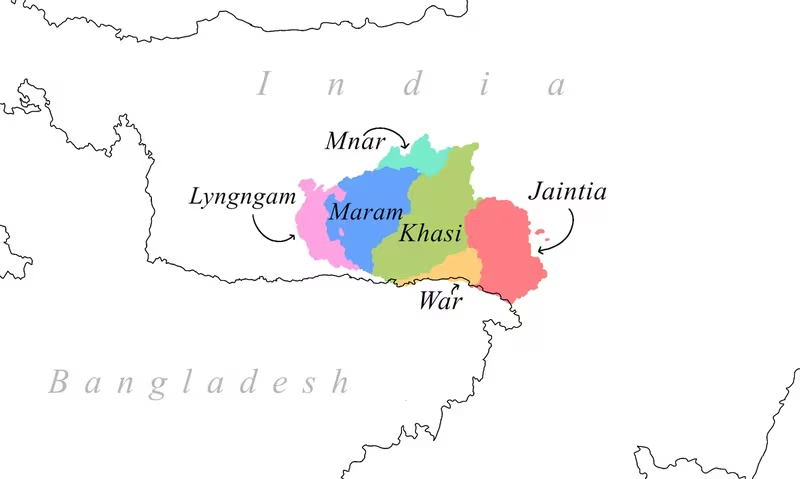
Khasi Language: A Latin-Script Tradition from Meghalaya
On 22 June 1841, the Welsh missionary Thomas Jones arrived in Sohra and began writing the local language in the Latin script. This moment helped establish the writing system now associated with Khasi, although earlier attempts had been made to represent the language in the Bengali-Assamese script. Khasi is an Austroasiatic language spoken primarily by the Khasi people of Meghalaya, especially in the Khasi Hills and Jaintia Hills. It has just over a million speakers in India and is the first language of roughly one-third of Meghalaya’s population.
Khasi belongs to the Khasic group of the Shillong Plateau. Its closest relatives include Pnar, Lyngngam, and War, although the boundaries between Khasi and these related languages remain a subject of classification. The language has extensive dialect variation, a distinctive 23-letter Latin alphabet, a stress-based sound system without tones, and a substantial modern literature. Khasi books include novels, poetry, religious works, textbooks, and non-fiction, while Khasi is also used in blogs and online newspapers. Its literary history includes the work of the poet U Soso Tham, whose death is commemorated annually as a regional holiday in Meghalaya.
Origins and Classification
Linguistic Family
Khasi is an Austroasiatic language. Its closest relatives are the other languages of the Khasic group found on the Shillong Plateau. These include Pnar, Lyngngam, and War.
The classification of the Khasic languages is complicated by the substantial dialect variation within Khasi. Pnar, Maram—including Langrin—and Lyngngam have sometimes been listed as varieties of Khasi. More recent studies described them as sister languages, suggesting that Khasi began as a marginal Pnar dialect. Bhoi and Nonglung also differ considerably from standard Khasi and may sometimes be treated as separate languages.
Khasi is surrounded by languages from several unrelated families. Assamese and Sylheti, both Indo-Aryan languages, are spoken to its north, east, and south. Garo, a Tibeto-Burman language, lies to the west, while Manipuri, Mizo, Bodo, and other Tibeto-Burman languages are also found in the surrounding region.
Origins
Khasi is associated with the Shillong Plateau and is spoken natively in Meghalaya. The historical development of the spoken language before the nineteenth century is not firmly established in the documented record. The earliest detailed written developments described here belong to the period when Khasi began to be represented in Bengali and Latin scripts.
Before British colonization, some Khasi Syiems, or royals, used the Bengali script for official records and communication. William Carey wrote Khasi in the Bengali script between 1813 and 1838 and sponsored a Bible translation in Khasi with the assistance of Alexander B. Lish. These efforts did not establish Bengali script as the lasting writing system of Khasi.
Name Etymology
The term Khasi is generally regarded as an autonym. Its English form was recorded by early colonial administrators and Christian missionaries in the nineteenth century. A deeper linguistic etymology has not been firmly established, and there is no scholarly consensus about the term’s original meaning.
Historical Development
Pre-Literary Khasi
Khasi developed among the Khasi communities of the Shillong Plateau region. Its closest linguistic relationships are with Pnar, Lyngngam, and War. The language’s dialect landscape reflects the close connections among communities in the region, but also makes classification difficult.
The spoken language has retained features associated with its Austroasiatic and Mon-Khmer relationships. These include a large inventory of phonemic vowels, many possible consonant combinations at the beginning of syllables, and a syllable structure in which words may have a CCVC form.
Bengali-Script Experiments (1813–1841)
In the first half of the nineteenth century, Khasi was written in the Bengali-Assamese script by some Khasi royals and by Christian missionaries. William Carey’s work between 1813 and 1838 included writing Khasi in Bengali script and supporting a Bible translation.
The Bengali-script tradition did not become the dominant written form of Khasi. The language’s later written history followed a different path after Thomas Jones introduced a Latin-script system in Sohra.
Latin-Script Formation (1841–1897)
Thomas Jones arrived in Sohra on 22 June 1841 and proceeded to write the local language in the Latin script. The modified Latin alphabet used for Khasi has some similarities with the Welsh alphabet. In 1842, the First Khasi Reader and the Rhodd Mam catechism became the first Khasi publications.
The first Khasi journal was U Nongkit Khubor, or The Messenger, published at Mawphlang in 1889 by William Williams. In 1897, Jeebon Roy published Ka Niam Jong Ki Khasi, the first book in Khasi written by a native Khasi writer.
Modern Literary and Public Use
Khasi literature expanded into multiple genres. Books in the language include novels, poetry, religious works, school textbooks, and non-fiction. U Soso Tham, who lived from 1873 to 1940, is regarded as the most famous Khasi poet. His death is commemorated each year as a regional holiday in Meghalaya.
Khasi is also used in contemporary digital communication. Its everyday presence includes blogs and several online newspapers, extending the language’s written use beyond printed books and formal publications.
Scripts and Writing Systems
Bengali-Assamese Script
The Bengali script was used by some Khasi Syiems for official records and communication before British colonization. William Carey used it to write Khasi from 1813 to 1838 and supported a Khasi Bible translation with Alexander B. Lish.
The first half of the nineteenth century saw attempts to establish Bengali-Assamese writing for Khasi, but these attempts met with little success. The script therefore remained an important part of the early written history of Khasi without becoming its principal modern script.
Modified Latin Script
Khasi is now written in the Latin script. Its alphabet is distinct from the English alphabet and contains 23 letters. It removes c, f, q, v, x, and z from the basic Latin alphabet and adds the letters ï and ñ, together with the digraph ng, which is treated as a letter in its own right.
The digraph ng also occurs in the Welsh alphabet. The association between Khasi’s Latin-script tradition and Welsh features reflects the role of Thomas Jones and the Welsh missionary context in the nineteenth-century development of Khasi writing.
Script Evolution
The modern Khasi writing system developed through adaptation rather than direct continuation of the Bengali-script experiments. Carey’s Bengali-script work belongs to the early nineteenth century, while Jones’s Latin-script work from 1841 became the foundation of the current orthographic tradition.
Several features of Khasi spelling reflect the history of this adaptation. The letter k occupies an unusual position because it replaced c. Earlier, c and ch had been used for sounds now written k and kh. Once c was removed from the alphabet, k was placed in its position.
The letter g occurs because it is part of ng, but g is not used independently in words of native origin. The letter h represents both a fricative sound and a word-final glottal stop. The letter y is not pronounced as it is in the English word “year”; it represents the close central unrounded vowel and the glottal stop between vowels. The sound found in “year” is written with ï.
Digraphs and Orthographic Conventions
Alongside ng, Khasi uses eight other digraphs. The aspirated consonants are written kh, ph, and th. Breathy voiced consonants are represented by bh, dh, and jh. The sound /ʃ/ is written sh.
The digraph ie represents the /e/ sound, while e represents /ɛ/. Unlike ng, these digraphs are treated as combinations of letters rather than as single letters.
Vowel length is not normally marked in Khasi spelling. It may be shown optionally with an acute accent, as in sim /sim/, “bird,” and rí /riː/, “country.”
Lost Khasi Script
A local legend says that the Khasi people received a script from God and later lost it in a great flood. In 2017, evidence was reported of an undeciphered script stored at the Kamarupa Anusandhan Samity Library in Guwahati, Assam. The script is considered to be Khasi in origin, although the account does not provide a decipherment.
Geographic Distribution
Historical Spread
Khasi is native to north-east India and is primarily spoken in Meghalaya. Its principal speech communities are located in the Khasi Hills and Jaintia Hills. The language is also connected to the wider Shillong Plateau, where related Khasic languages are spoken.
The Khasi-speaking area exists within a linguistically diverse region. Assamese lies to the north and east, Sylheti to the south, and Garo to the west. Other surrounding languages include Manipuri, Mizo, and Bodo.
Centers of Written Development
Sohra was central to the formation of the modern written language. It was the first place where the local dialect was written in both Latin and Bengali scripts by the British, and the Sohra dialect became the standard form of Khasi.
Mawphlang was the publication location of U Nongkit Khubor, the first Khasi journal, in 1889. Shillong later became an important center for standard Khasi. Although standard Khasi is spoken by a majority in Shillong, it differs significantly from other Shillong dialects, which form a dialect continuum across the capital region.
Modern Distribution
According to 2011 figures, 1,038,000 people in India spoke Khasi natively. Approximately 997,000 speakers lived in Meghalaya, where Khasi was the first language of one-third of the population. The largest community outside Meghalaya was in Assam, with 34,600 speakers. A very small number of speakers also lived in Bangladesh.
Dialects and Varieties
The Sohra dialect is treated as the standard form of Khasi. Other varieties spoken among Khasi tribes include Mylliem Khasi, Mawlai Khasi, Nongkrem Khasi, War Khasi, Bhoi Khasi, and Nonglung.
War Khasi should not be confused with the closely associated War language. Bhoi, spoken around Nongpoh, and Nonglung, spoken around Umsning in Ri Bhoi District, differ substantially from standard Khasi in word order. Bhoi is sometimes classified as intermediate between Khasi and Pnar, while Nonglung is associated with Mnar and may be classified as a dialect of War or Pnar.
The relationship between dialect and language is therefore not straightforward. Some varieties listed as Khasi have more recently been described as sister languages, while certain varieties within the Khasi area may be sufficiently different from standard Khasi to be treated as separate languages.
Literary Heritage
Early Publications
The first known Khasi publications in the Latin-script tradition appeared in 1842. They were the First Khasi Reader and the Rhodd Mam catechism. These works followed Thomas Jones’s arrival in Sohra and his decision to write Khasi in a modified Latin alphabet.
The first Khasi journal, U Nongkit Khubor, was published at Mawphlang in 1889 by William Williams. Jeebon Roy’s Ka Niam Jong Ki Khasi, published in 1897, was the first Khasi book written by a native Khasi writer.
Religious Texts
Religious works form an important part of Khasi publishing history. William Carey sponsored a Bible translation in Khasi between 1813 and 1838 with the assistance of Alexander B. Lish. The Rhodd Mam catechism was among the earliest Khasi publications, appearing in 1842.
Jeebon Roy’s Ka Niam Jong Ki Khasi, whose title means “The Religion of the Khasi,” was published in 1897 and represents an early major contribution by a Khasi writer.
Poetry and Prose
Khasi literature includes poetry, novels, and other forms of creative writing. The most famous Khasi poet identified in the historical record is U Soso Tham, who lived from 1873 to 1940. His literary reputation is reflected in the annual commemoration of his death as a regional holiday in Meghalaya.
Khasi publishing also includes school textbooks and non-fiction, giving the language a role in education and public knowledge as well as in creative literature.
Grammar and Phonology
Key Grammatical Features
Khasi is an Austroasiatic language with prefixing and infixing. It has a large number of consonant conjuncts. Simple sentences generally follow subject–verb–object order, although verb–subject–object order also occurs, especially after certain initial particles such as hangta, “then.”
The Khasi noun phrase follows this general order:
Case marker – Demonstrative – Numeral – Classifier – Article – Noun – Adjective – Prepositional phrase – Relative clause
Khasi has a classifier system used with numerals. The classifier tylli is used for non-human nouns, while ngut is used for humans.
The language has a pervasive gender system with four genders. Human beings and domestic animals generally have natural gender distinctions, as in ka kmie, “mother,” and u kpa, “father,” or ka syiar, “hen,” and u syiar, “rooster.” Gender assignment is not governed by universal rules, however, and many exceptions exist.
The language also marks gender through agreement. Verbs agree with third-person subjects in gender, while non-third-person subjects do not show the same agreement. The masculine and feminine markers u and ka may appear even when the subject is a full noun phrase.
Tense is expressed through particles placed after agreement markers and before the verb. The past marker is la, while the future marker is yn, often contracted to ’n after a vowel. Negation uses the enclitic =ɨm, contracted to ’m after a vowel. A special past negative particle, ʃɨm, replaces the ordinary past marker in past negation.
Khasi has a morphological causative formed with pn-, written pyn in an earlier grammatical description. The copula functions as an ordinary verb.
Case and Sentence Structure
The nominative case is unmarked, while prepositions are used to indicate relationships between arguments. Khasi descriptions identify eight prepositions on noun phrases for these relations, producing a total of nine cases when the unmarked nominative is included.
The particle ya, written ia in an earlier description, may precede an object. It can indicate a direct and immediate relation and is associated with dative and accusative functions. Definite nouns are more likely to receive accusative marking, while indefinite nouns often do not. When two objects occur, one must be preceded by ya; a pronominal object must also be preceded by it.
Khasi has a non-ascensional passive. In this construction, the agent is removed without moving the patient into subject position. The patient retains accusative marking and remains in the object position. Yes–no questions may be distinguished from statements by intonation, while wh-questions do not move the wh-element. Relative clauses follow the nouns they modify and agree in gender.
Sound System
Khasi is a stress language without tones. This distinguishes it from many Tibeto-Burman languages in the surrounding region. Like its Mon-Khmer relatives, it has a large inventory of phonemic vowels.
Khasi syllables may contain complex consonant combinations. Many lexical items have a CCVC structure, allowing several combinations of consonants in the onset. This consonant-rich syllable pattern is one of the language’s distinctive phonological characteristics.
Influence and Legacy
Linguistic Relationships
Khasi’s closest relationships are within the Khasic group of the Shillong Plateau. Pnar, Lyngngam, and War are closely associated with it, although recent studies describe these as sister languages rather than simply dialects of Khasi. Bhoi and Nonglung also demonstrate the range of variation in the Khasi linguistic area.
The surrounding languages belong largely to other families. Assamese and Sylheti are Indo-Aryan, while Garo, Manipuri, Mizo, Bodo, and several other languages in the region are Tibeto-Burman. Khasi nonetheless retains its own Austroasiatic profile, including stress rather than tone and a large vowel inventory.
Cultural Impact
Khasi’s cultural role is visible in its literature, education, religious writing, journalism, and digital communication. A sizable number of books have been published in the language. Its use in school textbooks supports education, while novels, poetry, and non-fiction sustain literary production.
Khasi also functions in daily online communication. Blogs and online newspapers show that the language remains active in contemporary public life rather than being restricted to ceremonial or literary contexts.
Modern Status
Current Speakers
Khasi had 1,038,000 native speakers in India according to 2011 figures. Meghalaya accounted for approximately 997,000 of these speakers, making Khasi the first language of one-third of the state’s population. Assam had the largest Khasi-speaking population outside Meghalaya, with 34,600 speakers. A very small number of speakers lived in Bangladesh.
Official Recognition
Khasi has been an associate official language of some districts within Meghalaya since 2005. According to the stated modern status of the language, it became a full-fledged official language of Meghalaya in 2026. There are also demands for its inclusion in the Eighth Schedule to the Constitution of India.
Preservation and Continuing Use
As of 2012, Khasi was no longer considered endangered by UNESCO. Its continuing use in books, schools, religious works, newspapers, blogs, and online communication supports its public presence.
Khasi also remains the subject of linguistic study. Descriptions include works such as William Pryse’s An Introduction to the Khasia Language, H. Roberts’s A Grammar of the Khassi Language, Lili Rabel’s Khasi, a Language of Assam, and K. S. Nagaraja’s Khasi – A Descriptive Analysis. A Khasi-English dictionary was published by Nissor Singh in 1906.
Learning and Study
Academic Study
Khasi has been studied through grammars, dictionaries, descriptive analyses, and research on gender, dialects, phonology, and syntax. Its classification within the Khasic group continues to involve questions about the relationship among Khasi, Pnar, Lyngngam, War, Bhoi, and Nonglung.
The language’s grammar has attracted attention because of its gender system, classifier system, agreement patterns, case marking, non-ascensional passive, prefixing and infixing, and flexible sentence-order patterns.
Resources
Resources for studying Khasi include grammars, dictionaries, online literature, vocabulary lists, and language technology materials. The historical record includes the works of Roberts, Rabel, Pryse, Nagaraja, and Singh. Contemporary resources include online Khasi literature, a Khasi entry in the Language Information Service of India, the World Atlas of Language Structures Online, and the Resource Center for Indian Language Technology Solutions.
Conclusion
Khasi is a living Austroasiatic language rooted in the Khasi Hills, Jaintia Hills, and wider Shillong Plateau. Its modern written identity emerged during the nineteenth century, when Bengali-script experiments gave way to the Latin-script system introduced by Thomas Jones in Sohra in 1841. That system developed distinctive conventions, including a 23-letter alphabet, the letters ï and ñ, and ng as a letter in its own right.
The language possesses substantial dialect diversity and a complex relationship with neighboring Khasic varieties such as Pnar, Lyngngam, War, Bhoi, and Nonglung. Its literature spans religious works, poetry, novels, textbooks, journalism, and non-fiction. With more than a million speakers in India, official recognition in Meghalaya, and continuing use in print and digital media, Khasi remains a central language of Meghalaya’s cultural and public life.