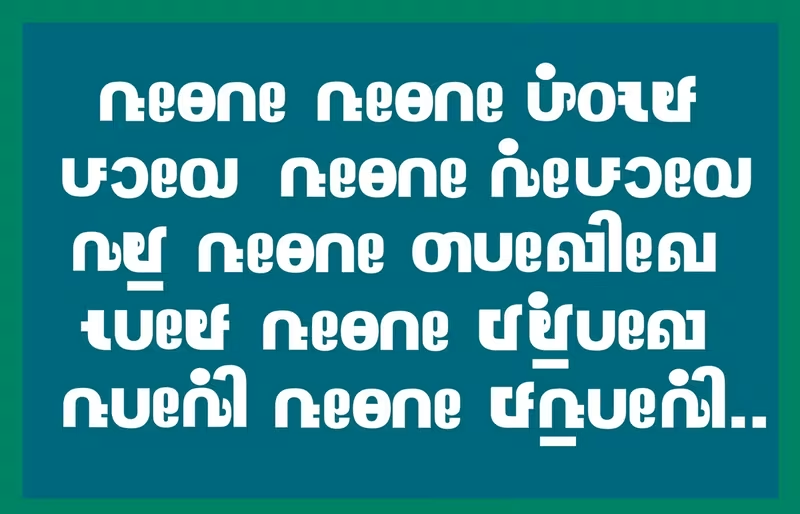
Kodava Language: Speech, Script, and Oral Heritage of Kodagu
The 1924 publication of Pattole Palame gave written form to a large body of Kodava folksongs and traditions that had been transmitted orally across generations. Compiled by Nadikerianda Chinnappa, the collection remains a central record of Kodava cultural expression. Its songs are still associated with marriage and death ceremonies, seasonal festivals, and observances honouring local deities and heroes.
Kodava, natively called Koḍava takkï, meaning “speech of Kodavas,” is a Dravidian language spoken in Kodagu district, also known historically as Coorg, in southern Karnataka. It is also known as Kodagu, Coorg, Coorgi, Kodaga, and Kodava thakk. The language has two main dialects: Mendele, spoken in northern and central Kodagu outside Kiggat naadu, and Kiggat, spoken in southern Kodagu within Kiggat naadu.
Kodava is endangered. The 2011 Census of India recorded 96,918 people who returned Kodava as their mother tongue and another 16,939 who returned Coorgi/Kodagu, producing a total of 113,857 people in the parent group identified as Coorgi/Kodagu. Its history combines a strong oral tradition, several writing systems, modern linguistic study, and continuing efforts to teach and represent the language.
Origins and Classification
Linguistic Family
Kodava belongs to the Dravidian language family and, more specifically, to the South Dravidian subfamily. Within South Dravidian, it is placed in the Tamil–Malayalam–Kodagu–Kota–Toda subgroup.
Comparative linguistics regards Kodava as closely related to Malayalam, Tamil, and Tulu. It has also been influenced by Kannada, Malayalam, Tamil, and Tulu. Kodava is particularly close to the Malayalam dialects of Kasaragod and Kannur, which are themselves related to Beary. A majority of the words are described as common between Kodava and Beary bashe, a variety associated with Tulu and Malayalam.
Kodava was historically associated with Old Canarese, or Hale Kannada. Early twentieth-century academics re-analysed it as a language in its own right. Comparative Dravidian studies now place it within the South Dravidian group.
Origins
Academic linguists including M. B. Emeneau and P. S. Subrahmanyam, together with Kodava scholars Boverianda Nanjamma and Chinnappa, consider Kodava older than Malayalam and Badaga, which they place before the ninth century CE. They regard it as younger than Tamil, Kannada, Tulu, and Telugu.
The surviving account therefore presents Kodava as a historically established South Dravidian language of Kodagu rather than as a recent form of a neighbouring language. The exact beginnings of spoken Kodava are not fixed by a single dated record.
Name Etymology
The name is explained as deriving from koḍa, “west,” and -(v/g)a, meaning “person.” In Kannada, the region was called Kodagu and its people Kodaga. In native folksongs, the people are called Kodava and the land Kodavu.
The language’s other names reflect its geography and community identity. “Coorgi” and “Coorg” derive from the English usage associated with Kodagu, while “Kodava thakk” literally means “speech of the Kodavas.”
Historical Development
Early Historical Stage
Kodava’s classification in South Dravidian reflects its relationship with Tamil, Malayalam, Tulu, Kota, and Toda. Linguistic scholarship places its development in a historical period before the formation of Malayalam as a distinct language, while also distinguishing it from older languages such as Tamil, Kannada, Tulu, and Telugu.
Kodava and Kannada share a lack of palatalization of word-initial k-. The feature is also discussed in relation to the Tamil–Malayalam branch.
Early Written Tradition
A script associated with an early stage of Kodava from the fourteenth century was discovered and is now called the Thirke script. It is a Brahmic abugida, meaning that consonant signs carry an inherent vowel that can be modified. Its characters are considered a mixture of forms from neighbouring scripts, including Grantha, Tigalari, and Vatteluttu.
Kodava family histories, rituals, and other records were traditionally written on palm leaves. These leaves were called Pattole, from patt, “palm,” and ole, “leaf.” Astrologers scripted such records in earlier times.
Grammar and Literary Documentation
Captain R. A. Cole published An Elementary Grammar of the Coorg Language in 1867. This work represents an early systematic documentation of Kodava grammar.
Kodava had no significant written literature until the twentieth century, although its oral traditions were extensive. Appachcha Kavi, a playwright, and Nadikerianda Chinnappa, a compiler of folk traditions, are identified as two major Kodava writers. Other important writers include B. D. Ganapathy and I. M. Muthanna.
Modern Period
Modern Kodava writing has involved both the use of existing scripts and the creation of new ones. Kannada has been the principal script used for Kodava writing, while Malayalam has also been used, particularly near Kerala. The Latin alphabet has appeared more recently.
Because existing scripts did not always represent Kodava sounds easily, Kodava writers developed several additional systems. Around seven scripts were developed between 1889 and 2008. Among them, Kodava Lipi, created by I. M. Muthanna in 1971, is considered the most acceptable by the Karnataka Kodava Sahitya Academy. In 2022, the academy accepted and recommended it as the official script of Kodava, and a proposal was sent to the Central Institute of Indian Languages.
Scripts and Writing Systems
Thirke Script
The Thirke script is associated with an early stage of Kodava from the fourteenth century. It is a Brahmic abugida combining features attributed to Grantha, Tigalari, and Vatteluttu. Kodava is traditionally described as having been written in Thirke.
Kannada and Malayalam Scripts
Kodava Takk is mostly written in the Kannada script. Malayalam is also used, especially in areas along the Kerala border. Historical Kodava records, including the Pattole Palame in its original publication, used Kannada script.
The use of more than one established script reflects Kodagu’s connections with Karnataka and neighbouring Kerala. More recently, Kodava has also appeared in the Latin alphabet.
Kodava Lipi
Dr. I. M. Muthanna developed Kodava Lipi in 1971. The script has 16 vowels, 24 consonants, and four diacritic marks. It is relatively simple in structure compared with other Brahmic scripts. Since its creation, it has seen increasing but limited use across Kodagu.
The Karnataka Kodava Sahitya Academy recommended Kodava Lipi as the official script of Kodava in 2022, although the proposal submitted to the Central Institute of Indian Languages had not yet received a response.
Coorgi–Cox Alphabet
The Coorgi–Cox alphabet was developed by linguist Gregg M. Cox in response to a request from Kodava individuals who wanted a distinct script for Kodava Takk. It was intended as a unified writing system for Kodava speakers.
The alphabet contains 26 consonant letters, eight vowel letters, and a diphthong marker. Each letter represents a single sound, and the system has no capital letters. A computer-based font was created. German linguist Gerard Cox created the script in 2005; it uses straight lines for five vowels and circles for diphthongs.
Geographic Distribution
Historical Spread
Kodava is native to Kodagu district in southern Karnataka. Its two principal dialects correspond to regions within Kodagu. Mendele is spoken in northern and central Kodagu, outside Kiggat naadu. Kiggat is spoken in Kiggat naadu in southern Kodagu.
Kodava was formerly spoken as a first language by 21 castes and tribes, including the Kodagu Heggades, Kudiyas, Kembattis, Airis, Ammas, Medas, Gollas, Koyuvas, and Boonepxattas. In modern times, the number of communities was reduced to 17 as some underwent language shift to Malayalam and Kannada.
Modern Distribution
The 2011 Census figures identify 96,918 people returning Kodava as their mother tongue and 16,939 returning Coorgi/Kodagu. Together, these returns total 113,857 people in the Coorgi/Kodagu parent group.
Literary Heritage
Oral Literature
The Kodava folk songs are called Palame, and are also known as Balo Patt or Dudi Patt. They were transmitted orally over several generations. Traditionally known as Balo Pat, these songs are performed by four men who beat dudis, or drums, while singing.
The songs remain part of ceremonies and festivals. Kodava folk dances are performed to the rhythm of many of them.
Pattole Palame
Pattole Palame, compiled by Nadikerianda Chinnappa, was first published in 1924. Nearly two-thirds of the volume consists of folksongs. It is regarded as the most important collection of Kodava literature and as one of the earliest, possibly the earliest, collections of a community’s folklore in an Indian language.
The work was originally written in Kannada script. It was later translated into English by Boverianda Nanjamma and Chinnappa, the grandchildren of Nadikerianda Chinnappa, and published by Rupa & Co. in New Delhi.
Drama and Modern Writing
Appachcha Kavi is identified as an important Kodava playwright. Nadikerianda Chinnappa was both a folk compiler and a major writer. B. D. Ganapathy and I. M. Muthanna are also important figures in Kodava writing.
The language’s written heritage therefore joins palm-leaf records, oral song, folk compilation, drama, grammar, and modern script design.
Grammar and Phonology
Key Features
Kodava nouns may be proper, common, verbal, derivative, or compound. Relationship nouns form a subclass of common nouns.
Verbal nouns are formed from verbal roots with vadu, expressing the act represented by the root. For example, yeḷadu means “to write,” while yeḷadu vadu means “the act of writing.”
Derivative nouns can be formed from noun roots. The forms -(k/g)ara, -karu, and -garu can indicate an actor, profession, possession of a quality, or a person associated with something. Examples include kumbaara, “potter,” from paathre, “vessel”; angaḍikara, “shopkeeper,” from angaḍi, “shop”; and boṭegara, “hunter,” from boṭe, “the act of hunting.”
Kodava nouns are described as masculine, feminine, or neuter. Masculine nouns represent males and male gods; feminine nouns represent women and goddesses; neuter nouns represent other things, including animals, although animals can be marked for sex. Masculines may be marked with aṇu, feminines with ponṇu, and masculine nouns ending in -ru may be feminised with -ti.
Sound System
Dravidian vowel systems generally contain five vowel qualities corresponding to a, e, i, o, and u, each with short and long variants. Kodava has two additional vowels: mid and high, or close, back unrounded vowels, with corresponding long forms.
Kodava and Kannada share the absence of palatalization in word-initial k-. A separate consonant notation is used only for Sanskrit loanwords.
Influence and Legacy
Linguistic Relationships
Kodava has developed within a network of South Dravidian languages. It is closely related to Malayalam, Tamil, and Tulu, and is also closely connected with Kannada. The language shares a substantial majority of its vocabulary with Beary bashe in the comparison described for the language.
These relationships do not erase Kodava’s distinct identity. Early twentieth-century scholarship re-analysed it as a language rather than treating it simply as Old Canarese or Hale Kannada.
Cultural Impact
Kodava’s cultural legacy is especially visible in its oral literature. The songs recorded in Pattole Palame remain connected with ceremonies, seasonal observances, local deities, heroes, and dance. Palm-leaf records preserved family histories and ritual knowledge, while modern writers and script designers have continued to develop written forms suited to Kodava.
Royal and Religious Patronage
No royal dynasty is identified in the historical account of Kodava. The preservation of the language is instead associated with community traditions, astrologers’ palm-leaf records, folk performers, writers, scholars, and the Karnataka Kodava Sahitya Academy.
Modern Status
Current Speakers
Kodava is an endangered language. The 2011 Census recorded 113,857 people under the Coorgi/Kodagu parent group, including 96,918 Kodava mother-tongue returns and 16,939 Coorgi/Kodagu returns.
Language shift has affected the communities that traditionally spoke Kodava. The number of castes and tribes using it as a native language declined from 21 to 17 as some communities shifted to Malayalam and Kannada.
Preservation Efforts
The Karnataka Kodava Sahitya Academy has supported the development of Kodava and recommended Kodava Lipi as an official script. Kodava is also taught to children by Shilpa Kalengada Bopanna using the Muthanna script, or Kodava Lipi.
Since 2021, Mangalore University has offered an MA degree in the Kodava language. These efforts complement the older work of documenting grammar, collecting oral literature, and developing scripts.
Learning and Study
Academic Study
Kodava grammar has been systematically studied since at least 1867, when R. A. Cole published An Elementary Grammar of the Coorg Language. Later comparative work placed Kodava within South Dravidian and examined its connections with Malayalam, Tamil, Tulu, Kannada, and related languages.
Resources
Important resources include Cole’s grammar, Pattole Palame, English translations of the folk collection, and the several writing systems created for Kodava. The language is also supported by university teaching, community instruction, and the work of the Karnataka Kodava Sahitya Academy.
Conclusion
Kodava is the language of Kodagu’s Kodava communities and a distinctive member of the South Dravidian family. Its history includes relationships with Kannada, Malayalam, Tamil, and Tulu, but also a separate linguistic identity recognised by modern scholarship. Its oral heritage is preserved most notably in the songs collected in Pattole Palame, while palm-leaf records, grammar writing, drama, and modern education document other dimensions of its cultural life.
The language’s endangered status makes its scripts and institutions especially significant. Kannada, Malayalam, Latin, Thirke, Kodava Lipi, and the Coorgi–Cox alphabet represent successive attempts to record Kodava speech. Contemporary teaching, university study, and script development continue the work of preserving Kodava as both a spoken language and a written cultural tradition.