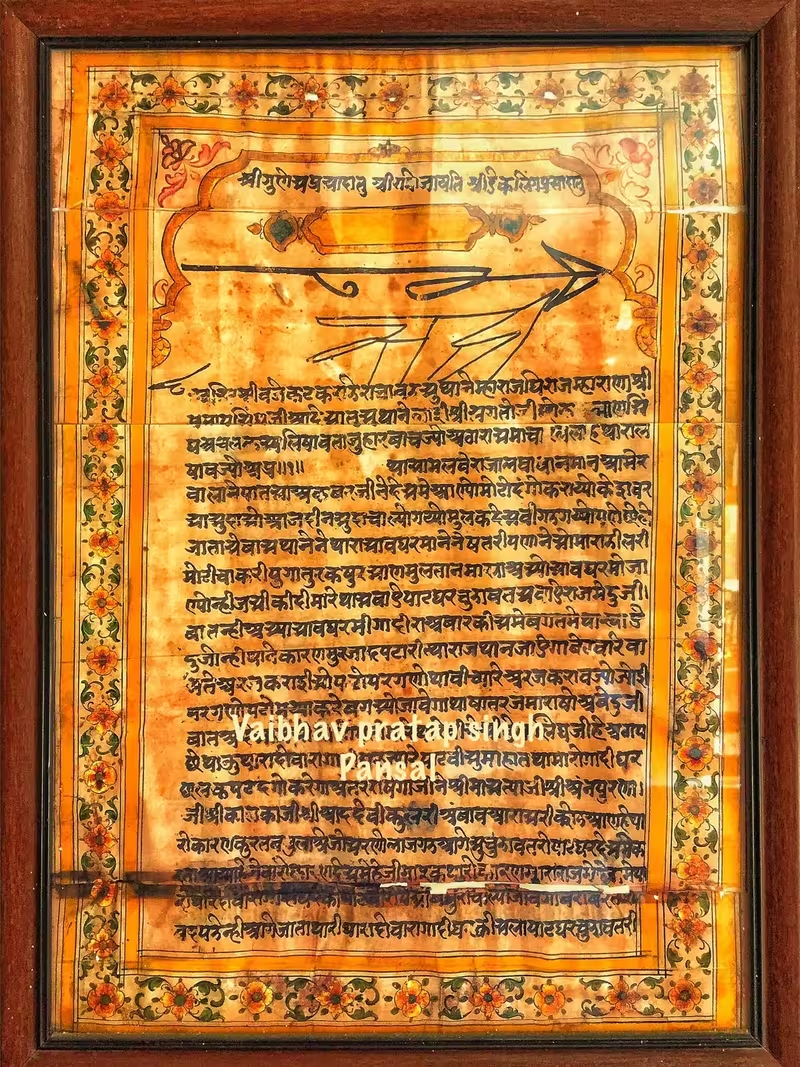
Rajasthani Language: A Western Indo-Aryan Literary Tradition
In 778 CE, Udyotan Suri’s Kuvalaya-mala referred to Maru Bhasa, an early name associated with the language of the desert region. More than a millennium later, Rajasthani remains a group of closely related Western Indo-Aryan languages spoken chiefly in Rajasthan and across adjoining parts of India and Pakistan. The term can refer both to this language group and, in some contexts, to a literary language based largely on Marwari.
Rajasthani includes major varieties such as Marwari, Malvi, Mewari, Dhundhari, Harauti, Nimadi, and Bagri. These varieties are spoken across Rajasthan, Malwa, Nimar, Gujarat, Haryana, Punjab, and parts of Pakistani Punjab and Sindh. Migration has also carried Rajasthani-speaking communities, especially members of the Marwari community, to other parts of India. A smaller Rajasthani-speaking population is recorded in Nepal.
The language has a substantial literary presence. Its traditions include the Dingal style of prose and poetry and the Pingal style of verse. Rajasthani has also developed distinctive grammatical, phonological, and orthographic features, including the use of the retroflex lateral ḷ, represented by ळ. Although the language is recognized by literary and academic institutions, it is not included in the Eighth Schedule of the Constitution of India. Its modern history therefore combines literary continuity with an ongoing movement for official recognition.
Origins and Classification
Linguistic Family
Rajasthani belongs to the Western Indo-Aryan branch of the Indo-Aryan language family. The various Rajasthani languages and dialects form a sub-branch within this larger group. Their classification has been debated because Indian census reporting has often counted many Rajasthani varieties under the broader category of Hindi.
The term Rajasthani can therefore describe a cluster of related languages rather than a single standardized speech form. Linguists and reference works commonly discuss Rajasthani through major varieties such as:
- Marwari
- Malvi
- Mewari
- Dhundhari
- Harauti
- Nimadi
- Bagri
The boundary between a language and a dialect varies according to the framework being used. This variation in classification affects census totals and makes comparisons between different speaker estimates difficult.
Standard Rajasthani, also called Standard Marwari in the supplied descriptions, functions as a common lingua franca among Rajasthani people. It is spoken in different parts of Rajasthan and beyond. Marwari is the most widely spoken individual Rajasthani language, with approximately eight million speakers in the historic Marwar region of western Rajasthan.
Origins
Rajasthani developed from Western Indo-Aryan linguistic traditions. References to a separate language of Rajasthan are as old as the eighth century, although a clearly articulated Rajasthani linguistic identity emerged only in the eighteenth century.
The early name Maru Bhasa, written मरु भासा, appears in connection with Udyotan Suri’s Kuvalaya-mala in 778 CE. Another historical designation, Marudeshi, referred more broadly to the culture of Rajasthan. The term Gurjari or Gurjarati, meanwhile, developed into the name Gujarati.
The historical record described in this tradition reflects a region of multiple kingdoms and local varieties. Rather than developing as a single uniform standard from the beginning, Rajasthani existed through a collection of regional forms used in speech, administration, and literary composition.
Name Etymology
The modern designation Rajasthani was introduced by George Abraham Grierson in 1908. Before that designation, the language was known through its various dialect names and through terms such as Maru Bhasa.
The name Rajasthani connects the language to Rajasthan, the region in which most of its varieties are spoken. The older term Maru Bhasa connects it to Maru, a historical name associated with the desert region. The term Marwari is associated particularly with the Marwar region and is also used for the most widely spoken Rajasthani language.
Historical Development
Early References and Regional Varieties (778 CE onward)
The reference to Maru Bhasa in Kuvalaya-mala provides an early historical marker for the language traditions associated with Rajasthan. This does not mean that a standardized modern Rajasthani already existed in the eighth century. Instead, it shows that a language associated with the region was recognized by name.
For much of its history, Rajasthani was represented through regional forms. The kingdoms of Rajasthan and Malwa used their local Rajasthani varieties for administration. These varieties served official functions from their establishment in the early medieval period until independence from Britain in 1947.
This administrative history is significant because it demonstrates that Rajasthani was not confined to informal speech. Local varieties were used in the practical work of government, even though individual kingdoms could maintain their own regional forms and writing practices.
Emergence of a Linguistic Identity (18th Century)
A distinct Rajasthani linguistic identity emerged during the eighteenth century. This identity developed across a region where several varieties were spoken and where cultural, political, and administrative boundaries did not always correspond to linguistic boundaries.
The term Rajasthani eventually provided a broader label for the varieties of the region. At the same time, Marwari remained especially important as a widely spoken variety and as the principal basis of the literary language referred to as Rajasthani in some contexts.
Grierson and Linguistic Documentation (1908–1920)
George Abraham Grierson played a major role in the modern scholarly classification of Rajasthani. In 1908, he was the first scholar to give the language the designation Rajasthani. His work also documented different regional writing hands, including the Marwari, Bikaneri, Malvi, and Hadauti hands.
The Linguistic Survey of India associated with Grierson is identified as a source for the geographical distribution of Rajasthani and Gujarati. Other scholars later studied particular varieties and regional forms. George Macalister worked on Dhundhari and Shekhawati; L. P. Tessitori studied Rajasthani and Marwari; and later scholars examined Bagri, Bhili, Hadoti, Gade Lohar, Gojri, and other varieties.
Modern Period
After independence in 1947, Rajasthani continued to be spoken across Rajasthan and adjacent regions. Its modern history has been shaped by two developments: institutional recognition and pressure from more dominant languages.
The Sahitya Akademi, India’s National Academy of Letters, lists Rajasthani among the languages in which it conducts literary programs and gives awards. The University Grants Commission also recognizes Rajasthani as a distinct language. It is taught at Maharaja Ganga Singh University in Bikaner, the University of Rajasthan in Jaipur, Jai Narain Vyas University in Jodhpur, Vardhaman Mahaveer Open University in Kota, and Mohanlal Sukhadia University in Udaipur.
Rajasthani has also entered formal education in stages. The state Board of Secondary Education included it in its courses of study, where it has been an optional subject since 1973. In 2019, the Rajasthan Government included Rajasthani as a language subject in the state’s open school system.
Scripts and Writing Systems
Devanagari
In India, Rajasthani is written in the Devanagari script. Devanagari is an abugida written from left to right. Contemporary Rajasthani writing in Devanagari includes features that distinguish it from standard Hindi writing.
One particularly important letter is ळ, representing the retroflex lateral ḷ. It contrasts with ल, representing l. The distinction can affect meaning. The examples given include:
- कालौ, meaning “black color”
- काळौ, meaning “insane”
Rajasthani script practice also reflects the language’s pronunciation. The palatal sounds represented by श and ष are pronounced in Rajasthani, but the script uses the dental स for them. There is no independent sign for ज्ञ; instead, ग्य is written.
Rajasthani orthographic practice also avoids several Sanskrit-style conjunct forms. In place of क्ष, writers may use च, क, or ख according to pronunciation and word form. Examples include:
- लखण for लक्षण
- लिछमण for लक्ष्मण
- राकस for राक्षस
The sound ऋ does not have a separate independent sign in this system. It is written as रि, as in रितु for ऋतु.
Mahajani or Modiya
Before the widespread use of Devanagari, Rajasthani was written in the Mahajani script, also called Modiya. The script is also referred to as Maru Gurjari in some records.
Rajasthani and Gujarati developed cursive and modified forms of Devanagari. The present Gujarati script may be considered a standardized variant of this broader development. Different kingdoms used their own regional hands, and Grierson documented the Marwari, Bikaneri, Malvi, and Hadauti forms.
The variety of hands reflects the administrative and regional history of Rajasthani writing. The language did not rely on a single uniform calligraphic form across all political territories.
Sindhi Script in Pakistan
In Pakistan, where Rajasthani is considered a minor language, Rajasthani dialects are written in a variant of the Sindhi script. This provides a separate modern writing practice from the Devanagari used in India.
Script Evolution
Rajasthani writing demonstrates the relationship between spoken varieties, administrative institutions, and regional script traditions. Earlier writing used Mahajani or Modiya, while modern Indian usage relies primarily on Devanagari. Historical varieties also developed local cursive hands, and Pakistani Rajasthani uses a Sindhi-script variant.
The orthography described for Rajasthani prioritizes local pronunciation in several areas. It commonly avoids ligatures and the traditional ref form. For example:
- धरम is used instead of धर्म
- वगत or वखत may be used instead of वक्त
A single quotation mark can indicate a continuation sound, as in देख'र and हरे'क. The vowels अे and अै may be written in place of ए and ऐ, as in अेक for एक.
Geographic Distribution
Historical Spread
Most Rajasthani languages are spoken in Rajasthan. Their distribution also extends through Gujarat, western Madhya Pradesh, especially Malwa and Nimar, Haryana, and Punjab.
In Pakistan, Rajasthani varieties are spoken in the Bahawalpur division of Punjab and in the Tharparkar district of Sindh. The geographical area of the language group has been documented in the Linguistic Survey of India.
The distribution of Rajasthani reflects both historical regional continuity and movement of communities. The language group is not confined to the political boundaries of the present-day state of Rajasthan.
Migration and Community Use
Rajasthani languages have reached different parts of India through the migration of people from the Marwari community. In these communities, Rajasthani varieties continue to serve as languages of internal communication.
This pattern helps explain why Rajasthani is heard in areas far from its main historical territory. Migration has expanded the social geography of the language without eliminating the importance of Rajasthan as its primary regional center.
Modern Distribution
Standard Rajasthani or Standard Marwari is spoken by more than 25 million people according to the 2011 figure given for different parts of Rajasthan. This total must be treated with care because some Standard Marwari speakers were counted as Hindi speakers in the census.
Marwari has approximately eight million speakers in the historic Marwar region of western Rajasthan. Rajasthani is also spoken to a lesser extent in Nepal, where 25,394 speakers were recorded in the 2011 Census of Nepal.
Because many Rajasthani varieties are grouped under Hindi in Indian census reporting, speaker totals do not always provide a direct comparison between linguistic studies and official population categories.
Literary Heritage
Early and Regional Literature
Rajasthani literary history developed through several regional and stylistic traditions. The early reference to Maru Bhasa in Kuvalaya-mala provides an important historical marker. Later literary activity was connected with regional courts, communities of poets, and distinct performance traditions.
Rajasthani’s literary identity is closely linked to the distinction between Dingal and Pingal. These styles reflect different social and poetic contexts and demonstrate the range of literary forms associated with the language.
Dingal
Dingal is a literary style used for prose and poetry in the Maru-Bhasa tradition. It can be presented in both written and spoken form. Dingal is particularly associated with Charan literary practice and is written in couplets, songs, and poems.
Works mentioned in connection with Dingal include Kushallabh’s Pingali Shiromani and Giridhar Charan’s Sagat Singh Raso, dedicated to Shakti Singh, the younger brother of Maharana Pratap. Dingal was also used in compositions associated with Suryamal Misharan and Baankidas.
The Dingal tradition therefore combines literary composition, oral presentation, and poetic performance. Its forms include not only long written works but also shorter poetic structures suitable for recitation.
Pingal
Pingal was used for writing poetry by Bhats. It represents an amalgamation of Braj Bhasha and Rajasthani. Unlike Dingal, which is described as a style of both prose and poetry, Pingal is specifically associated with verse.
The relationship between Pingal and Braj Bhasha shows that Rajasthani literary culture developed through interaction with neighboring literary languages and traditions. Pingal is therefore part of a wider North Indian poetic environment while retaining its Rajasthani component.
Dictionaries and Scholarly Works
Rajasthani literary and linguistic study includes important dictionary work. Ram Karan Asopa’s Dingal Sabdkosh, a Dingal dictionary associated with Rajasthani and Marwari, was produced between 1890 and 1920.
Other scholars produced studies of individual varieties and the language group as a whole. L. P. Tessitori worked on Rajasthani and Marwari between 1914 and 1916. Grierson studied almost all of the dialects of Rajasthani, and later researchers continued work on Rajasthani, Marwari, Bagri, Hadoti, Bhili, and related varieties.
Modern Literary Presence
Rajasthani has a recognized literary presence beyond state-level activism. The Sahitya Akademi conducts literary programs in Rajasthani and confers awards in the language. This institutional activity supports the continuation of Rajasthani as a literary medium even though national constitutional recognition has not yet been granted.
Grammar and Phonology
Word Order
Rajasthani is head-final, or left-branching. Adjectives precede nouns, direct objects come before verbs, and postpositions follow the nouns or phrases they govern. Its basic word order is subject–object–verb, or SOV.
The language has two genders and two numbers. It has no definite or indefinite articles.
A Rajasthani verb is built from a verbal root followed by suffixes that mark aspect and agreement. This main verbal form may be followed by an auxiliary derived from “to be.” The auxiliary marks tense and mood and can also show agreement.
Rajasthani has morphological causatives, including causatives formed up to a second level, and morphological passives.
Cases and Postpositions
Rajasthani has two numbers and two genders with three cases. Postpositions belong to two categories:
- inflectional postpositions
- derivational postpositions
Derivational postpositions are often omitted in actual discourse.
Rajasthani combines several patterns of case marking. These include nominative–accusative, absolutive–ergative, and tripartite patterns. In a nominative–accusative pattern, transitive and intransitive subjects receive similar marking, distinct from the marking of the transitive object. In an absolutive–ergative pattern, the intransitive subject and transitive object share marking, while the transitive subject differs. In a tripartite pattern, the transitive subject, intransitive subject, and transitive object receive different marking.
The distribution of these patterns is partly related to the type of noun phrase. The likelihood of ergative marking increases along a hierarchy extending from first-person pronouns through second-person pronouns, demonstratives and third-person pronouns, proper nouns, and common nouns. Common nouns can be further considered in terms of human, animate, and inanimate referents.
Agreement
Rajasthani combines accusative and tripartite marking in the nominal system with consistently ergative verbal concord. The verb agrees with both marked and unmarked objects in number and gender, but not in person.
A distinctive split can occur in verbal agreement. The participial part of a predicate may agree with the object noun phrase, while the auxiliary agrees with the agent noun phrase. A stative participle from a transitive verb may also agree with the agent.
Honorific agreement creates another special pattern. An honorific feminine noun can require masculine plural forms in both its modifiers and the verb.
Rajasthani has retained an important feature of ergative syntax that has been lost in other representatives of Modern Western New Indo-Aryan: the agent noun phrase can be freely omitted from a perfective transitive clause.
Relative and Correlative Constructions
Like other Indo-Aryan languages, Rajasthani uses relative-correlative constructions. A modifying clause is often marked by a relative pronoun or adverb, while the main clause contains a corresponding demonstrative.
In Rajasthani, the relative pronoun or adverb may be omitted from the subordinate clause. Unlike some neighboring New Indo-Aryan languages, however, Rajasthani can use the relative pronoun or adverb in place of the correlative.
The relative pronoun jakau can appear not only in relative-correlative constructions but also in complex sentences expressing cause-and-effect relationships.
Passive and Causative Structures
Rajasthani is described as the only Western New Indo-Aryan language in which reflexes of the Old Indo-Aryan synthetic passive have entered the perfective domain.
The language also has causative structures. In general, a second causative implies the addition of a mediator to the argument structure. Some factors, however, prevent an additional agent from being added in particular causative constructions.
Sound System
Rajasthani has 11 vowels and 38 consonants. The Bagri variety has developed three lexical tones: low, mid, and high.
One of the most notable features of Rajasthani phonology is its use of retroflex consonants. These include:
- ṭ, written ट
- ṭh, written ठ
- ḍ, written ड
- ḍh, written ढ
- ṇ, written ण
Retroflex consonants differ from the corresponding dentals:
- t, written त
- th, written थ
- d, written द
- dh, written ध
- n, written न
Rajasthani also frequently uses the retroflex lateral ḷ, written ळ. This sound occurs in Vedic and some Prakrit traditions and is produced by placing the tongue against the upper hard palate and flapping it forward.
Relationship with Hindi
Rajasthani shares approximately 50 to 65 percent lexical similarity with Hindi, based on comparison using a 210-word Swadesh list. It has many cognate words with Hindi, but most pronouns and interrogative words are distinct.
A notable phonetic correspondence is the realization of Hindi /s/ as /h/ in Rajasthani. The example given is Hindi /sona/, “gold,” compared with Marwari /hono/. The /h/ may sometimes be lost.
Vowel substitutions also occur. The Hindi /l/ sound, written ल, is often realized in Rajasthani as the retroflex lateral /ɭ/, written ळ.
Vocabulary and Linguistic Contact
Tadbhav Vocabulary
Modern Indo-Aryan vocabulary is commonly divided into tadbhav, tatsam, loanwords, and words of local origin.
Tadbhav means “of the nature of that.” In Rajasthani, it refers to words of Sanskritic origin that have changed over time and become characteristic of modern Indo-Aryan speech. These words are generally everyday, non-technical vocabulary and form an important part of the spoken vernacular.
Their history reflects the descent of modern Indo-Aryan languages from older Indo-Aryan forms through long periods of linguistic change.
Tatsam Vocabulary
Tatsam means “same as that.” It refers to words borrowed from Sanskrit that retain a relatively pure Sanskrit character. These words are especially important in formal, technical, and religious vocabulary.
Tatsam words may retain Sanskrit inflections and markings and can form a separate grammatical category. Some have changed meaning in modern usage, while others are newly created neologisms or calques. A word meaning “spreading,” for example, may acquire the modern sense “broadcasting.”
Tatsam words and their tadbhav counterparts can coexist. They may differ in form, register, or meaning.
Persian and Arabic
Persian and Arabic have influenced Rajasthani vocabulary through the long history of Persian-speaking Muslim rule in the Indian subcontinent. Persian and Arabic loans entered Indian languages on a large scale, and many became integrated into local grammar.
Examples include:
- dāvo, “claim”
- fāydo, “benefit”
- natījo, “result”
- hamlo, “attack”
These words carry Rajasthani grammatical marking. The masculine ending -o appears in several examples, while khānũ, “compartment,” has the neuter ending -ũ.
Some loanwords have become verbs through combination with Rajasthani verbal morphology. Examples include:
- kabūlnũ, “to admit”
- kharīdnũ, “to buy”
- kharǎcnũ, “to spend”
- gujarnũ, “to pass”
The incorporation of Persian and Arabic vocabulary is therefore not limited to isolated nouns. In some cases, the borrowed forms have been adapted to Rajasthani grammar and verb formation.
English
English became the major newer foreign source of vocabulary after the decline of Persian educational and administrative influence. English loanwords entered Rajasthani through British colonial rule and through the continuing role of English in education, prestige, and social mobility in the Republic of India.
English words can coexist with Rajasthani equivalents or replace them. Speech may include individual English words, expressions, or even complete switched sentences.
English alveolar consonants may be represented as retroflexes rather than dentals. Rajasthani also developed two new characters to represent English /æ/ and /ɔ/. Some loanwords remain close to their English pronunciation, while others undergo greater Rajasthani adaptation.
English nouns may receive Rajasthani plural marking, including plural forms in -o. English words without grammatical gender must also be assigned one of Rajasthani’s three genders in the vocabulary account described here.
Portuguese
Portuguese influence on Rajasthani was smaller than Persian, Arabic, or English influence, but trade introduced a number of Portuguese words. The impact of Portuguese was greater on coastal languages, and Portuguese loans in those languages tend to remain closer to the original forms.
Words Entering English
Some Indian words associated with Gujarati, Hindi, and related regional languages entered English. Examples include:
- bungalow, from Gujarati bangalo, associated with a Bengal-style house
- coolie, from Hindi quli, probably connected with koli
- tank, associated with Gujarati tankh, a cistern or underground reservoir
These histories show how vocabulary connected with the Indian subcontinent moved into English through colonial contact, trade, and everyday administration.
Media and Public Culture
Newspapers
The first newspaper published in Rajasthani was Rajputana Gazette, issued from Ajmer in 1885. Its appearance marked an important stage in the development of Rajasthani print media.
Film, Television, and Radio
The first film made in Rajasthani was Nazrana, released in 1942. In contemporary media, Stage app is identified as the first over-the-top platform in Rajasthani and Haryanvi, while Gangaur TV is identified as the first television channel in Rajasthani.
All India Radio broadcasts and publishes news in Rajasthani. These media institutions extend the language beyond local speech and literary publication into film, digital platforms, television, and radio.
Royal and Religious Patronage
Regional Administration
The historical kingdoms of the Rajasthani-speaking region, including kingdoms in Malwa, used their local Rajasthani varieties as official languages of administration. This practice continued from the early medieval period until independence from Britain in 1947.
The historical record does not describe one single royal standard imposed across the entire region. Instead, individual kingdoms used local forms and their own writing hands. The Marwari, Bikaneri, Malvi, and Hadauti hands documented by Grierson illustrate this regional diversity.
Literary Communities
Rajasthani literary development was supported by communities and literary traditions associated with Charans and Bhats. Dingal is described as a literary genre of the Charans, while Pingal was used for poetry by Bhats.
These traditions connected language with oral performance, courtly and regional culture, poetry, and transmission through recitation. Their importance lies not only in the existence of written texts but also in the social settings through which verse and song circulated.
Modern Status
Current Speakers
Standard Rajasthani or Standard Marwari is spoken by more than 25 million people in different parts of Rajasthan according to the 2011 figure given for the language. Marwari has approximately eight million speakers in the historic Marwar region of western Rajasthan.
These figures should be interpreted in light of census classification. Many Rajasthani varieties are recorded under the broader Hindi category in Indian census reporting, and some Standard Marwari speakers are counted as Hindi speakers. Consequently, linguistic descriptions often treat Rajasthani as a language cluster rather than relying on one single census total.
Nepal’s 2011 census recorded 25,394 Rajasthani speakers.
Official Recognition
Rajasthani has not been included in the Eighth Schedule of the Constitution of India. National recognition has therefore lagged behind its use by millions of speakers and its literary and academic recognition.
The Sahitya Akademi and University Grants Commission recognize Rajasthani as a distinct language. It is taught at several universities in Rajasthan, and the state Board of Secondary Education has included it as an optional subject since 1973.
In 2003, the Rajasthan Legislative Assembly unanimously passed a resolution seeking the inclusion of Rajasthani in the Eighth Schedule. Support has also been voiced by all 25 Members of Parliament elected from Rajasthan and by former Chief Minister Vasundhara Raje Scindia.
In 2015, a senior member of the Rajasthani Bhasha Manyata Samiti stated that twelve years had passed without forward movement on the recognition demand. In March 2023, the Government of Rajasthan formed a committee to make Rajasthani an official language of the state following protests by young people associated with the Rajasthani Yuva Samiti.
Preservation Efforts
The campaign for recognition has continued since Indian independence. Its aims include adding Rajasthani to the Eighth Schedule and making it the official language of Rajasthan. The movement has become increasingly rooted among younger people.
Other preservation and development efforts include:
- teaching Rajasthani as an optional school subject
- introducing Rajasthani into the state open school system
- university-level teaching
- literary programs and awards through the Sahitya Akademi
- radio, television, film, and digital media production
- linguistic documentation of regional varieties
Challenges
Rajasthani faces several pressures. Its classification under Hindi in official documents and census reporting can obscure its separate identity and make speaker totals difficult to compare.
The language group’s internal diversity also creates standardization challenges. Marwari, Mewari, Shekhawati, Hadoti, and other varieties do not always share one standardized form. This diversity is culturally important but can complicate educational planning, publishing, and official language policy.
Hindi and English dominate much formal education, while urbanization and migration can encourage speakers to prioritize languages associated with economic and social opportunity. These pressures may reduce the transmission of Rajasthani within families.
The language also faces limited representation in mainstream media and restricted contemporary publishing. Younger generations may increasingly use Hindi or English in daily life, placing intergenerational transmission at risk.
Learning and Study
Academic Study
Rajasthani has been studied by linguists working on both the language group and individual regional varieties. Important scholars and areas of study include:
- Ram Karan Asopa, Dingal Sabdkosh, covering Dingal, Rajasthani, and Marwari
- George Macalister, Dhundhari and Shekhawati
- L. P. Tessitori, Rajasthani and Marwari
- George Abraham Grierson, almost all Rajasthani dialects
- Suniti Kumar Chatterjee, Rajasthani
- W. S. Allen, Harauti and Rajasthani
- Christopher Shackle, Bagri
- David Magier, Marwari
- Peter E. Hook, Rajasthani and Marwari
- Anvita Abbi, Bagri
- Amitabh V. Dwivedi, Hadoti
- Gulab Chand, Hadoti
Later scholars have continued work on Rajasthani, Marwari, Bagri, Bhili, Gade Lohar, Gojri, Hadoti, and other varieties.
Educational Resources
Rajasthani can be studied through university programs, school courses, literary publications, dictionaries, linguistic surveys, radio broadcasts, and digital media. The Devanagari writing system is central to contemporary Indian use, while the study of Mahajani or Modiya and historical regional hands remains important for understanding older records.
The language’s literary styles also offer distinct fields of study. Dingal can be approached through its prose, couplets, songs, and poems, while Pingal provides a way to study the interaction between Braj Bhasha and Rajasthani poetic traditions.
Conclusion
Rajasthani is a group of Western Indo-Aryan languages with deep roots in the linguistic and cultural history of Rajasthan. Its early association with the name Maru Bhasa, its emergence as a recognizable linguistic identity in the eighteenth century, and Grierson’s designation of Rajasthani in 1908 mark important stages in its historical development.
The language’s identity is expressed through regional varieties such as Marwari, Malvi, Mewari, Dhundhari, Harauti, Nimadi, and Bagri; through distinctive grammar and retroflex sounds; and through writing traditions that include Devanagari, Mahajani, Modiya, and a Sindhi-script variant. Its literary heritage includes Dingal and Pingal, while its modern presence extends through education, newspapers, film, television, radio, and digital media.
Rajasthani is widely spoken and institutionally recognized in literary and academic settings, but it remains outside the Eighth Schedule of the Constitution of India. Its future depends on continued literary production, educational use, media representation, documentation of its varieties, and the sustained efforts of speakers seeking official recognition.