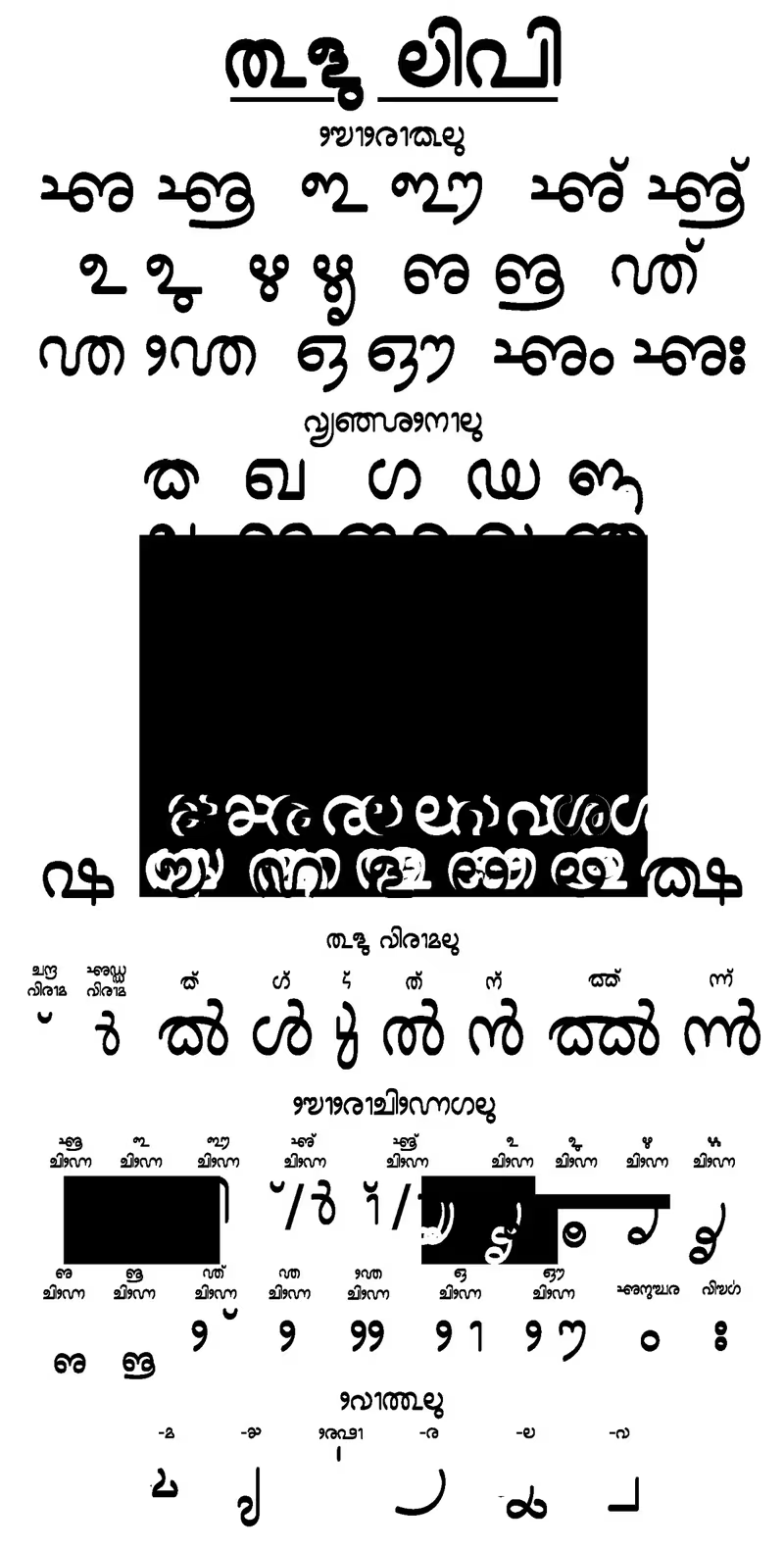
Tigalari Script: A Grantha-Derived Manuscript Tradition
A stone inscription dated 1159 CE at the Sri Veeranarayana temple in Kulashekara provides the oldest recorded example of Tigalari: a complete text in the script and in the Tulu language. From its historical heartland in Canara and the Western Hilly regions of Karnataka, Tigalari served as a vehicle for Tulu, Kannada, and Sanskrit. Its most extensive use was religious and scholarly. Tulu-speaking Shivalli Brahmins and Kannada-speaking Havyaka and Kota Brahmins used it to write Vedic mantras and Sanskrit religious texts, while thousands of surviving manuscripts preserve Vedas, Upanishads, Jyotisha, Dharmashastra, Purana, and other works.
Tigalari evolved from the Grantha script and is closely related to Malayalam, which developed from the same broader Grantha tradition. In its historical use, Tigalari was especially associated with Sanskrit, although Tulu and Kannada works are also preserved in it. The script’s use diminished when Kannada became the principal script for printed Tulu publications after the Basel Mission Press introduced Kannada printing in 1834. Today, Tigalari remains in use in parts of the Kanara region and in traditional maṭhas, while museums, manuscript libraries, cultural organisations, and Tulu speakers work toward its preservation and revival.
Origins and Classification
Script Classification
Tigalari is a Southern Brahmic script. It was used to write three languages identified in historical records associated with the script: Tulu, Kannada, and Sanskrit. Its principal historical function was the writing of Sanskrit, particularly Vedic texts and religious material.
Tigalari is not described as a spoken language in its own right. Rather, it is a writing system that served several linguistic communities. Its regional use connected Tulu-speaking Brahmins in the coastal and southern Karnataka area with Kannada-speaking Brahmin communities in the Malanadu region. Manuscripts in the script were also preserved in parts of Kerala.
Origins
According to Arthur Coke Burnell, a form of the Grantha alphabet originally used in the Chola dynasty reached the southwestern coast of India during the eighth or ninth century. In the relatively secluded southwestern region, where communication with the eastern coast was limited, the writing system underwent gradual modification.
This development produced what has been described as the Tigalari–Malayalam script. The system was used by Malayali, Havyaka Brahmin, and Tulu Brahmin communities and was originally used primarily for Sanskrit. Over time, it divided into two scripts: Tigalari and Malayalam. Malayalam was extended and modified for the vernacular language Malayalam, while Tigalari continued to be used chiefly for Sanskrit.
Name Etymology and Regional Names
The name of the script varies according to regional, linguistic, and historical usage. Tigalari is the name most commonly found in manuscript catalogues and academic publications. Gunda Jois, drawing on stone inscriptions, palm-leaf manuscripts, and early research by western scholars such as B. L. Rice, concluded that Tigalari was the only historical name used for the script.
In Kannada-speaking parts of the Malnad region, it is called Tigalari lipi. Tulu speakers call it Tulu lipi, and in the coastal regions of Karnataka it is commonly known as the Tulu script or Tulu Grantha script. A Tulu Ramayana manuscript in the Dharmasthala archives refers to the writing system as Tigalari Lipi.
In Kerala, the script is called Arya Ezhuttu. The more recently coined term Grantha Malayalam is also used. Arya Ezhuttu covers a range extending from the older form identified with Tigalari to the form standardised through Malayalam printing types in Kerala. The name Arya Ezhuttu means “Arya writing”; in the historical explanation of the term, Sanskrit is an Indo-Aryan language while Malayalam is a Dravidian language.
Historical Development
Grantha-Derived Formation (8th–10th Centuries CE)
Tigalari’s early development belongs to the wider history of Grantha-derived scripts in southern India. A Grantha form reached the southwestern coast in the eighth or ninth century and developed under regional conditions. The resulting writing system displayed a relationship to Malayalam that remains visible in their letter forms and writing practices.
It is assumed that a single script, sometimes called Western Grantha, developed from Grantha around the ninth or tenth century before later dividing into Tigalari and Malayalam. This relationship explains why the two scripts are frequently discussed together.
Early Inscriptional Evidence (1159 CE and After)
The oldest record of Tigalari usage is a stone inscription at the Sri Veeranarayana temple in Kulashekara. It is dated to 1159 CE and is written completely in Tigalari script and the Tulu language.
Other Tulu inscriptions from the fifteenth century are also written in Tigalari. These inscriptions demonstrate that the script was not restricted to Sanskrit manuscripts. Although its dominant manuscript tradition was Sanskrit, Tigalari also served as a medium for Tulu writing over several centuries.
Manuscript Tradition
Thousands of manuscripts have been found in Tigalari. Their subjects include the Vedas, Upanishads, Jyotisha, Dharmashastra, Purana, and other Sanskrit works. Many of the manuscripts are religious or scholarly, reflecting the script’s close association with Brahminical learning and the preservation of Vedic materials.
The manuscript record also includes Kannada and Tulu works. Gokarna Mahatmyam is an example of a Kannada manuscript preserved in Tigalari. The sixteenth-century Kaushika Ramayana, written in Old Kannada by Battaleshwara of Yana in Uttara Kannada, is also found in the script. The Mahabharato, written in Tulu and dated to the fifteenth century, represents another part of the tradition. Earlier Sanskrit manuscripts associated with Madhvacharya, from the twelfth and thirteenth centuries, are also found in Tigalari.
Decline of Printing Use
The role of Tigalari changed substantially during the nineteenth century. The Basel Mission Press introduced Kannada script for printing in 1834. After this, Kannada became the script generally followed for published Tulu works.
In 1872, Basel missionary Brigel wrote that Tulu had no literature “in the proper sense of the word” and no independent writing system, while also noting the use of a modification of the Malayalam alphabet. Missionary Männer similarly wrote in 1886 that Tulu had no literature apart from some legends written on palm leaves in “Malayalam character.” He stated that this alphabet had been in use until the mission introduced Kannada printing. The New Testament was translated into Tulu and printed in Kannada script in 1847.
According to Vaishnavi Murthy, the introduction of Kannada printing presses contributed to the disappearance of the traditional Tulu script because Kannada became the writing system used for publishing Tulu works.
Modern Revival
Although use declined, Tigalari did not disappear entirely. It remains in use in parts of the Kanara region and in traditional maṭhas of the former Dakshina Kannada and Uttara Kannada districts. The National Mission for Manuscripts has organised workshops on the script, while Dharmasthala and the Ashta Mathas of Udupi have undertaken significant preservation work.
Tulu speakers have shown increasing interest in reviving the script. The Karnataka Tulu Sahitya Academy holds meetings with experts on standardisation and has introduced Tulu, written in Kannada script, as well as Tigalari script in schools across the Mangalore and Udupi districts. The academy provides instructional manuals and conducts workshops. In parts of the Tulu Nadu region, signboards are also being installed in Tulu script.
Scripts and Writing Systems
Tigalari
Tigalari is a Southern Brahmic script descended from Grantha. It was used for Tulu, Kannada, and Sanskrit, with Sanskrit forming the largest part of the manuscript record. It was particularly suited to the preservation of Vedic mantras, Vedic texts, religious works, and other Sanskrit scholarship.
The script includes independent vowels, vowel diacritics, consonants, signs, and punctuation. Its relationship to Malayalam is especially close. Tigalari and Malayalam resemble each other in individual letters and in their use of consonant conjuncts, which are employed less extensively than in some other Indic scripts.
Malayalam and Arya Ezhuttu
Malayalam developed alongside Tigalari from a shared Grantha-derived tradition. In the historical account associated with Burnell, the two scripts emerged from the earlier Tigalari–Malayalam writing system. Malayalam was adapted for the vernacular Malayalam language, while Tigalari was used mainly for Sanskrit.
In Kerala, the older form of this writing tradition is called Arya Ezhuttu or Grantha Malayalam. The terminology reflects the continuity between older forms of the script and the Malayalam script as it became standardised through printing types.
Script Evolution
The history of Tigalari can therefore be understood as a process of regional adaptation. Grantha provided the earlier model; a western form developed on the southwestern coast; and this tradition eventually separated into Tigalari and Malayalam. Tigalari retained a strong association with Sanskrit and manuscript transmission, while Malayalam developed as the principal script for Malayalam vernacular writing.
In September 2024, Tigalari was added to the Unicode Standard in version 16.0. Its Unicode block is named Tulu-Tigalari and occupies the range U+11380–U+113FF.
Geographic Distribution
Historical Spread
Tigalari was used across Canara and the Western Hilly regions of Karnataka. Manuscripts have been found in North Canara, Udupi, South Canara, Shimoga, Chikkamagaluru, and Kasaragod district of Kerala. The number of manuscripts found across this region is described as innumerable.
The major language of the manuscripts is Sanskrit. Important subject areas include the Veda, Jyotisha, and Sanskrit epics. Tulu and Kannada works are also represented.
Centers of Learning and Preservation
Honnavar in Uttara Kannada is known for Samaveda manuscripts. Dharmasthala preserves Tigalari materials, including the Tulu Ramayana manuscript that identifies the script as Tigalari Lipi. Other collections are found at Ramachandrapura Matha of Hosanagar, Sonda Swarnavalli Matha of Sirsi, and the Ashta Mathas of Udupi.
Modern Distribution
Today, the script survives in parts of the Kanara region and in traditional maṭhas of the former Dakshina Kannada and Uttara Kannada districts. The strongest contemporary revival activity is associated with Tulu-speaking areas, especially around Mangalore and Udupi. The Karnataka Tulu Sahitya Academy has supported school instruction, manuals, workshops, expert consultations, and the installation of Tulu-script signboards.
Literary Heritage
Tulu Epics
Two Tulu epics from the seventeenth century, Sri Bhagavato and Kaveri, were written in Tigalari. They belong to the same regional manuscript tradition as earlier Tulu inscriptions and demonstrate that the script could be used for extended literary compositions in Tulu.
The fifteenth-century Mahabharato, also in Tulu, is another major example. These works challenge descriptions of Tulu as having no writing system by demonstrating the existence of texts written on palm leaves in the traditional script.
Kannada Works
Tigalari was also used for Kannada manuscripts. Gokarna Mahatmyam is one such example. The sixteenth-century Kaushika Ramayana, written in Old Kannada by Battaleshwara of Yana in Uttara Kannada, is a particularly notable work preserved in the script.
Vedic and Religious Texts
The most substantial part of the Tigalari manuscript heritage consists of Sanskrit works. These include the Vedas, Upanishads, Dharmashastra, Purana, and religious texts. Tulu-speaking Shivalli Brahmins and Kannada-speaking Havyaka and Kota Brahmins used the script for Vedic mantras and Sanskrit religious writing.
Tantric and Śaiva Texts
The Oriental Research Institute in Mysore preserves manuscripts including Sharadatilaka in Tigalari. This work is a treatise on the theory and practice of Tantric worship. Its author, Lakshmana Deshikendra, is said to have written it as an aid for worshippers unable to study the more extensive Tantra texts. The composition presents the substance of major Tantra classics in verse.
The French Institute of Pondicherry also preserves Tigalari manuscripts. Its collection includes approximately 8,600 palm-leaf codices, most in Sanskrit and Grantha, with others in Tamil, Malayalam, Telugu, Nandinagari, and Tigalari. A Shaiva Agama manuscript in Tigalari came from southern Karnataka and was copied in the eighteenth century on sritala palm leaves.
Grammar and Phonology
Key Features
Tigalari is a script rather than a language, so grammatical and phonological features belong to the languages written in it. The historical record identifies Tulu, Kannada, and Sanskrit as languages written in Tigalari.
The script’s character inventory includes independent vowels, vowel diacritics, consonants, signs, and punctuation. It is also associated with the use of consonant conjuncts. Compared with other Indic scripts, Tigalari and Malayalam are described as using consonant conjuncts less extensively.
Sound System
The available historical description focuses on the script’s letters and writing conventions rather than on a separate Tigalari sound system. Comparative charts discuss consonants such as ka, kha, ga, gha, and ṅa alongside their forms in Grantha, Malayalam, Kannada, and Sinhala.
Influence and Legacy
Relationship with Malayalam
Tigalari and Malayalam are sister scripts that developed from Grantha. Their close resemblance is visible both in individual letters and in the treatment of consonant conjuncts. The shared history of Tigalari, Malayalam, and Arya Ezhuttu illustrates the regional diversification of Grantha-derived writing systems.
Relationship with Tulu and Kannada
Tigalari provided a manuscript medium for both Tulu and Kannada, although its strongest historical association was with Sanskrit. The survival of Tulu epics, inscriptions, and legends in the script provides evidence of an older written tradition that was later overshadowed by Kannada printing.
The introduction of Kannada script for printing Tulu in the nineteenth century changed the course of Tulu publishing. Modern revival initiatives now seek to restore awareness of Tigalari while continuing to recognise the established role of Kannada in written Tulu.
Cultural Impact
Tigalari preserves a broad record of religious, literary, scientific, and practical knowledge. Manuscripts in the script cover Vedic ritual, astrology, astronomy, medicine, mathematics, veterinary science, history, art, and dharmaśāstra. Its legacy is therefore not limited to religious writing; it also records the intellectual activities of institutions and communities across the southwestern region.
Royal and Religious Patronage
Religious Institutions
The script’s preservation is closely connected with temples, maṭhas, Brahmin communities, and manuscript libraries. The Sri Veeranarayana temple at Kulashekara preserves the earliest recorded Tigalari inscription. Dharmasthala, the Ashta Mathas of Udupi, Ramachandrapura Matha, and Sonda Swarnavalli Matha are among the institutions associated with its preservation.
Tulu-speaking Shivalli Brahmins and Kannada-speaking Havyaka and Kota Brahmins historically used Tigalari for Vedic mantras and Sanskrit religious texts. This liturgical function helped maintain the script in manuscript traditions even as its public and printed use declined.
Manuscript Libraries
The Keladi Museum and Historical Research Bureau in Shimoga has a library containing about a thousand paper and palm-leaf manuscripts in Kannada, Sanskrit, Tamil, and Telugu, in addition to about four hundred palm-leaf manuscripts in Tigalari. The Tigalari collection covers literature, art, dharmaśāstra, history, astrology, astronomy, medicine, mathematics, and veterinary science.
The Saraswathi Mahal Library in Thanjavur contains manuscripts in numerous scripts, including Grantha, Devanagari, Telugu, Malayalam, Kannada, Tamil, Tigalari, and Oriya. These collections place Tigalari within the wider manuscript culture of southern India.
Modern Status
Current Use
The extent of contemporary Tigalari use is not represented by a recorded speaker population because Tigalari is a script used to write several languages. Its usage has decreased, but it remains in parts of the Kanara region and in traditional maṭhas.
Preservation Efforts
The National Mission for Manuscripts has conducted workshops on Tigalari. Museums and research institutes preserve manuscripts, while Dharmasthala and the Ashta Mathas of Udupi have undertaken significant work to protect the script’s heritage.
The Karnataka Tulu Sahitya Academy has introduced Tigalari script in schools across Mangalore and Udupi districts. It publishes instructional manuals, organises teaching workshops, and consults experts about standardisation. There is also support from local legislators for popularising the script, and Tulu Nadu communities have begun installing signboards in Tulu script.
Unicode Recognition
Unicode recognition gives Tigalari a contemporary digital presence. The script was added to Unicode version 16.0 in September 2024 under the block name Tulu-Tigalari, covering U+11380–U+113FF.
Learning and Study
Academic Study
Tigalari has been examined through inscriptions, palm-leaf manuscripts, manuscript catalogues, and palaeographic research. Gunda Jois studied the script for more than four decades and used evidence from inscriptions, manuscripts, and early western scholarship to investigate its historical name and development.
Comparative study places Tigalari alongside Grantha, Malayalam, Kannada, and Sinhala. The relationship with Malayalam is especially important for understanding the division of the older Grantha-derived tradition into regional scripts.
Resources
The Karnataka Tulu Sahitya Academy provides instructional manuals and conducts workshops. It has also introduced Tulu written in Kannada script and Tigalari script in schools in the Mangalore and Udupi districts. Further resources are associated with publications and instructional books for learning Tigalari, including lessons on Tulu alphabets and Tulu lipi.
Conclusion
Tigalari is a Grantha-derived Southern Brahmic script whose history reaches from an 1159 CE Tulu inscription to the Unicode Standard of 2024. It served as a major manuscript script for Sanskrit Vedic and religious texts, while also preserving important Tulu and Kannada works. Its historical distribution extended across Canara, the Western Hilly regions of Karnataka, and parts of Kerala.
The script’s decline followed the introduction of Kannada printing for Tulu in the nineteenth century, but its manuscript heritage remains extensive. Collections at Keladi, Mysore, Thanjavur, Pondicherry, Dharmasthala, and several religious institutions preserve evidence of its use in literature, ritual, science, medicine, and mathematics. Contemporary workshops, school programmes, instructional manuals, expert consultations, and digital encoding have created new opportunities for its study and revival. Tigalari therefore remains both a record of regional intellectual history and a living focus of cultural preservation.