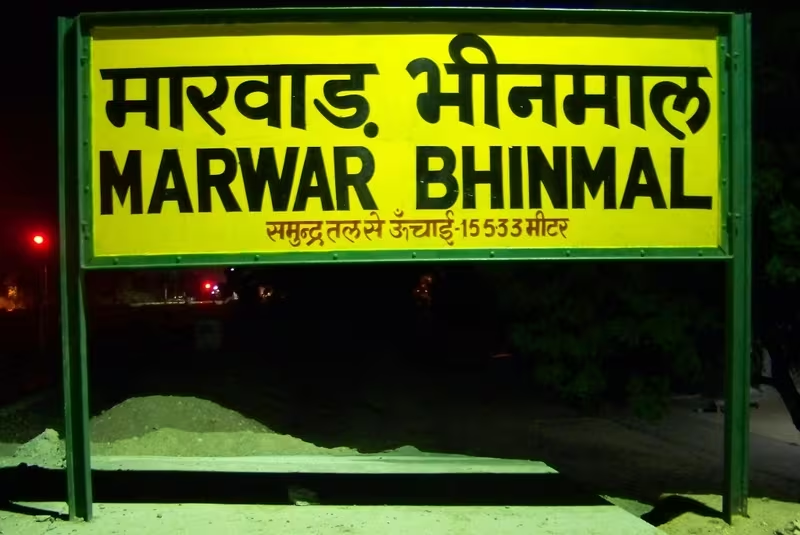
Overview
At 25.0°N and 72.25°E, in Rajasthan’s Jalore district, stands Bhinmal—the modern town known in earlier centuries as Shrimal or Srimal. Its history reaches across political, religious and intellectual traditions. Bhinmal was described as the early capital of the Gurjara-Pratihara dynasty, and the wider kingdom associated with it covered parts of modern southern Rajasthan and northern Gujarat.
The town is also remembered for its association with two major literary and scientific figures. Sanskrit poet Magha was born here, while the mathematician-astronomer Brahmagupta is connected with Bhinmal and is believed to have written his celebrated treatise in 628 CE during the reign of the ruler Vyāgrahamukha. Jain traditions further describe Shrimal as a centre from which the Shrimali clan and its religious communities spread across Rajasthan.
Bhinmal’s history was shaped by competition among regional powers. It was mentioned by the Chinese pilgrim Xuanzang in the seventh century, attacked by Arab governors in the eighth, and later drawn into the expansion of the Pratiharas, the Parmaras and other ruling houses. Although its political centrality changed over time, its name continued through religious communities, local traditions and historical memory.
Etymology and Names
The older name of Bhinmal was Shrimal, also written as Srimal. The Shrimali Brahmins took their name from this town, and merchants associated with it were known as Shrimali Vaniyas. The name therefore survived not only in historical records but also in the identities of communities that later settled in different parts of Rajasthan.
The origin of the name Bhinmal is not certain. One explanation connects it with the town’s Bhil population. Another account, preserved in the Shrimalamahatmaya, links the name to the poverty and depopulation said to have followed invasions, after which many residents migrated. These explanations belong to different historical and literary traditions and should not be treated as a settled etymology.
Xuanzang, who travelled in India between 631 and 645 CE during the reign of Harsha, recorded the place as Pi-lo-mo-lo. His description is generally identified with Bhillamala, another form of the town’s name. These variations reflect the movement of the name between Sanskrit, regional and foreign records.
Geography and Location
Bhinmal lies 72 kilometres south of Jalore in present-day Rajasthan. Historically, its position connected the political world of southern Rajasthan with northern Gujarat and the western Indian kingdoms of Sindh, Lata and Malava. Xuanzang distinguished the Gurjara country from neighbouring Bharukaccha, Ujjayini, Malava, Valabhi and Surashtra.
The town’s historical importance therefore did not rest only on its local settlement. It stood within a wider zone of movement and rivalry linking Rajasthan, Gujarat, Malwa and Sindh. This geography helps explain why Bhinmal became both a political centre and a target during the Arab campaigns of the early eighth century.
Ancient History
Jain scriptural and later sectarian accounts place Shrimal within a much older religious history. Accounts of Acharya Swayamprabhasuri describe his visit to Rajasthan 57 years after Mahavira’s nirvana, traditionally dated to 527 BCE. This would place the visit to Shrimal around 470 BCE. The chronology belongs to Jain tradition and is not independently fixed by the surviving political records.
According to these accounts, Jain and Buddhist monks had not widely preached in the difficult desert region, where Brahmins were said to have held religious influence. The town was described as a centre of practices associated with the Kundapanth and Caliyapanth traditions. Swayamprabhasuri is said to have come to Shrimal after meeting merchants from the town near Mount Abu.
The story relates that preparations were under way for an Ashvamedha sacrifice when the teacher arrived. After a debate with the Brahmin leader, Swayamprabhasuri is said to have persuaded King Jayasen and 90,000 households to adopt non-violence and, eventually, Jainism. The account also credits him with consecrating a temple and image of Rishabhanatha, the first Tirthankara, and with organizing a pilgrimage procession to Palitana.
These narratives describe the religious memory of Shrimal rather than a securely dated political history. They remain important because they explain how Jain communities associated their origins with the town and why the name Śrīmali became attached to a wider clan.
Historical Timeline
Gurjara Country and Xuanzang
Bhinmal’s political prominence is especially visible in seventh-century accounts. The town was the capital of the Gurjara country, called Kiu-che-lo by Xuanzang, and was described as the second-largest kingdom of western India. Its ruler was portrayed as a young Kshatriya, about 20 years old, known for wisdom and courage. The kingdom was said to measure 833 miles in circuit.
The identity of this ruler is not firmly established. It has been suggested that he may have been the immediate successor of Vyāgrahamukha, the Chavda ruler under whom Brahmagupta wrote his treatise in 628 CE. This connection remains an interpretation rather than a conclusive identification.
The Gurjara kingdom was already known in the seventh century. Harshacharita, composed by Banabhatta, mentions the Gurjaras and records that their king was defeated by Prabhakaravardhana, the father of Harsha, who died around 605 CE. The surrounding political geography indicates a kingdom extending through parts of present-day southern Rajasthan and northern Gujarat.
Arab Campaigns
The Arab conquest of Sindh in 712 CE brought Bhinmal into the campaigns of governors based in the newly established Arab province. Arabic chroniclers referred to the region as Al-Baylaman, alongside Mermad, identified with Marumada in western Rajasthan. The country was first attacked by Muhammad bin Qasim between 712 and 715 and later by Junayd between 723 and 726.
After bin Qasim’s victory, the chronicler al-Baladhuri stated that Indian rulers, including the ruler of Bhinmal, accepted Islam and paid tribute. The account suggests that these arrangements did not last after bin Qasim’s departure. Junayd’s later campaign was therefore presented as a reconquest. Following this attack, the kingdom centred on Bhinmal appears to have been annexed by the Arabs, although the precise extent and duration of this control remain difficult to establish.
Rise of the Pratiharas
A new dynasty emerged at Jalore, near Bhinmal, around 730 CE. Its founder, Nagabhata I, is credited in different accounts with defeating the “invincible Gurjaras”—possibly referring to the rulers of Bhinmal—or with defeating a Muslim ruler. He is also remembered for repelling a later major Arab attack.
The Gwalior inscription of Mihira Bhoja praises Nagabhata in highly symbolic language. It presents him as a protector who destroyed the armies of the mlecchas, a term used in the inscription for the enemies of the dynasty. Such inscriptions combine political memory with royal praise, but they show how the Pratiharas represented their military role in western India.
The Pratihara dynasty expanded towards Ujjain. Nagabhata’s successor Vatsaraja later lost Ujjain to the Rashtrakuta prince Dhruva, who claimed to have driven him into a “trackless desert.” An inscription from Daulatpura dated 843 CE records Vatsaraja making grants near Didwana. In later centuries, the Pratiharas became the dominant power across substantial parts of Rajasthan and Gujarat and established an empire centred at Kannauj, the former capital of Harshavardhana.
Parmara Control and Later Pratiharas
By the late tenth century, Bhinmal was involved in another regional contest. Raja Man Pratihar ruled Bhinmal in Jalore when the Parmara emperor Vakpati Munja, who ruled between 972 and 990 CE, invaded the region. After the conquest, the territories were divided among Parmara princes. Aranyaraj Parmar received the Abu region, while Chandan Parmar and Dharnivarah Parmar received the Jalore region.
Raja Man Pratihar’s son, Dewalsimha Pratihar, was a contemporary of Mahipal Parmar of Abu, who ruled from 1000 to 1014 CE. Dewalsimha made unsuccessful efforts to recover Bhinmal or restore Pratihara authority. He eventually established himself southwest of the town, in a territory associated with four hills—Dodasa, Nadwana, Kala-Pahad and Sundha—and made Lohiyana, now identified with Jaswantpura, his capital.
Political Significance
Bhinmal’s political importance arose from its position as the early capital of the Gurjara-Pratihara kingdom. The town was connected to a polity that occupied the borderlands between Rajasthan and Gujarat and confronted powers from Sindh, Malwa and the Deccan.
Its history also illustrates how political authority could move without erasing older identities. Even after the Pratiharas expanded towards Ujjain and Kannauj, and after Parmara power reshaped the region, Bhinmal remained present in dynastic claims, local traditions and community names.
The later Dewal Pratiharas continued to hold territory around Jalore. According to the historical tradition preserved in the account, they participated in Jalore’s resistance against Alauddin Khilji. This connects Bhinmal’s regional political legacy with the later history of Jalore and the Delhi Sultanate.
Religious and Cultural Importance
Bhinmal’s cultural reputation rests on several overlapping traditions. It was associated with Jain teachers, the Shrimali clan, the Mahalakshmi tradition and the Sanskrit literary world. The town’s Mahalakshmi image was moved to Patan in 1147, after Vanaraja Chavda had established a new capital there. This movement marked a shift in the symbolic centre of the communities connected with Shrimal.
Bhinmal is also associated with the poet Magha, author of the Sanskrit epic Shishupala-vadha, and with Brahmagupta, one of India’s best-known mathematician-astronomers. Brahmagupta’s treatise was written in 628 CE under Vyāgrahamukha. The connection between the scholar and Bhinmal is an important part of the town’s intellectual heritage.
Monuments and Architecture
The monuments associated with Bhinmal include Dadeli Baori and the Mahalakshmi Kamaleshvari Temple at Dhora Dhal. These sites preserve the town’s continuing religious and architectural traditions.
The Shri Parshwanath temple is particularly notable for the discovery made during construction work in 2002. A temple structure about 450 years old was unearthed, containing five white-marble images of Jain Tirthankaras. The discovery adds a material dimension to Bhinmal’s long association with Jain communities and sacred memory.
Decline, Transformation and Modern City
Bhinmal’s political role changed as power shifted towards Jalore, Ujjain, Kannauj, Patan and other regional centres. The movement of the Mahalakshmi image to Patan in 1147 is one indication that the town’s symbolic importance was being redistributed. Yet Bhinmal did not disappear from history. Its name continued through Shrimali communities, Jain traditions, local temples and accounts of regional resistance.
Today Bhinmal is a town in Jalore district. According to the 2011 Census figure given for the town and its associated area, the population was 302,553, including 254,621 rural residents and 47,932 urban residents. Literacy was recorded at 53.6 percent, with male literacy at 70.2 percent and female literacy at 36.8 percent. The town has a Vidhan Sabha constituency and a separate District Transport Office with vehicle registration code RJ-46.
Bhinmal’s modern cultural presence also includes documentary film. My Beautiful Village Bhinmal, made by Azad Jain, received the Best Documentary-Writing Award at the Rolling Frames Short Film Summit in Bangalore in 2014. It was screened at festivals in India and Europe, presenting the town and its people to audiences beyond Rajasthan.
Timeline
Traditional Jain chronology
Jain accounts place Acharya Swayamprabhasuri’s visit to Shrimal around 470 BCE.
Gurjara kingdom in early records
Banabhatta’s account refers to the Gurjaras and their conflict with Prabhakaravardhana.
Brahmagupta’s treatise
Brahmagupta is associated with Bhinmal and is said to have written his treatise under Vyāgrahamukha.
Xuanzang’s account
Xuanzang recorded the Gurjara country and its capital at Bhillamala, identified with Bhinmal.
First Arab campaign
Muhammad bin Qasim’s conquest of Sindh extended into campaigns involving Bhinmal.
Junayd’s campaign
Arab governor Junayd attacked the region again, and Bhinmal’s kingdom appears to have been annexed.
Rise of Nagabhata I
A Pratihara dynasty emerged at nearby Jalore and is credited with defeating regional and Arab opponents.
Parmara invasion
Vakpati Munja invaded the region and distributed conquered territories among Parmara princes.
Mahalakshmi image moved
The principal Mahalakshmi image associated with Bhinmal was moved to Patan.
Jain temple structure discovered
Construction work at the Shri Parshwanath temple exposed a structure about 450 years old.
Bhinmal in documentary film
My Beautiful Village Bhinmal received a documentary-writing award in Bangalore.