
The Sultan Who Sang in Two Tongues: Ibrahim Adil Shah II's Kitab-e-Nauras
The year 1599 found the Deccan plateau at a crossroads of civilizations. In Bijapur—officially known as Vijayapura, the "city of victory"—a young sultan was about to commit an act that would scandalize the orthodox and inspire generations.
The Court of Many Voices
Ibrahim Adil Shah II surveyed his durbar with the practiced eye of a ruler who understood that power lay not merely in conquest, but in synthesis. At thirty-two, he had inherited more than a kingdom when he ascended the throne of the Bijapur Sultanate. He had inherited a question that had haunted the Deccan for generations: could Muslim and Hindu, Persian and Sanskrit, coexist not merely in tolerance, but in creative fusion?
The Adil Shahi dynasty had ruled Bijapur since 1490, when Yusuf Adil Shah declared independence from the fragmenting Bahmani Sultanate. By 1518, the formal split had created five Deccan sultanates, each charting its own course through the treacherous waters of religious politics and regional ambition. But Ibrahim's Bijapur was different. The city that the Chalukyas had founded in the 10th century as Vijayapura had become a cosmopolitan marvel, its population swelling toward half a million souls.
In Ibrahim's court, Hindu musicians tuned their veenas beside Persian poets who recited ghazals. Sufi mystics debated philosophy with Brahmin scholars. The trading connections that stretched overseas brought not just spices and textiles, but ideas—dangerous, transformative ideas about what a kingdom could be.
"Your Majesty," his chief minister ventured carefully, "the ulema grow restless. They say your patronage of Hindu arts encourages... syncretism."
Ibrahim smiled, a gesture that never quite reached his eyes. "Tell me, Minister, when a nightingale sings, does it first ask whether its listeners are Muslim or Hindu?"
A Manuscript of Rebellion
Late into the night, Ibrahim worked alone in his private chambers. Before him lay sheets of paper covered in two scripts that had rarely shared the same page: the flowing curves of Persian nastaliq and the angular precision of Sanskrit Devanagari.
The Kitab-e-Nauras—the Book of Nine Rasas—was taking shape, and with each verse, Ibrahim knew he was crossing lines that had been drawn in blood across the subcontinent. He was invoking Saraswati, the Hindu goddess of learning and music, in the same breath as Allah. He was praising Ganapati and Ganesha alongside Islamic devotional content. He was, in essence, suggesting that the divine could be approached through multiple doors.
"This is madness," his advisor Malik Rumi had warned him earlier that evening. "The orthodox will never accept it. You risk your legitimacy."
"My legitimacy," Ibrahim had replied, "rests on whether I can govern the kingdom I actually have, not the one the ulema wish I had. Half my subjects worship in temples. Should I pretend they don't exist?"
But alone now, with only candlelight and his conscience, Ibrahim felt the weight of his gamble. The Bijapur Sultanate controlled territories where Hindu and Muslim populations intermingled, where ancient temple towns stood beside new mosques, where the boundaries between communities were less walls than permeable membranes. To rule such a realm required more than military might. It required a new language—or rather, a fusion of old languages into something unprecedented.
He dipped his quill and wrote, switching fluidly between Persian and Sanskrit, between Islamic devotion and Hindu philosophy. The nine rasas—the emotional essences of classical Indian aesthetics—would be his framework. Through them, he would explore love, humor, compassion, anger, courage, fear, disgust, wonder, and peace. Universal human experiences that transcended sectarian boundaries.
The Nine Rasas Unite
The musical gathering in the palace courtyard represented Ibrahim's vision made manifest. Under a canopy of stars, Hindu musicians played alongside Persian instrumentalists. The veena's contemplative tones wove through the rubab's plaintive voice. Tablas kept rhythm while dancers moved through classical poses representing each of the nine rasas.
Ibrahim had composed not just poetry but songs—59 songs in total, each one a careful balance of traditions. He sang them himself, his voice trained in both Hindustani classical music and Persian maqam. The lyrics moved seamlessly between languages, between devotional traditions, creating something that belonged fully to neither and yet honored both.
"Listen," he told his assembled court, "to how shringar rasa—the essence of love—knows no religious boundary. When I praise the beauty of the divine, does it matter whether I call that beauty Krishna or use the 99 names of Allah? The longing is the same. The human heart is the same."
A Hindu merchant in the audience found tears streaming down his face. A Sufi mystic nodded in recognition. But in the shadows, Ibrahim could see the stiff postures of the orthodox ulema, their disapproval palpable even in silence.
The Kitab-e-Nauras was not merely a book of poetry and music. It was a political statement, a theological argument, and a vision for how diverse peoples might share not just territory but culture. In every verse that invoked both Saraswati and Allah, Ibrahim was proposing a radical idea: that synthesis was not betrayal but strength.
The Orthodox Strike Back
The backlash came swiftly. In the mosques of Bijapur, Friday sermons grew pointed. How could a Muslim ruler invoke Hindu deities? How could he suggest equivalence between Islamic monotheism and Hindu polytheism? The ulema, those guardians of religious orthodoxy, saw in Ibrahim's work not artistic innovation but dangerous heresy.
"He calls upon Ganapati," one prominent scholar thundered from his pulpit. "He praises Saraswati as if she were real, not merely the delusion of idolaters. This is shirk—the unforgivable sin of associating partners with Allah!"
Petitions arrived at the palace. Delegations of religious scholars requested audiences. Some were respectful but firm; others barely concealed their contempt. They reminded Ibrahim that his legitimacy as sultan rested partly on his role as defender of Islam in the Deccan. By blurring religious boundaries, was he not undermining the very foundation of his authority?
Ibrahim received them all with courtesy, but he did not yield. "Tell me," he asked one delegation, "when the Mughal emperor Akbar attempted his Din-i-Ilahi, his synthesis of religions, did it succeed?"
"It failed, Your Majesty," the lead scholar replied. "Because it was artificial, imposed from above, rejecting the truths of Islam for political convenience."
"Precisely," Ibrahim said. "Akbar tried to create a new religion. I am doing no such thing. I remain a Muslim. I pray five times daily. I fast during Ramadan. But I also recognize that music and poetry can draw from multiple wells without poisoning the water. The Kitab-e-Nauras does not ask anyone to change their faith. It asks only that we recognize beauty and devotion wherever we find them."
But the arguments of theologians were one thing; the politics of succession were another. Ibrahim knew that his position was never entirely secure. Rivals watched for any sign of weakness, any excuse to challenge his rule. By defying orthodox opinion, was he handing them that excuse?
A Sultan's Solitude
On the ramparts of Bijapur Fort, as dawn broke over the city, Ibrahim stood alone with his completed manuscript. Below him, the city awakened—a tapestry of temples and mosques, Hindu merchants opening their shops beside Muslim craftsmen, Sufi khanqahs and Brahmin schools, all existing in the complicated peace that his dynasty had maintained for over a century.
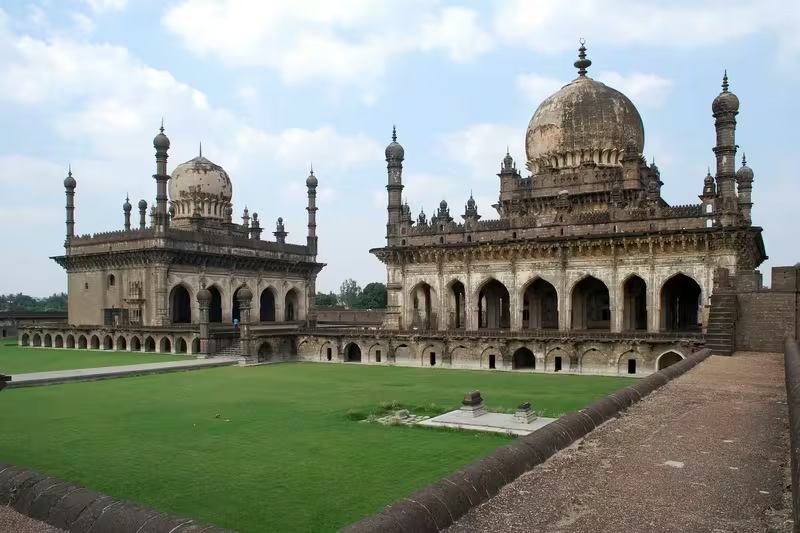
The Bijapur that Yusuf Adil Shah had founded, that Ali Adil Shah had fortified and expanded, was Ibrahim's inheritance and his responsibility. The magnificent monuments—the Jama Masjid, the Bara Kaman, the architectural wonders that would one day include the Gol Gumbaz—testified to the dynasty's greatness. But Ibrahim understood that monuments of stone, however grand, were not enough. A kingdom needed monuments of the spirit as well.
The Kitab-e-Nauras was his offering, his bet that synthesis was possible, that the city originally named Vijayapura—city of victory—could achieve a different kind of victory: not of one faith over another, but of shared humanity over sectarian division.
Yet doubt gnawed at him. History was littered with rulers who had tried to bridge religious divides, only to be crushed between the forces they sought to reconcile. Akbar's Din-i-Ilahi had died with him. Other attempts at synthesis had fared no better. Was Ibrahim's artistic vision simply naive idealism, doomed to fail in the harsh realities of political and religious competition?
He clutched the manuscript tighter. Whatever the future held, he had created something true. The 59 songs of the Kitab-e-Nauras represented not just his artistic achievement but his deepest conviction: that the divine was large enough to be approached through many paths, and that a kingdom's strength lay in honoring rather than suppressing its diversity.
Legacy of the Nine Rasas
When Ibrahim finally presented the Kitab-e-Nauras publicly, the response was as divided as he had feared—and as transcendent as he had hoped. The orthodox remained scandalized, but they could not deny the work's artistic power. The Hindu subjects of the sultanate heard themselves acknowledged, their traditions honored by their Muslim ruler. The Sufis recognized a kindred spirit who understood that mystical devotion transcended doctrinal boundaries.
More importantly, ordinary people—merchants and craftsmen, musicians and poets, the diverse inhabitants of cosmopolitan Bijapur—found in the Kitab-e-Nauras a mirror of their own lived experience. They had always navigated between cultures, borrowed from each other's festivals and music, found ways to be neighbors despite theological differences. Ibrahim had simply given artistic expression to what they already practiced in daily life.
The Kitab-e-Nauras survived. Through centuries of conflict, through the fall of the Bijapur Sultanate to the Mughals in 1686, through British colonialism and partition, through all the forces that would try to draw rigid boundaries between communities, Ibrahim's manuscript endured as testimony to a moment when a sultan dared to imagine synthesis over separation.
In a public square, as the sun set over Bijapur's domes and minarets, a gathering of diverse listeners—Hindu and Muslim, high-born and common—sat together to hear verses from the Kitab-e-Nauras. The words moved between Sanskrit and Persian, between invocations of Saraswati and Allah, between the nine rasas that defined human emotional experience.
And in that moment, Ibrahim Adil Shah II's vision lived. Not as political program or religious doctrine, but as what it had always been: an artistic testament to the possibility that different traditions might not just coexist, but create something beautiful together.
The city of Vijayapura—city of victory—had witnessed many conquests. But perhaps Ibrahim's greatest victory was this: proving that the human spirit, expressed through music and poetry, could transcend the boundaries that politics and orthodoxy tried to enforce. In the Kitab-e-Nauras, two tongues sang as one, and for a brief, shining moment, the dream of synthesis seemed not just possible, but inevitable.