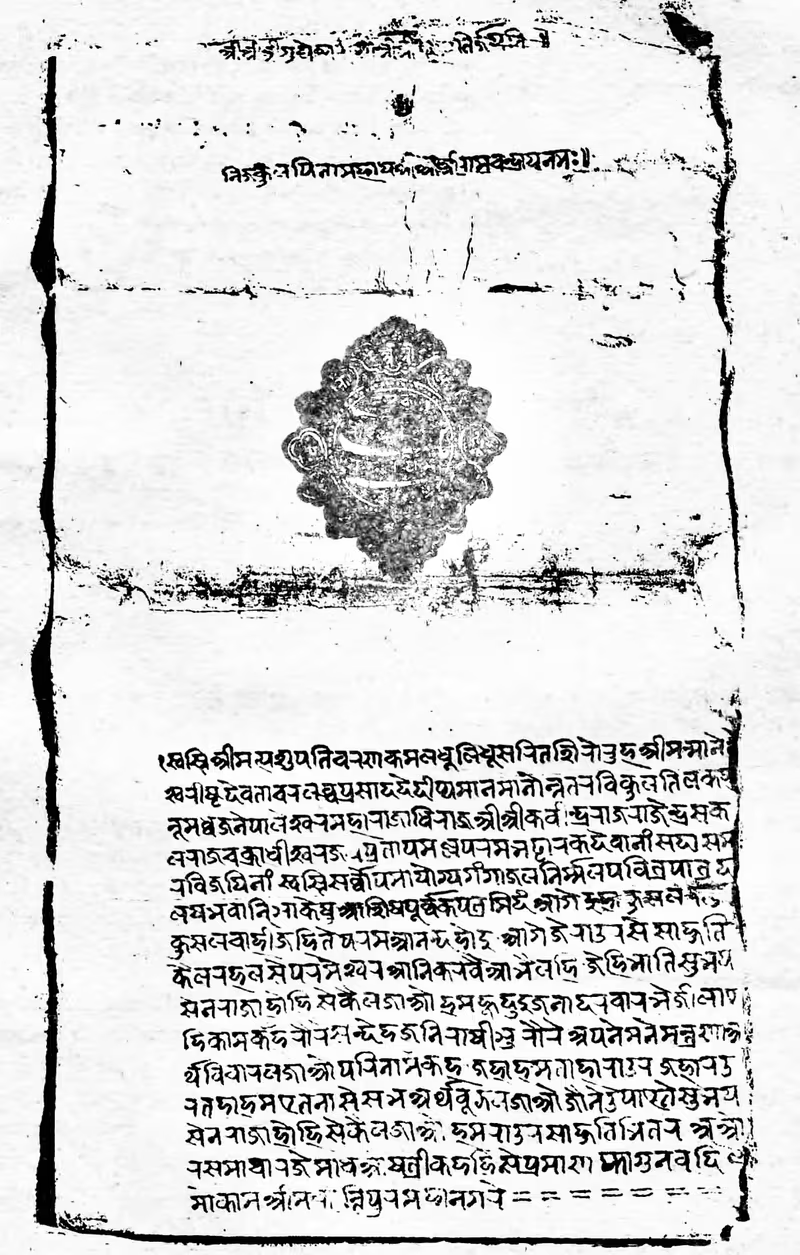
Bhojpuri Language: From Bhojpur Folklore to a Global Diaspora
In 1789, the word “Bhojpuri” appeared in the form Bodjpooria in the translator’s preface to A Translation of the Sëir Mutaqherin. That early written occurrence points to a language whose history has always extended beyond a single modern state or script. Bhojpuri is native to the Bhojpur–Purvanchal region of India and to the Terai region of Nepal. Its principal Indian-speaking areas are eastern Uttar Pradesh, western Bihar, and northwestern Jharkhand, while its overseas history reaches Fiji, Mauritius, South Africa, Suriname, Guyana, Trinidad and Tobago, Jamaica, and other parts of the Caribbean.
The 2011 Census of India recorded approximately 50.5 million speakers. Bhojpuri has a powerful tradition of oral literature, including folklore, songs, theatre, and performance. It has also developed written forms in Kaithi and Devanagari, a modern film industry, newspapers, television channels, digital publications, and translation tools. At the same time, UNESCO lists it as potentially vulnerable, particularly because Hindi increasingly replaces some Bhojpuri words and dominates many formal domains. Bhojpuri therefore combines demographic strength with pressures on transmission, standardisation, and public use.
Origins and Classification
Linguistic Family
Bhojpuri belongs to the Indo-European language family and the Eastern Indo-Aryan group. Its closest living relatives are Magahi and Maithili. Odia, Bengali, and Assamese are also closely related. Bhojpuri, Magahi, and Maithili are grouped together as the Bihari languages.
The Bihari languages, together with the other branches of Eastern Indo-Aryan, are considered direct descendants of Magadhi Prakrit. Bhojpuri is further classified by some scholars as a Western Magadhan language. In this three-way division of the Magadhan languages, Bengali, Assamese, and Odia are placed in the Eastern group; Maithili and Magahi in the Central group; and Bhojpuri in the Western group.
This classification reflects both shared inheritance and distinctive developments. Bhojpuri has an inflectional system resembling those of Bengali, Maithili, and Odia. Its vowel system also shows an Eastern Indo-Aryan pattern. The vowel a is broad in Eastern Indo-Aryan languages and becomes less broad as one moves westward. Bhojpuri preserves a contrast between a clear-cut a and a drawled vowel resembling the sound of aw in English awl. The drawled vowel can be represented by the avagraha sign, as in the written example देेखऽलऽ for dekh'la, “you see.”
Bhojpuri also shares features with Bengali and other Eastern Indo-Aryan languages that distinguish it from Hindi. Adjectives do not change according to the gender of the noun. The language forms past and future tenses with suffixes beginning in -la and -ba, respectively. Thus, a future form corresponding to “I shall see” is given as dekh-ab in Bhojpuri and dekh-bo in Bengali.
Origins
Bhojpuri is described as a descendant of Magadhi Prakrit that began taking shape during the reign of the Vardhana dynasty. In Harshacharita, Bāṇabhaṭṭa mentioned two poets, Isānchandra and Benibhārata, who wrote in a local language rather than in Prakrit and Sanskrit. The connection between this early vernacular literary activity and the later history of Bhojpuri is part of the language’s historical background.
Some scholars and enthusiasts trace Bhojpuri literary history to Siddha Sahitya as early as the eighth century. This interpretation, however, is not widely accepted. A more securely described period begins between the eleventh and fourteenth centuries, when Bhojpuri folklore and Nath literature appeared and the regional form of the language became more established.
Name Etymology
The name Bhojpuri is derived from Bhojpur. After the conquest of the Chero and Ujjainiya Rajputs in the twelfth century, the Ujjainiya Rajputs—described as descendants of Raja Bhoj of Ujjain in Malwa—captured Shahabad and named their capital Bhojpur, “the city of Raja Bhoj.”
Their governmental seat was Bhojpur village near Dumraon in Buxar. Two villages, Chhotka Bhojpur and Barka Bhojpur, still exist in Buxar, where the ruins of a Navratna Fortress can be seen. Over time, “Bhojpur” became a synonym for the Shahabad or Arrah region, corresponding broadly to today’s Bhojpur, Buxar, Kaimur, and Rohtas districts. The adjective Bhojpuri or Bhojpuriya consequently came to refer to the language and people of Bhojpur and then to communities beyond that region.
The language and its speakers have also been known by several regional names. In Mughal armies, Bhojpuriya people were called Buxariya. In Bengal, they were called Paschhimas, meaning “Westerners,” while Bhojpuri people used names such as Deshwali or Khoṭṭa for them. In upper provinces such as Oudh, they were called Purabiya. Other names included Banarasi, Chhaprahiya, and Bangarahi. Rahul Sankrityayan suggested Mallika or Malli, associated with the ancient Malla tribe, and Kashiki, associated with ancient Kashi.
The name also changed in overseas settings. Girmitya labourers taken to British colonies often called their language simply Hindustani or Hindi. In Fiji, the resulting variety became known as Fiji Hindi; in the Caribbean, it became known as Caribbean Hindustani. In South Africa, speakers often referred to the language locally as “Hindustani,” while the variety brought by indentured labourers who embarked at Calcutta was also known as “Kalkatia.”
Historical Development
Early Literary Associations (700–1100 CE)
The history of Bhojpuri is connected to the gradual development of local Indo-Aryan speech from Magadhi Prakrit. The language began taking shape during the period associated with the Vardhana dynasty. Bāṇabhaṭṭa’s reference in Harshacharita to poets composing in local language rather than in the prestige languages Prakrit and Sanskrit provides an early indication of vernacular literary activity in the broader region.
The proposed connection with Siddha Sahitya extends the literary history of Bhojpuri to the eighth century, but the identification is not widely accepted. The surviving historical account therefore presents this as a possible early association rather than an established beginning.
Folklore and Regional Formation (1100–1400 CE)
Between the eleventh and fourteenth centuries, a substantial body of Bhojpuri folklore came into existence. Important examples include Lorikayan, Sorathi Birjabh, Vijaymal, Gopichand, and Raja Bharthariar. Nath saints also composed literature in Bhojpuri during this period.
This was a formative stage for both the language and its regional identity. Bhojpuri changed during these centuries, and its regional boundaries became established. The prominence of folklore is significant because Bhojpuri literary culture continued to rely heavily on oral performance even after written publication expanded.
Saints, Discourse, and New Vocabulary (1400–1700 CE)
During the period of saints, figures associated with different sects used Bhojpuri as a language of discourse. The tradition is connected with Kabir, Dharni Das, Kina Ram, and Dariya Saheb. Arabic and Persian words entered Bhojpuri during this era, adding to the vocabulary of a language already related to other Indo-Aryan varieties.
Folk songs are also said to have been composed in this period. The combination of religious discourse and oral song helped establish patterns that remained important in later Bhojpuri culture. Even in the modern diaspora, Bhojpuri has often survived more strongly through song and performance than through formal print literature.
Research and Colonial Expansion (1700–1900 CE)
The eighteenth and nineteenth centuries brought two connected developments: the first academic studies of Bhojpuri and the international movement of Bhojpuri-speaking labourers. British scholars studied the language in detail, researched its folk literature, and mapped the Bhojpuri region.
Between 1838 and 1917, labourers from the Bhojpuri-speaking region were taken to plantations in Fiji, Mauritius, Guyana, Trinidad and Tobago, South Africa, and other British colonies, as well as to Suriname, which was a Dutch colony. These migrations transformed the geographical history of Bhojpuri. New contact varieties formed, and Bhojpuri folk music gave rise to genres including Chutney music, Baithak Gana, Geet Gawanai, and Lok Geet.
In South Africa, most migrants arriving through Calcutta between 1860 and 1911 originated in Bhojpuri-speaking areas of Bihar and eastern Uttar Pradesh, though many also came from Awadhi-speaking areas. Contact between these related varieties produced a distinct koiné variety of Bhojpuri in South Africa. It was further influenced by English, Zulu, and Fanagalo.
British scholarship also produced major linguistic documentation. Beames published the first grammar of Bhojpuri in 1868. George Abraham Grierson compiled and published Bhojpuri folksongs, published Bhojpuri folklore, produced dictionaries, and conducted the Linguistic Survey of India. He characterised Bhojpuri as “a practical language of an energetic race.” Buchanan, Beames, and Grierson were among the British scholars who studied the language during this period.
Modern Period (1900–Present)
The twentieth century saw the expansion of Bhojpuri literature, theatre, journalism, cinema, education, and digital media. Notable works published in the nineteenth century included Devakshara Charita and Badmash Darpan. In the twentieth century, Bhikhari Thakur made a major contribution to Bhojpuri literature and theatre through plays such as Bidesiya, Beti Bechwa, and Gabarghichor, as well as novels such as Bindia and Phulsunghi.
The first Bhojpuri film, Ganga Maiyya Tohe Piyari Chadhaibo, was released in 1962. It became the founding stone of the Bhojpuri film industry.
The language’s modern history also includes pressures from Hindi. Bhojpuri is listed as potentially vulnerable in the UNESCO World Atlas of Languages because of Hindi influence. The word Bujhã, for example, is being replaced by the Hindi word Samjhã. Most Bhojpuri speakers are bilingual because Hindi dominates formal education and media. Bhojpuri remains especially important in homes and informal settings, while Hindi is often preferred in formal or urban environments.
Digital developments have accelerated in the twenty-first century. Bhojpuri was long treated as a low-resource language because of limited standardised digital data and advanced computational tools. Doctoral research at Jawaharlal Nehru University in 2018 focused on creating large-scale digital corpora and experimental machine-translation systems. Google Translate added Bhojpuri in May 2022, significantly expanding its digital accessibility.
Scripts and Writing Systems
Kaithi
Bhojpuri was historically written in the Kaithi script. Kaithi served administrative purposes during the Mughal era for writing Bhojpuri, Awadhi, Maithili, Magahi, and Hindustani. Its use for Bhojpuri is documented from at least the sixteenth century through the first decade of the twentieth century.
Kaithi developed regional variants. The three classified variants are Tirhuti, Magahi, and Bhojpuri. The Bhojpuri variant was used specifically for writing Bhojpuri. Government gazetteers reported that Kaithi continued to be used in some districts of Bihar into the 1960s, although it is now rarely used for Bhojpuri.
Bhojpuri residents who moved to British colonies in Africa, the Indian Ocean, and the Caribbean during the nineteenth and early twentieth centuries used both Kaithi and Devanagari. In Mauritius, Kaithi was historically regarded as informal.
Devanagari
Since 1894, Devanagari has served as Bhojpuri’s primary script. By that year, both Kaithi and Devanagari had become common scripts for official texts in Bihar. At present, almost all Bhojpuri texts are written in Devanagari, including texts produced on islands outside India where Bhojpuri is spoken.
Devanagari is also the major script of modern Mauritian Bhojpuri. The script’s widespread use supports Bhojpuri publication, education, journalism, cinema, digital content, and translation tools.
Script Evolution
The history of Bhojpuri writing reflects a shift from a practical administrative script to a dominant modern literary and public script. Kaithi was used for administration across several Indo-Aryan languages and developed a specific Bhojpuri variant. Devanagari became common for official texts in Bihar by 1894 and gradually became primary.
This transition did not eliminate the historical importance of Kaithi. The Kaithi form of the Universal Declaration of Human Rights demonstrates the script’s continuing cultural and documentary value, while the Devanagari version shows the form used by almost all contemporary Bhojpuri texts.
Geographic Distribution
Historical Spread
The core Bhojpuri-speaking region covers approximately 73,000 square kilometres in India and Nepal. In India, it includes eastern Uttar Pradesh, western Bihar, and northwestern Jharkhand. In Nepal, it is spoken especially in western Madhesh and eastern Lumbini, including southwestern districts bordering Bihar and Uttar Pradesh.
The Bhojpuri-speaking region borders the Awadhi-speaking region to the west, the Nepali-speaking region to the north, the Magahi- and Bajjika-speaking regions to the east, and the Chhattisgarhi- and Bagheli-speaking regions to the south.
Bhojpuri-speaking Muslims are also part of the Muhajir community in Pakistan and Bangladesh. In Bangladesh, some are referred to as Stranded Pakistanis because Bhojpuri and Urdu are their native languages rather than Bengali. They migrated to Bangladesh during the Partition of India, when the territory was part of East Pakistan.
Regional Dialects
Bhojpuri has four widely identified dialects:
- Southern Standard Bhojpuri, also known as Kharwari, is spoken in the Shahabad district area, including Buxar, Bhojpur, Rohtas, and Kaimur, and in the Saran region, including Saran, Siwan, and Gopalganj. It is also spoken in eastern parts of Azamgarh and Varanasi regions in Uttar Pradesh, and in Palamu and Garhwa districts in Jharkhand.
- Northern Bhojpuri is common in western Tirhut, including east and west Champaran and Muzaffarpur, and in the Gorakhpur and Basti divisions of Uttar Pradesh. It is also spoken in Nepal.
- Western Bhojpuri is prevalent in the Varanasi, Azamgarh, and Mirzapur divisions of Uttar Pradesh. Banarasi is a local name for Bhojpuri derived from Banaras.
- Nagpuria Bhojpuri is the southernmost popular dialect. It is found in the Chota Nagpur Plateau of Jharkhand, particularly in parts of Palamu, South Chotanagpur, and Kolhan. It is sometimes called Sadari.
A more detailed classification identifies Bhojpuri Domra, Madhesi, Musahari, Northern Standard Bhojpuri varieties such as Basti, Gorakhpuri, and Sarawaria, Southern Standard Bhojpuri or Kharwari, Western Standard Bhojpuri varieties such as Benarsi and Purbi, and Nagpuriya Bhojpuri.
Overseas Distribution
Bhojpuri is spoken by descendants of indentured labourers taken to plantations during the nineteenth and early twentieth centuries. These communities live in Mauritius, Fiji, South Africa, Trinidad and Tobago, Guyana, Suriname, Jamaica, and other parts of the Caribbean.
In Mauritius, nearly 450,000 indentured labourers arrived between 1834 and the early 1900s, and the majority were Bhojpuri speakers who did not return to India. Mauritian Bhojpuri developed as a blend of several Indian Bhojpuri varieties rather than from a single dialect. It has undergone grammatical simplification and has been influenced by Mauritian Creole and Hindi.
In South Africa, Bhojpuri experienced substantial decline during the twentieth century as speakers shifted toward English. Intergenerational transmission had largely ceased by the late 1900s. In Mauritius, by contrast, music remains a major vehicle for maintaining the language. In Trinidad and Tobago, Caribbean Hindustani remains present, while Chutney music often incorporates English and Soca rhythms.
Literary Heritage
Classical and Folk Literature
Bhojpuri does not belong to the established literary languages of India, but it has a strong oral-literary tradition. Lorikayan, the story of Veer Lorik, is an important example of Bhojpuri folklore from eastern Uttar Pradesh. Other medieval folklore includes Sorathi Birjabh, Vijaymal, Gopichand, and Raja Bharthariar.
The persistence of oral literature is especially clear in the diaspora. Bhojpuri often continues through songs, performance, radio, recordings, and digital platforms rather than through formal print literature alone.
Religious and Saint Literature
Between 1400 and 1700, saints from different sectarian traditions used Bhojpuri as a language of discourse. Kabir, Dharni Das, Kina Ram, and Dariya Saheb are associated with this period of Bhojpuri religious and philosophical expression. Nath saints had also composed literature in Bhojpuri during the preceding centuries.
The importance of this material lies not only in individual texts but also in the use of Bhojpuri as a language for public teaching and religious communication. Arabic and Persian vocabulary entered the language during the same period.
Poetry and Drama
Bhikhari Thakur is one of the major figures of modern Bhojpuri literature and theatre. His plays include Bidesiya, Beti Bechwa, and Gabarghichor. His work contributed significantly to the development of Bhojpuri theatre, while Bindia and Phulsunghi represent his contribution to the novel.
Phool Daliya, by Prasiddha Narayan Singh, is a well-known book of poetry. It contains poems in the veer ras style on freedom, Singh’s experiences in the Quit India movement, and India’s struggle with poverty after independence.
Documentation of Oral Traditions
Bhojpuri folklore has been the subject of sustained academic research. W. G. Archer published collections of folk songs. Durga Shankar Prasad Singh also published collections, drawing primarily on women’s songs from the Shahabad district. Satya Vrata Sinha worked on the academic classification of folktales.
V. S. Gautam examined the themes of folk songs such as Bidesiya and their role in the development of national consciousness during the colonial period. These studies document a literary culture that has often been transmitted through performance, memory, and community participation.
Journalism and Media
The first Bhojpuri journal, Bagsar Samāchar, was published in 1915 but closed in 1918. The first Bhojpuri weekly appeared on 15 August 1947. Bhojpuri journalism expanded greatly during the 1960s and 1970s.
Important publications from that period included Anjor, published by the Bhojpuri Parivar organisation in Patna, as well as journals associated with Bhojpuri Mandal in Motihari and Bhojpuri Samaj in Arrah. Purvaiya, published from Varanasi, was another important folkloric journal.
Contemporary Bhojpuri media includes newspapers and magazines published in Bihar, Jharkhand, and Uttar Pradesh; the monthly online literary magazine Aakhar; Parichhan, a Maithili–Bhojpuri literary-cultural magazine; and The Sunday Indian, Bhojpuri, a national news magazine. Bhojpuri television media includes Lok Lucknow, Mahuaa TV, and Hamar TV. Bhojpuri Wikipedia was launched in 2003.
Grammar and Phonology
Key Grammatical Features
Bhojpuri is an inflecting and almost entirely suffixing language. Nouns are inflected for case, number, and gender. Verbs are inflected for tense, aspect, mood, and person-number-gender agreement.
A notable feature is its system of verbal honorifics. Politeness toward the subject is marked directly in the verb form. Bhojpuri syntax generally follows a Subject–Object–Verb order, although the language permits considerable freedom in word order.
Unlike Hindi, Bhojpuri uses a nominative–accusative case system and does not have an oblique case. According to George Abraham Grierson, its grammar is simpler than that of other languages in the same family.
Bhojpuri nouns have three forms: short, long, and redundant. Adjectives do not change according to gender. Plurals can be formed by adding -na or -ni, or by using words expressing multitude, such as sabh, “all,” and lōg, “people.”
The verb system contains several features considered distinctive within the Magadhan group. In most instances, the verb depends on the subject, while the object has no effect on its form. The present tense is formed by adding a suffix beginning in -lā to the present subjunctive. For “to see,” the base form is dekhe and the present form is dhekhelā. This differs from the corresponding forms cited for Magahi, Maithili, and Bengali.
The past and future systems use characteristic suffixes. The future includes -ba, while past perfect forms in regular verbs are formed with -al. Some verbs have irregular forms, such as kar becoming kail and mar becoming mual. The present perfect is made by adding ha’ to the past form: ham dekh'li means “I saw,” while ham dekh'li ha’ means “I have seen.”
Bhojpuri numerals use the classifiers gō and ṭhō, which emphasise countability and totality. The suffixes -o and -e express inclusiveness and exclusiveness. In the cited examples, ham āmo khāïb means “I will eat mangoes too,” while ham āme khāïb means “I will eat only mangoes.” These suffixes may be added to numerals, adjectives, and other lexical categories.
Auxiliaries are based on five forms: ha, ho, hokh, bāṭ, and rah. These forms also act as copulas. The bāṭ form provides for tenses, hokh or ho provides for modes, and rah is the past form of the other three.
Politeness and Honorifics
Bhojpuri has a three-tier system of politeness reflected in syntax and vocabulary. Verbs can be conjugated through these levels, and the imperative forms of verbs such as aail, “to come,” and bolal, “to speak,” can express subtle differences in politeness and propriety.
Pronouns and adjectives also mark social relationships. Forms for “your” include tum, described as casual and intimate; tōhār, polite and intimate; t'hār, formal yet intimate; rā'ur, polite and formal; and āpke, extremely formal.
In ordinary usage, tu is mainly used for a younger individual, while raua is used for someone older or someone holding a higher position in the workplace. In extremely polite or formal situations, the pronoun is generally omitted.
Bhojpuri differs from other Magadhan languages in its use of raürā or raüwā as an honorific second-person pronoun, alongside the apne form. The apne form occurs in other Magadhan languages, but raüwā is described as entirely absent from them.
Sound System
Bhojpuri has six vowel phonemes. The higher vowels are relatively tense, and the lower vowels are relatively lax. It has 31 consonant phonemes and 34 contoids. These include six bilabial, four apico-dental, five apico-alveolar, seven retroflex, six alveo-palatal, five dorso-velar, and one glottal sound.
Robert L. Trammell’s 1971 description of Northern Standard Bhojpuri identifies a peak-type syllable system. Every syllable has a vowel phoneme as its highest point of sonority. Codas may contain one, two, or three consonants. Vowels may occur as simple peaks or as peak nuclei in diphthongs.
The intonation system has four pitch levels and three terminal contours. Word stress is phonemic, meaning that the position of stress can change meaning. The noun सौटा /ˈsota/, “a short stick,” is distinguished from the verb सोटा /soˈta/, “to be slim,” solely by the shift in stress.
Bhojpuri also contains devoicing aspirate sonorants, including म्ह /mʱ/ and न्ह /nʱ/. These function as independent phonemes and are distinct from their unaspirated counterparts such as /m/ and /n/.
Influence and Legacy
Languages and Varieties
Bhojpuri has contributed to the development of overseas varieties associated with indentured labour migration. Fiji Hindi is an official language of Fiji and is described as a variant of Awadhi and Bhojpuri spoken by Indo-Fijians. Caribbean Hindustani is another language influenced by Awadhi and Bhojpuri. It is spoken by Indo-Caribbean communities in Guyana, Suriname, Jamaica, and Trinidad and Tobago.
In South Africa, contact between Bhojpuri and Awadhi created a distinct koiné variety. South African Bhojpuri also reflects contact with English, Zulu, and Fanagalo. In Mauritius, Bhojpuri has influenced Mauritian Creole; more than 300 words from Indo-Aryan languages have entered Mauritian Creole, most likely from Bhojpuri.
Loanwords
Bhojpuri vocabulary includes words of Sanskrit origin, words of uncertain origin, words borrowed from other Indo-Aryan languages, Sanskrit words in original or modified form, words of non-Aryan Indian origin, and words of foreign origin.
Persian vocabulary is classified into several groups. Words associated with kingly states include amīr, kābū, and hajūr. Administrative and legal vocabulary includes darogā, hak, and huliyā. Words associated with Islam include Allāh, tobā, and mahjid. Intellectual culture, music, and education include ilīm, ijjat, and munsi. Material culture includes kāgaj, kismis, and sāl.
Bengali has also contributed vocabulary, partly because Bengal was a major centre for Bhojpuri-speaking people. European words entered Bhojpuri as well, in some cases through Bengali. Examples include:
- aspatāla, from “hospital”
- injin, from “engine”
- eroplena, from “aeroplane”
- kār, from “car”
- ṭeksī, from “taxi”
- ṭesan, from “station”
- ḍākṭar, from “doctor”
- nars, from “nurse”
- peṭarol, from “petrol”
- rēl, from “rail,” meaning train
- sāikīl, from “bicycle”
- sūgar, from “sugar,” used for diabetes
South African Bhojpuri has additional forms reflecting its linguistic environment. Examples include khār for “car,” baz for “bus,” ven for “van,” ḍokṭar or ḍokṭe for “doctor,” and nes or staf-nes for “nurse.”
Cultural Impact
Bhojpuri’s cultural influence is especially visible in music. Folk songs formed an important part of Bhojpuri culture in India, while migration carried Bhojpuri musical traditions overseas. Chutney music, Baithak Gana, Geet Gawanai, and Lok Geet developed in diaspora settings.
In the Caribbean, wedding performances rooted in Bhojpuri folk traditions contributed to the evolution of Chutney music as a distinct genre. Chutney often combines Bhojpuri elements with English lyrics and Soca rhythms. In Trinidad and Tobago, the music of artists such as Sundar Popo exemplifies English admixture and linguistic creolisation.
In Mauritius, music remains a primary means of maintaining Bhojpuri. Songs frequently adapt Bhojpuri to new environments and mix it with Mauritian Creole. Through music, Bhojpuri has continued across generations and across media including radio, recordings, and digital platforms.
Royal and Religious Patronage
Historical Political Context
The historical account of Bhojpuri associates the language’s name with the Ujjainiya Rajputs and the establishment of Bhojpur as a capital after the conquest of Chero territory in the twelfth century. The political importance of Bhojpur helped extend the adjective “Bhojpuri” from a regional place-name to a term for the language and people associated with the wider area.
Later, the language was used in different administrative and military environments. Bhojpuriya people in Mughal armies were called Buxariya, while Kaithi was used for administrative writing during the Mughal era. The available account does not identify a single royal institution responsible for the development of Bhojpuri literature.
Religious Institutions and Saints
Saints and religious teachers played an important role in the history of Bhojpuri discourse. Kabir, Dharni Das, Kina Ram, and Dariya Saheb are associated with the period from 1400 to 1700, when Bhojpuri served as a language of religious communication. Nath saints also composed Bhojpuri literature during the earlier period of regional formation.
The role of this religious and oral activity was not limited to preservation of written texts. It helped sustain Bhojpuri as a language of preaching, performance, song, and community exchange.
Modern Status
Current Speakers
According to the 2011 Census of India, approximately 50.5 million people speak Bhojpuri. The language is concentrated in eastern Uttar Pradesh, western Bihar, and northwestern Jharkhand, and it is a major language in parts of southwestern Nepal.
Bhojpuri is also spoken by diaspora communities whose ancestors were indentured labourers. These communities are found in Fiji, Mauritius, South Africa, Trinidad and Tobago, Guyana, Suriname, Jamaica, and other parts of the Caribbean.
Official Recognition
Greater official recognition, including inclusion in the Eighth Schedule to the Constitution of India, has been demanded. In 2018, Bhojpuri received second-language status in Jharkhand.
The language is taught at the matriculation and higher-secondary levels through the Bihar School Education Board and the Board of High School and Intermediate Education Uttar Pradesh. It is also taught at universities including Veer Kunwar Singh University, Banaras Hindu University, Nalanda Open University, and Dr. Shakuntala Misra National Rehabilitation University.
In Mauritius, Bhojpuri is recognised by the government and taught at university. Fiji Hindi, a variety associated with Awadhi and Bhojpuri, is an official language of Fiji.
Preservation and Vulnerability
UNESCO lists Bhojpuri as potentially vulnerable. Hindi is the formal language of much education and media, and many Bhojpuri speakers are bilingual. Bhojpuri is commonly used in the home and in informal situations, while Hindi may be preferred in formal, urban, or status-conscious settings.
This relationship has produced both code-switching and linguistic activism. A notable example is the “ne-hatao aandolan”, or “remove ne movement,” in Bhojpuri-speaking areas of Patna during the 1960s. The movement opposed the Hindi grammatical particle ne, which marks the agent in certain past-tense constructions but is absent in Bhojpuri. Demonstrators regarded it as unnecessary and demanded its removal from Hindi. Although some outsiders viewed the movement as humorous, it represented a serious assertion of Bhojpuri linguistic identity.
Bhojpuri features also transfer into the Hindi spoken by bilinguals. Speakers may use the definite noun suffix -wa, as in laikwa for “the boy,” instead of standard Hindi laṛka. They may substitute Bhojpuri adverbs and interrogatives, such as lage for Hindi pa:s, and introduce Bhojpuri words whose use can narrow the meaning of a Hindi word. The Bhojpuri term kaTahar for a mature jackfruit is one example.
Digital Development
Bhojpuri was long considered a low-resource language because of the scarcity of standardised digital data and advanced computational tools. Research at Jawaharlal Nehru University in 2018 worked toward creating large-scale digital corpora and experimental machine-translation systems.
Google Translate added Bhojpuri in May 2022. This milestone improved the language’s accessibility for speakers in India, Nepal, and the global diaspora. Challenges remain, particularly because Bhojpuri has wide dialectal variation and no single universally adopted written standard.
Learning and Study
Academic Study
The academic study of Bhojpuri began in a substantial way during the colonial period. British scholars including Buchanan, Beames, and George Abraham Grierson investigated the language, documented its folklore, and mapped its regional distribution.
Beames published the first Bhojpuri grammar in 1868. Grierson published folksongs and folklore, prepared Bhojpuri dictionaries, and included the language in the Linguistic Survey of India. Later work examined Bhojpuri grammar, dialects, oral literature, diaspora varieties, and language contact.
Modern linguistic study includes phonological research on Northern Standard Bhojpuri. Robert L. Trammell published a phonological description in 1971, including analysis of syllable structure, stress, vowels, consonants, and intonation. Other scholarship has focused on folk-song collections, folktale classification, national consciousness, and the development of diaspora forms.
Resources
Bhojpuri learning and research resources include school and university instruction, Bhojpuri newspapers and magazines, television channels, online literary publications, the Bhojpuri Wikipedia, and digital corpora. The Universal Declaration of Human Rights has been published in Bhojpuri by the United Nations Information Centre, India, and recordings of Bhojpuri are available through archived language-documentation collections.
The language also has an English–Bhojpuri machine-translation system and a Bhojpuri language-resource collection in the Computational Resource for South Asian Languages archive. Google Translate’s inclusion of Bhojpuri in 2022 provides a widely accessible digital tool, although dialect variation and differences in writing practice remain important considerations for learners.
Conclusion
Bhojpuri developed from the Eastern Indo-Aryan tradition associated with Magadhi Prakrit and became rooted in the Bhojpur–Purvanchal region, the Terai, and adjoining areas of India and Nepal. Its history includes medieval folklore, saintly discourse, Persian and Arabic vocabulary, colonial documentation, and the international movement of labourers whose descendants created new Bhojpuri-related varieties overseas.
The language’s cultural life remains especially strong in oral literature, folk song, theatre, cinema, journalism, and diaspora music. Kaithi preserves its historical writing tradition, while Devanagari is now the primary script. Bhojpuri has approximately 50.5 million speakers in India and a global community, yet Hindi influence, uneven intergenerational transmission, and the absence of a single standard create continuing challenges. Its presence in education, universities, digital corpora, translation systems, and Google Translate demonstrates an expanding modern infrastructure alongside an enduring oral heritage.