Overview
At an elevation of about 621 metres, Basavakalyan stands in Karnataka’s Bidar district at the centre of a historical landscape shaped by dynasties, religious debate, and temple architecture. Known earlier as Kalyani or Kalyana, the city became the royal capital of the Western Chalukyas in the 11th century. It later remained the capital of the Kalachuris of Kalyani.
Basavakalyan is equally associated with the 12th-century movement led by Basaveshwara, also known as Basava. The city is linked with the Anubhava Mantapa, the Sharana community, and the growth of Vachana literature. Basava, Akka Mahadevi, Channabasavanna, Siddarama, and Allamaprabhu are among the figures connected with this intellectual and religious centre.
The city’s heritage combines Chalukyan temples, a historic fort, Islamic monuments, religious institutions, caves, and modern commemorative sites. Its present identity also includes education, industry, and a population that speaks Kannada alongside Marathi, Hindi, and Urdu.
Etymology and Names
Before Indian independence, the city was generally known as Kalyani. The name Kalyana was also used in historical and cultural contexts. After the reorganisation of Indian states along linguistic lines in 1956, Kalyani was renamed Basavakalyan in memory of Basava, the 12th-century social reformer associated with the city.
The modern name therefore joins the older identity of Kalyani with the memory of Basaveshwara. This reflects the two central strands of the city’s past: its role as a royal capital under the Kalyani Chalukyas and its later importance as a centre of social and religious change.
Geography and Location
Basavakalyan is located at 17.87°N and 76.95°E in Bidar district, Karnataka. Its average elevation is 621 metres, or approximately 2,037 feet. The city lies within the Deccan region and has historically formed part of a wider network of settlements connected with the political powers of the plateau.
Nearby heritage sites include Jalasangvi, Narayanapura, and Shivapura, which contain temples associated with the Chalukyan period. Narayanapur village, about 2.5 kilometres from Basavakalyan, has a 12th-century Lord Shiva temple attributed to the Chalukyas. Soldapka, around 20 kilometres away, contains the ruins of a Shiva temple with architectural remains and written scripts.
Historical Timeline
Basavakalyan’s political history reflects the changing balance of power in the Deccan. The city was ruled successively by the Western Chalukyas, Kalachuris of Kalyani, Yadavas of Devagiri, Kakatiyas, Delhi Sultanate, Bahamani Sultanate, Bidar Sultanate, Bijapur Sultanate, Mughals, and Hyderabad Nizams.
Western Chalukya Capital
The city’s most prominent political phase began when Someshvara I moved the Chalukyan capital from Manyakheta, identified with present-day Malkhed in Kalaburagi district, to Kalyani. His reign is dated to 1041–1068, and Kalyani served as the capital of the Western Chalukyas from 1050 to 1195.
The dynasty is also called the Kalyani Chalukyas to distinguish it from the earlier Chalukyas of Badami. During this period, the Chalukyan power extended across much of the western Deccan and parts of South India. Kalyani became a royal centre from which rulers such as Someshvara I, Someshvara II, Vikramaditya VI, Someshvara III, Jagadhekamalla III, and Tailapa III governed.
Vikramaditya VI’s court included notable scholars. Someshvara, Bilhana—the poet from Kashmir—and the legal scholar Vijnaneshvara are associated with his reign. The coronation of Vikramaditya VI began on 26 February 1077. The Jalsangi Temple is connected with this event.
Kalachuris and Basaveshwara
The Kalachuris of Kalyani succeeded the Kalyani Chalukyas and continued to use Kalyani as their capital. King Bijjala ruled from 1156 to 1167, and Basaveshwara served as his prime minister.
Basava’s work is associated with a movement that challenged untouchability, gender discrimination, and religious orthodoxy. The movement brought together the Sharanas, or spiritually engaged devotees, and encouraged the composition of Vachana Sahitya. More than 600 people are described as becoming writers within this tradition.
The Anubhava Mantapa is central to the memory of this period. Associated with Basava and led by Allamprabhu, it is remembered as a forum for spiritual and social discussion. Basavakalyan’s importance in later religious history rests largely on this tradition of debate, personal devotion, and social criticism.
Religious and Cultural Importance
Basavakalyan is associated with a broad group of 12th-century Sharanas. Basaveshwara’s teachings emphasised practical responses to social problems and opposed rigid forms of orthodoxy. Akka Mahadevi, Channabasavanna, Siddarama, and Allamprabhu are among the other figures linked to the city’s religious and literary heritage.
The Basaveshwara Temple stands at the centre of the city. Other religious sites include Gachchina Matha, Kambali Matha, Sadananda Matha, Sai Baba Temple, Munde Pali Hanuman Temple, Hingulambika Mandir, and Gavimath at Maridevara Gudda.
A later heritage complex developed by the Basava Dharma Peetha Charitable Trust includes a prayer hall, living rooms, a water reservoir called Haralayya Tirtha, and a Sharana village representing the occupations, or kayakas, of the 12th-century Sharanas. The complex also includes the Sri Basaveswara Cave and Akkamahadevi Cave, carved into laterite rock-soil, and an orphanage.
Monuments and Architecture
Basavakalyan Fort is attributed to the Chalukyas and was later under Nizam rule. A side fort contains a museum with historic objects and information, including Jain idols dated to the 10th and 11th centuries.
The surrounding region preserves several examples of Chalukyan temple architecture. Temples at Jalasangvi, Narayanapura, and Shivapura contribute to the historical landscape around the city. The Shiva temple at Narayanapur is especially close to Basavakalyan, while the remains at Soldapka provide evidence of architectural and inscriptional activity farther afield.
The city also contains Islamic monuments, including Moti Mahal, Hydari Mahal, and Peeran Durga. These sites reflect the succession of Muslim sultanates and later powers that ruled parts of the Deccan after the Chalukyan and Kalachuri periods.
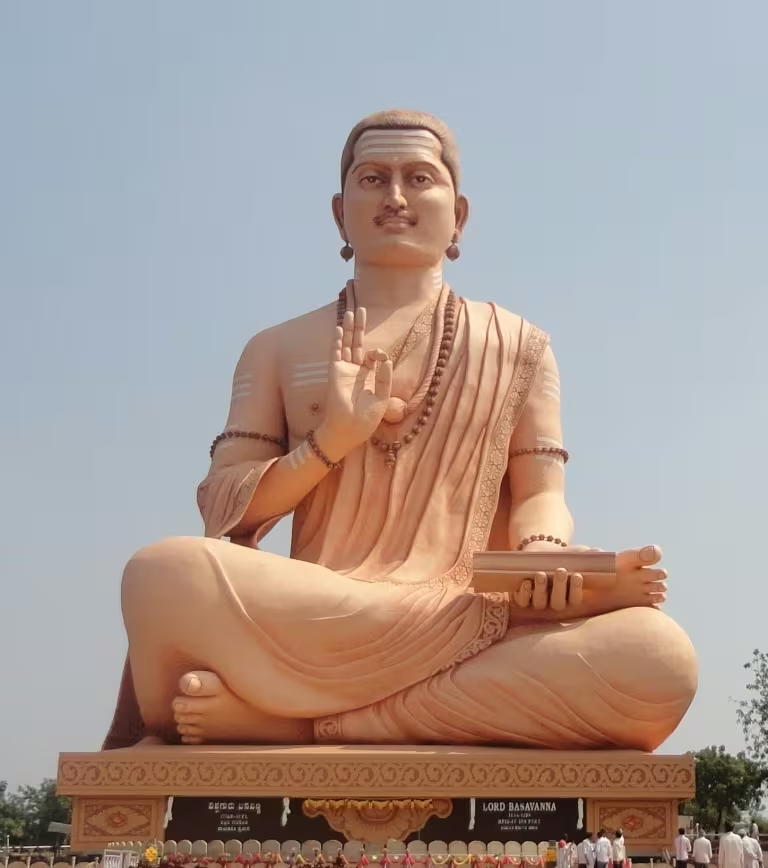
On Sharana Shaila stands a 108-foot statue of Basavanna. The statue is placed on a pedestal 24 feet high, measuring 60 by 80 feet. Together, the hillock, statue, caves, reservoir, and Sharana village form a modern commemorative landscape devoted to the memory of Basava and the Sharana heritage.
Modern City
Basavakalyan is today a municipal council and one of the major cities of Bidar district. It is described as an important industrial hub and has a substantial educational presence. The city also contains hospitals, schools, and software companies, reflecting its contemporary urban development.
According to the 2011 Census of India, Basavakalyan had a population of 69,717, including 36,116 males and 33,601 females. Children aged between zero and six numbered 9,949, or 14.27 percent of the population. The recorded literacy rate was 77.46 percent, with male literacy at about 82.46 percent and female literacy at about 72.13 percent.
Kannada is spoken by the majority of residents, while Marathi, Hindi, and Urdu are also used. The coexistence of multiple languages reflects the city’s location in a historically connected Deccan region.
Timeline
Kalyani becomes a capital
Kalyani serves as the royal capital of the Western Chalukyas.
Coronation of Vikramaditya VI
The coronation begins on 26 February 1077.
Bijjala assumes power
Kalachuri king Bijjala rules Kalyani, with Basaveshwara serving as prime minister.
End of the Western Chalukya capital period
Kalyani’s period as the Western Chalukyan capital comes to an end.
Renaming of the city
Following linguistic reorganisation, Kalyani is renamed Basavakalyan in memory of Basava.
Basava Dharma Peetha project
The Basava Dharma Peetha Charitable Trust purchases land near the town entrance to revive Sharana cultural heritage.