Overview
Between the Parabhadi and Landa sandstone hills, Lalitagiri preserves a Buddhist landscape that remained active for many centuries. Also known as Nalitagiri, the complex in Cuttack district contains a large stupa, an apsidal chaityagriha, four monasteries, inscriptions, sculptures and relic caskets. Archaeological investigations indicate a cultural sequence beginning in the post-Mauryan period and continuing into the 13th century CE.
Lalitagiri is especially notable for the discovery of Buddha relics. The complex also records several stages in the history of Buddhism: early traditions associated with Hinayana, the later presence of Mahayana imagery, and a final Vajrayana or Tantric phase. Alongside Ratnagiri and Udayagiri, it forms Odisha's Buddhist “Diamond Triangle.”
The site was once considered a possible location for Pushpagiri Vihara, the important Buddhist centre mentioned in the account of the seventh-century Chinese traveller Xuanzang. Excavations at Lalitagiri did not establish that identification. Later work at Langudi Hill suggested that Pushpagiri was located elsewhere.
Etymology and Names
Lalitagiri is also called Nalitagiri. The complex is associated with the hill landscape in which it stands, rather than with a surviving urban settlement of a later period. The name is used today for the archaeological site and its surrounding Buddhist remains.
Geography and Location
Lalitagiri lies in Mahanga Tahsil of Cuttack district, Odisha. It occupies a hill setting in the standalone Assian range, between the Parabhadi and Landa sandstone hills. This terrain provided a distinctive setting for stupas, monasteries and rock-related architectural features.
The complex is approximately 60 kilometres from Cuttack, the former state capital of Odisha, and 90 kilometres from Bhubaneswar, the present state capital. Its relationship with the neighbouring Buddhist sites is central to its historical identity: Udayagiri lies about 8 kilometres away and Ratnagiri about 12 kilometres away. Together, the three sites are known as the Diamond Triangle.
Ancient History
Archaeological evidence places Lalitagiri among the earliest Buddhist sites in Odisha. The excavated cultural sequence begins in the post-Mauryan period, conventionally dated here from the 3rd century BCE onward. Potsherds bearing inscriptions range from the post-Mauryan period to the 8th–9th centuries CE, indicating that Buddhist communities occupied the complex over a long span.
The remains point to continuity rather than a brief episode of settlement. The site is inferred to have maintained an unbroken Buddhist presence from the 3rd century BCE to the 10th century CE, while the wider cultural sequence continued to the 13th century. Different religious traditions appeared across these centuries, including Hinayana, Mahayana and Vajrayana Buddhism.
Historical Timeline
- 3rd century BCE onward: Lalitagiri develops as an early Buddhist centre.
- Early Christian era to the 6th–7th century CE: The apsidal chaityagriha and related architectural features belong to this broad sequence.
- 7th century CE: Xuanzang's account of Pushpagiri encourages later efforts to locate that famous Buddhist centre.
- 8th–10th century CE: The site enters a Vajrayana or Tantric phase during the rule of the Bhauma-Kara dynasty.
- 9th–10th century CE: The seal of Sri Chandraditya Vihara Samagra Arya Vikshu Sanghasa is produced.
- 10th–11th century CE: The largest monastery is constructed or in use.
- 1905: M. M. Chakravarty records archaeological antiquities from the Diamond Triangle.
- 1927–1928: R. P. Chanda documents Lalitagiri in the Memoirs of the Archaeological Survey of India.
- 1937: The central government declares the site a protected monument.
- 1977: Utkal University undertakes excavations.
- 1985–1991: Detailed excavations are conducted by the Archaeological Survey of India.
Early and Medieval Buddhist Phases
The earliest remains reveal Lalitagiri as a centre of Buddhist ritual and monastic activity. Later, Mahayana Buddhism left a rich sculptural record, including images of Buddhas in meditative forms, Bodhisattvas, Tara, Jambhala and Avalokiteśvara.
The final major phase is associated with Vajrayana, or Tantric Buddhism. This phase is linked to the Bhauma-Kara period between the 8th and 10th centuries CE. Images of Tara Kurukulla, or Kurukulla Tara, are associated with Lalitagiri as well as Udayagiri and Ratnagiri. Hariti images were also found across these sites. In Buddhist tradition, Hariti was transformed from a child abductor into a protector of children after being persuaded by the Buddha.
Rediscovery and Archaeology
Modern investigation began with the recording of antiquities in 1905. Documentation followed in the late 1920s, and Lalitagiri received protected-monument status in 1937. Excavations by Utkal University in 1977 preceded the major Archaeological Survey of India campaigns from 1985 to 1991.
The ASI initially excavated Lalitagiri in the hope of finding Pushpagiri. Although the discoveries established the site's exceptional importance, they did not identify it with Pushpagiri. Evidence from Langudi Hill later pointed toward that location instead.
Religious and Cultural Importance
Lalitagiri's importance lies in the range of Buddhist traditions represented at the site. Early inscriptions and potsherds indicate communities belonging to Hinayana and Mahayana traditions. Later sculpture and ritual evidence show the development of Vajrayana Buddhism and Tantric practice.
The site also reflects the interaction between Buddhist and wider religious imagery. Finds include stone tablets bearing impressions of Ganesha and Mahisasurmardini, alongside Buddhist sculptures and ritual objects. These discoveries form part of the complex religious environment of historical Odisha.
Monuments and Architecture
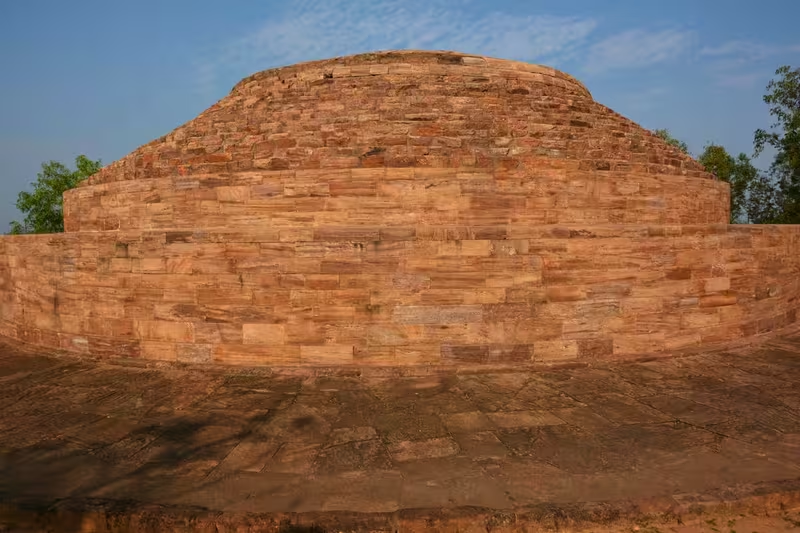
The principal stupa stood on the hill and contained two rare stone caskets holding Buddha relics. The caskets were made of Khondalite and were designed like nested puzzle boxes. Within them were further containers of steatite, silver and gold. The innermost gold casket held a small piece of bone identified as a relic, making the discovery the first of its kind in eastern India.
Lalitagiri's apsidal chaityagriha faces east and measures approximately 33 by 11 metres. Its walls are about 3.3 metres thick, and a circular stupa occupies the centre. It is regarded as the first Buddhist structure of this type discovered in Odisha. Shell inscriptions in Kushana Brahmi were found around the moonstone at the building's perimeter. A fragment of railing with a half-lotus medallion was also recovered.
Four monasteries have been identified. The largest, an east-facing two-storeyed structure measuring about 36 square metres, contains a central open space 12.9 metres square. It is dated to the 10th–11th century CE and had a brick rainwater cistern at the rear. Another monastery stood at the northern end of the hill and may belong to a time when Buddhism was declining at Lalitagiri.
The third monastery faces south-east and measures about 28 by 27 metres. Its central open space measures about 8 square metres and represents the late development of the apsidal chaitya tradition. The fourth, measuring about 30 square metres, contained large Buddha heads in its sanctum. A terracotta seal from the 9th–10th century mentions the Sri Chandraditya Vihara.
Museum and Collections
A temporary enclosure initially displayed sculptures discovered during excavation. Lalitagiri now has a permanent museum housing Mahayana-period sculptures, including large stone images of Buddha, Bodhisattvas, Tara and Jambhala. Some statues carry inscriptions.
Standing Buddha images show a draped garment extending from the shoulder to the knee, a style associated with the Gandhara and Mathura schools of sculpture. The relic caskets recovered from the hill stupa are also displayed in the museum.
Modern Status and Preservation
Lalitagiri was formally protected in 1937 and remains an archaeological and heritage site. Its museum, architectural remains and relic discoveries make it a key destination within Odisha's Buddhist Diamond Triangle. Its proximity to Cuttack, Bhubaneswar, Udayagiri and Ratnagiri allows the site to be understood as part of a wider network of Buddhist establishments rather than as an isolated monument.