Overview
In the agricultural fields of western Uttar Pradesh, the levelling of land exposed human skeletons and ancient pottery. The discovery led to archaeological excavations at Sinauli, a site in the Ganga-Yamuna Doab that has transformed discussions about Bronze Age burial practices in northern India.
The Archaeological Survey of India (ASI) excavated the site in 2005–2006 and returned for trial excavations in March–May 2018. The earlier work revealed more than a hundred burials. The later excavation, conducted roughly 100 metres away, uncovered coffin burials, copper weapons, ornaments, pottery, and three full-sized wooden vehicles. These discoveries have been dated broadly between about 2200 and 1500 BCE, with the cemetery’s radiocarbon evidence placing several burials between approximately 1865 and 1507 BCE.
Sinauli is especially important because its burials combine elaborate funerary arrangements with military-looking equipment and vehicles. The vehicles were presented by excavation director Sanjay Kumar Manjul as chariots. Other scholars have argued that their solid wheels make them more likely to have been heavy, ox-pulled carts. This distinction affects how the site is connected to the Late Harappan world, early Indo-Iranian migrations, and the development of horse-drawn chariot technology.
Etymology and Names
The site is generally known as Sinauli, while the cemetery is also referred to as the Sanauli cemetery. The archaeological material does not establish a historical name used by the people who lived or buried their dead there. “Sinauli” is therefore a modern place-name, and “Sanauli” is a variant used in descriptions of the cemetery and excavations.
Geography and Location
Sinauli lies in western Uttar Pradesh in the Ganga-Yamuna Doab, the broad region between the Ganga and Yamuna rivers. The site was encountered in land being levelled for agriculture. Its location placed it within a major zone of interaction during the Bronze Age, where communities associated with different cultural traditions lived, traded, and came into contact.
The available archaeological record identifies Sinauli primarily as a cemetery rather than a fully excavated settlement. A burnt-brick wall with a finished inner surface ran along the eastern side of the burial area found in 2005–2006. Its purpose is not established in the surviving account, but it indicates that the cemetery included built features in addition to graves.
Ancient History
The 2005–2006 Excavations
The ASI began excavations at Sinauli in September 2005 after farmers discovered skeletons and pottery. Work during the 2005–2006 season uncovered more than one hundred burials. Excavation director D. V. Sharma initially associated the cemetery with the Indus Valley Civilisation. That identification has been contested; a Late Harappan or post-Harappan context is considered more likely in the archaeological discussion.
The burials were arranged predominantly along a northwest-southeast axis. Most were primary burials, in which the body appears to have been placed directly in the grave. Other graves were interpreted as secondary, multiple, or symbolic burials. The cemetery represented a broad age range, from children aged about one or two years to adults, and included both male and female individuals.
Grave goods were arranged according to recurring patterns. Odd numbers of vessels—three, five, seven, nine, or eleven—were commonly placed near the head. A dish-on-stand was usually positioned below the hip area, although examples also occurred near the head or feet. Flask-shaped vessels, terracotta figurines, gold bracelets, copper bangles, beads, and necklaces were among the associated objects. The beads included materials such as semi-precious stone, steatite, faience, and glass. Two necklaces were made from long, barrel-shaped beads.
Several objects have particular importance. Two antennae swords resemble examples of the Copper Hoard type found in Late Harappan contexts. One was discovered in a grave with a copper sheath. Another notable object was a violin-shaped, flat copper container containing nearly thirty-five arrowhead-shaped copper pieces arranged in a row. In one case, a dish-on-stand supported a goat’s head.
Radiocarbon evidence later placed the burials at approximately 1865–1507 BCE. Three samples produced measurements of 3,500, 3,815, and 3,457 years before present, with a stated margin of error of 295 years. These dates complicate the earliest association of the cemetery with the broader Indus Valley Civilisation and support a Late Harappan or post-Harappan setting.
The 2018 Excavations
The 2018 trial excavations expanded the picture of Sinauli. Seven human burials were excavated, including three coffin burials. In these graves, the head was positioned on the northern side, while pottery was placed beyond the head and to the south beyond the feet. Copper objects were found below the coffins or sarcophagi.
The 2018 excavations produced copper helmets, antenna swords, other copper swords, a copper ladle, grey-ware pottery, large terracotta pots, red vases with flaring rims, copper nails, and beads. The findings were associated by Sanjay Manjul with the Ochre Coloured Pottery (OCP)/Copper Hoard cultural horizon. This cultural complex was considered contemporaneous with the Late Harappan culture, though distinct from it.
Organic matter from the burial site was dated to 3,500 ± 127 years old. The oldest soil sediments produced a date of 4,798 ± 34 years old. The older sediment date may reflect the movement or mixing of carbon from lower levels, particularly because digging graves could relocate earlier soil. The dates therefore need to be read in relation to the stratigraphy and the disturbance created by burial activity.
The Coffin Burials
Coffin Burial I
The first coffin burial was a primary burial measuring approximately 2.4 metres long and 40 centimetres high. It contained the body of an adult man, oriented northwest-southeast with the head facing northwest. The decomposed coffin had stood on four wooden legs and had been covered on every side with copper sheets about 3 millimetres thick.
The copper covering was not plain. The sides carried running floral motifs, while the sheets around the legs included intricate carvings. The lid had eight high-relief motifs. One interpretation sees the central image as a person wearing a headdress formed from two bull horns with a pipal leaf between them; another possibility is that it represents a bull’s head.
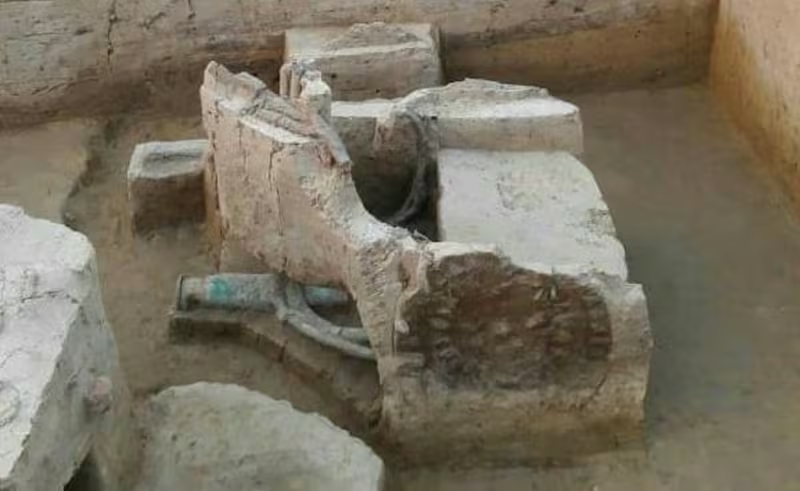
Two full-sized vehicles were associated with this coffin. Their wooden chassis were covered with thick copper sheets. Each had two solid wheels rather than spoked wheels. Copper triangles, fixed with copper nails, decorated the wheels in three concentric circles extending from the hub flange. The vehicles had a semi-circular seat framed with copper pipes, along with a pipe that may have supported an umbrella. The wheels rotated on a fixed axle connected by a shaft to a yoke.
No remains of a draught animal—whether horse or bull—were found with the vehicles. This absence has contributed to the debate over their function.
Coffin Burial II
A third vehicle was found with another wooden coffin. This burial also contained a shield decorated with geometric copper patterns, a torch, an antenna sword, a digging implement, hundreds of beads, and a variety of pots.
Unlike the two vehicles associated with the first coffin, this cart had copper triangle decorations on its pole and yoke. The combination of vehicle, weaponry, ornaments, and vessels suggests that the burial was intended to represent a person of unusual status, although the precise social structure of the community cannot be reconstructed from the available evidence alone.
Coffin Burial III
The third coffin burial contained the skeleton of a woman. It was a primary burial, but unlike the first coffin it had no copper lid. The woman wore an armlet made from banded agate beads around the elbow.
Her grave goods included ten red vases with flaring rims, four bowls, two basins, a thin symbolic antenna sword, a bow, and arrows. The burial demonstrates that weapons and prestigious objects were not confined to one type of grave or exclusively associated with male individuals.
Wooden coffins are unusual but not without parallels in South Asian archaeology. Coffins had previously been found at Harappa in Punjab and Dholavira in Gujarat. Sinauli adds another important example from the Ganga-Yamuna Doab.
Chariots, Carts, and Historical Interpretation
The most publicised interpretation of the 2018 discoveries came from Sanjay Kumar Manjul, who identified the vehicles as war chariots. He described them as the first chariots recovered through excavation in the Indian subcontinent and connected them with a royal burial belonging to the OCP/Copper Hoard Culture. He also argued that the funerary rituals showed close affinity with Vedic rituals and referred to a date of approximately 1750 BCE for the Mahabharata.
These claims have been debated. A central issue is the construction of the wheels. The Sinauli wheels are solid, not spoked. Several scholars have therefore identified the vehicles as carts rather than chariots. Heavy solid-wheel carts would be more suitable for ox traction than for fast movement behind horses, and would not fit the conventional image of the light, horse-drawn war chariot associated with later Indo-Aryan military technology.
Michael Witzel has rejected the chariot identification and suggested that the finds may indicate the survival of an extra-Harappan organised society. Asko Parpola has argued that the vehicles were ox-pulled carts and connected them with an early migration of Proto-Indo-Iranian-speaking people into the Indian subcontinent. In his interpretation, the Copper Hoard people arrived through the BMAC region and formed a ruling elite within a major Late Harappan settlement. He distinguishes this movement from later groups associated with the pre- and proto-Rigvedic communities.
Other scholars have urged caution about linking the vehicles directly to Vedic traditions. Historian Ruchika Sharma has questioned why the ASI calls them chariots when Late Harappan contexts already provide evidence for bullock carts, including terracotta examples. The interpretation of the site therefore remains open, involving questions of vehicle technology, cultural contact, social hierarchy, and the use of later literary traditions to understand archaeological remains.
Myth, Memory, and Popular Associations
Sinauli has also become associated with the Mahabharata in popular discussion. The vehicles resemble the chariots described in epic narratives, while local legends identify Sinauli as one of the five villages that Krishna supposedly offered to negotiate with the Kaurava princes before the Kurukshetra war.
These associations are part of the modern reception of the site rather than established evidence for the historical identity of the people buried there. The excavated objects can demonstrate burial practices, craft production, and technologies; they do not by themselves prove a direct connection with a particular epic episode.
Excavation and Heritage
Local residents played a role in the discovery of Sinauli, when agricultural land levelling exposed the remains. During the 2018 work, local youths were given basic training and enlisted in excavation activities by the ASI. Their participation connects the scientific investigation of the site with the community living around it.
Sinauli’s importance lies not in a single object but in the combination of evidence: more than a hundred earlier burials, carefully arranged pottery, ornaments made from varied materials, copper weapons, decorated coffins, and vehicles whose design has prompted competing interpretations. Together, these finds show that Bronze Age communities in northern India maintained elaborate funerary traditions and possessed the resources to create objects requiring considerable technical skill.
Timeline
Early cemetery horizon
The broadest proposed dating for the Sinauli burials begins around this period, although later radiocarbon evidence favours a more recent range for many graves.
Burial complex
Radiocarbon evidence places part of the cemetery approximately within the period beginning around 1865 BCE.
Proposed epic-era association
Sanjay Manjul connected the finds with a proposed Mahabharata date of around 1750 BCE; this interpretation is debated.
Later cemetery dates
The stated radiocarbon range for three samples extends to approximately 1507 BCE.
Discovery and excavation
After skeletons and pottery were found during agricultural land levelling, the ASI began excavations in September.
Large cemetery exposed
The 2005–2006 excavation uncovered more than one hundred burials, pottery, ornaments, copper weapons, and a burnt-brick wall.
Coffins and vehicles
Trial excavations around 100 metres from the earlier area revealed seven burials, three coffin burials, and three full-sized wooden vehicles.