Bimaran Casket: A Tiny Gold Reliquary and an Early Buddha Image
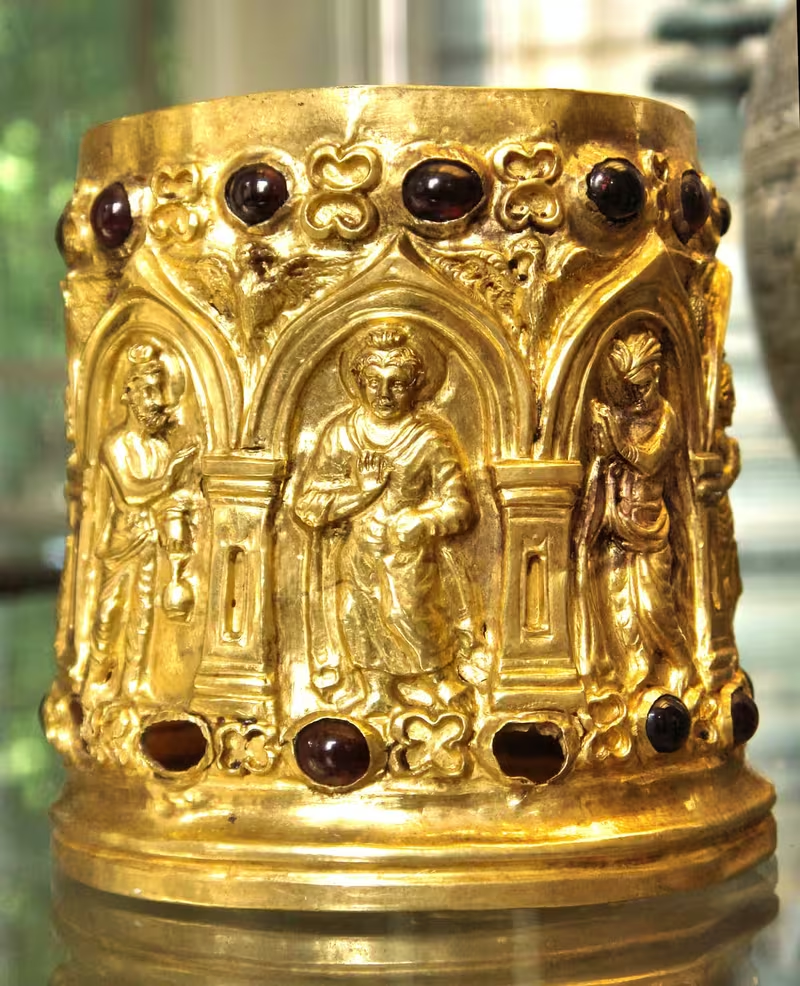
Standing only 7 centimetres high, the Bimaran casket is a small gold reliquary with an unusually large place in the history of Buddhist art. It was found inside Stupa No. 2 at Bimaran, near Jalalabad in eastern Afghanistan, with four Indo-Scythian coins and a steatite container associated with Buddhist relics. Its gold-repoussé surface shows the Buddha in a standing pose, accompanied by Brahma and Śakra, while two richly adorned devotees or Bodhisattvas stand between repeated divine-Buddha groups. Rubies from Badakhshan add colour to the object’s decoration.
The casket is particularly important because its Buddha image is already accompanied by a developed iconographic system. The composition includes attendants, Bodhisattvas, architectural niches, a halo, and recognisable gestures and garments. This sophistication has made the reliquary central to arguments about when artists began representing the Buddha in human form. Its associated coinage has also generated debate: the coins were first assigned to Azes II, later reassigned to Azes I, and more recently connected with Kharahostes or his son Mujatria. Depending on whether coin evidence or stylistic assumptions are given priority, the reliquary has been dated from around 10 BCE to the 2nd century CE.
Discovery and Provenance
Discovery
The Bimaran casket was discovered by the archaeologist Charles Masson during his work in Afghanistan between 1833 and 1838. It came from Stupa No. 2 at Bimaran, where it had been placed in the main relic chamber. The casket was found without its lid.
Another excavator, Johann Honigberger, had worked on the monument before Masson. Honigberger opened the stupa from the north by digging into it, but abandoned the attempt before reaching the relic chamber. His excavations were described as having uncovered objects “more by luck than any systematic excavation technique.” Masson subsequently dug into the core of the stupa and reached the main chamber, where the reliquary was found.
Masson’s work made the object available for study, but his excavation methods were not precise by modern archaeological standards. The absence of modern excavation techniques makes the circumstances of the find less secure than those of a systematically documented excavation. Nevertheless, the associated objects—especially the coins and steatite container—remain essential to discussion of the casket’s date and purpose.
Journey Through History
The reliquary was deposited in a Buddhist stupa together with a steatite box. The box contained inscriptions stating that it held relics of the Buddha. When it was opened in the nineteenth century, it did not contain identifiable relics. Instead, it held burnt pearls, beads of precious and semi-precious stones, and four coins.
The casket’s original Buddhist setting is therefore known through its findspot and associated objects rather than through a continuous record of ownership. The reliquary was intended for the preservation or deposition of sacred material, and the steatite container reinforced that function. The four coins were of the same type and were in near-new condition, a detail that has influenced arguments that the casket was deposited soon after the coins were minted.
Current Home
The Bimaran casket is now in the collections of the British Museum. It is displayed in the Joseph E. Hotung Gallery. The museum dates it to approximately 60 CE, while other scholars have proposed an earlier date based on the coins and a later date based principally on artistic assumptions.
Physical Description
Materials and Construction
The casket is made of gold repoussé, a technique in which decoration is raised in relief from the surface. Its small body resembles a pyxis of the Classical world. A lotus decorates the bottom. The object was discovered without its lid, so its original complete form cannot be observed.
Its surface combines precious materials with sculptural decoration. Two rows of rubies from Badakhshan run around the reliquary, while the figures are rendered in high relief. The combination of gold, gemstones, and figural imagery makes the object an especially refined example of the Greco-Buddhist art of Gandhara.
Dimensions and Form
The reliquary is 7 centimetres high. Its compact size contrasts with the complexity of its decoration. Around the body are arched niches known as homme arcade, or caitya, derived from Greco-Roman architectural forms. Within these niches are eight figures arranged in repeated groups.
Two groups consist of Brahma, the Buddha, and Śakra. Two further figures occupy the spaces between these groups. Their jewellery and prayerful gestures identify them as probably Bodhisattvas or devotees. The arrangement creates a continuous sacred scene around the small container.
Condition
The casket survives as a decorated gold container, although it was found without its lid. Its associated steatite box and the original contents were documented during its opening in the nineteenth century. The object is preserved in the British Museum collections and remains available for examination and display.
Artistic Details
The Buddha is shown in a contrapposto pose and appears to walk sideways. His right forearm crosses his chest to form the Abhaya mudra, while his left fist is clenched on his hip. He wears a Greek-style himation and has a bundled hairstyle, moustache, abundant topknot, and simple halo. The modelling is described as realistic and Hellenistic in character.
The Buddha’s garment is relatively light compared with the heavier robes seen in other standing Buddha images. It appears to represent the first two layers of monastic clothing, the antaravasaka and uttarasanga, without the heavier overcoat, the sangati. The garment also folds over both the right and left arms, suggesting a scarf-like uttariya. These details produce an image distinct from the more heavily draped classical standing Buddha.
The two other human figures wear necklaces, bracelets, armbands, and halos. They hold their hands together in Añjali Mudrā, a gesture of reverence. Their ornament and posture indicate that they are probably Bodhisattvas or devotees.
Historical Context
The Era
The reliquary is usually associated with the Indo-Scythian period and the artistic environment of Gandhara. Its date remains disputed. Gérard Fussman proposed 1–15 CE, while the British Museum gives approximately 60 CE. Some scholars have placed it as late as the 2nd century CE, relying on stylistic assumptions rather than the coin evidence.
A date near the beginning of the Common Era is especially significant because the casket’s iconography appears mature. The scene already includes the Buddha, Brahma, Śakra, and Bodhisattva or devotee figures within an architectural framework. This has led to the argument that earlier Buddha images must have existed before the Bimaran example was made.
The reliquary’s style has also been compared with the art of the Scythians, including the gold and gemstone work of the Tillya Tepe archaeological site in northern Afghanistan. The Bimaran casket has further similarities with the Kanishka casket, although the latter is more coarsely executed and securely dated to around 127 CE.
Purpose and Function
The Bimaran casket was a Buddhist reliquary. It was placed within Stupa No. 2, and its associated steatite box carried inscriptions identifying its contents as relics of the Buddha. The container’s purpose was therefore connected with the preservation and ritual deposition of sacred remains or materials.
The burnt pearls and precious and semi-precious stone beads found in the steatite box, together with the four coins, formed part of the deposit. The coins may have helped establish the time of deposition, particularly because they were scarcely worn.
Commissioning and Creation
The artist and commissioner are not known. The casket’s sophisticated combination of gold repoussé, gemstones, Hellenistic figural modelling, Buddhist iconography, and Greco-Roman architectural niches demonstrates a highly developed artistic tradition, but the surviving record does not name the workshop or patron.
The reliquary was probably made before 60 CE, the latest date considered for its coins. Fussman placed its manufacture in 1–15 CE. A more specific date around 10 BCE or the beginning of the Common Era has been proposed when the coins are attributed to Kharahostes or Mujatria.
Significance and Symbolism
Historical Importance
The Bimaran casket is important because it may preserve one of the earliest known representations of the Buddha. Its date bears directly on the chronology of Buddhist art and on the question of when the Buddha began to be represented in human form.
The object’s importance does not rest on the Buddha figure alone. The image is accompanied by an established group of attendants and devotional figures. Brahma and Śakra appear beside the Buddha, while the two richly adorned figures offer reverence. Such an advanced arrangement implies that earlier forms of Buddhist figural art may have existed for some time before the casket was made.
Artistic Significance
The reliquary is considered a masterpiece of the Greco-Buddhist art of Gandhara. Its art combines Hellenistic features—contrapposto, the himation, naturalistic execution, and architectural arches—with Buddhist subjects and ritual purpose.
The Buddha’s posture and dress are particularly unusual. The combination is otherwise known chiefly from coins of Kanishka, where one type bears the inscription “Shakyamuni Buddha.” The Bimaran image therefore provides evidence for an iconographic tradition that does not fit neatly into a single, later standard form.
Religious and Cultural Meaning
The casket’s imagery presents the Buddha as the central sacred figure, attended by Brahma and Śakra. The accompanying devotees or Bodhisattvas express reverence through Añjali Mudrā. The halo marks the Buddha’s sanctity, while the reliquary’s placement in a stupa connects the image with the veneration of Buddhist relics.
The use of gold, rubies, and high relief also gives the container a precious and ceremonial character. Its decoration transforms a small vessel for relics into a visual statement about Buddhist devotion and sacred presence.
Inscriptions and Text
No complete inscription from the steatite container is reproduced in the surviving account of the object. The container is described as carrying inscriptions stating that it held relics of the Buddha.
The most substantial written evidence associated with the find comes from the four coins. Their Greek legend reads, in corrupted form, “King of Kings Azes.” The Kharoshthi legend on the reverse translates as “The Great king follower of the Dharma, King of Kings Azes.” These inscriptions name Azes, although the coins’ symbols and design have led scholars to connect them with Kharahostes or Mujatria.
Scholarly Study
Key Research
When first studied, the coins found in the casket were attributed to Azes II. Robert Senior later argued that Azes II never existed and that discoveries assigned to his reign should instead be reassigned to Azes I. More recent research, particularly Joe Cribb’s 2015 study, attributes the coins to Kharahostes or his son Mujatria, who issued posthumous coins in the name of Azes.
All four coins are tetradrachms of debased silver. They show a king riding a horse to the right, with his right hand extended. A three-pellet dynastic mark appears on the obverse, together with a circular Greek legend. The reverse shows Tyche standing and holding a cornucopia, accompanied by a Kharoshthi inscription.
The three-pellet symbol is characteristic of Kharahostes and is also known from Mujatria. The horseman-with-Tyche coin type corresponds to the main coinage of Kharahostes. The coins are in near-new condition, supporting the possibility that they were deposited soon after minting.
The discovery of the name Kharahostes on a silver Buddhist reliquary from Shinkot in Bajaur has added context. It suggests that Kharahostes made Buddhist dedications similar to that represented by the Bimaran reliquary.
Debates and Controversies
The dating of the casket remains contested. An attribution to Azes II would suggest a date between 30 BCE and 10 BCE. The later reassignment of the coins to Azes I changed that framework, while the identification of Kharahostes or Mujatria places the likely deposition around 10 BCE to 10 CE, probably near the beginning of Kharahostes’s reign.
Another proposal connected the coins with the Kushan ruler Kujula Kadphises and placed the casket around 60 CE. This suggestion rests partly on a similar three-pellet mark found on one of his coin types. However, that type is not the same as the horseman-with-Tyche coins from the Bimaran reliquary, and Kujula Kadphises is not known to have issued Scythian-type coins in the name of Azes.
Some scholars date the casket to the 2nd century CE because of its artistic style. The argument against an early date assumes that Buddha images were not introduced into Buddhist art until the early centuries of the Common Era. The opposing view gives greater weight to the coins and argues that the casket’s mature iconography indicates that earlier Buddha images must already have existed.
Legacy and Influence
Impact on Art History
The Bimaran casket has had a major impact on discussions of the origins of Buddhist figural art. If it was made around the beginning of the Common Era, its sophisticated image suggests that representations of the Buddha may extend back into the 1st century BCE.
This possibility has encouraged broader consideration of the role of Indo-Greek and Indo-Scythian patrons in the development of Greco-Buddhist art. The casket’s imagery has been used in arguments that Buddhist art was already flourishing before the Kushan period, rather than beginning only under later Kushan rule.
Modern Recognition
The reliquary is held by the British Museum and is displayed in the Joseph E. Hotung Gallery. It is recognised as a masterpiece of Gandharan Greco-Buddhist art and continues to be discussed because its date affects the chronology of the Buddha image.
Viewing Today
The Bimaran casket is in the collections of the British Museum and is displayed in the Joseph E. Hotung Gallery. Its small scale makes its decoration especially remarkable: the object is only 7 centimetres high, yet its surface carries repeated groups of figures, architectural niches, a lotus, and rows of rubies.
Conclusion
The Bimaran casket unites relic worship, precious-metal craftsmanship, Indo-Scythian coinage, and early Buddhist imagery in a single, exceptionally small object. Found inside a stupa near Jalalabad, it preserves a Buddha with a rare posture and light garment, flanked by Brahma, Śakra, and reverent devotees or Bodhisattvas. Its four coins bear the name of Azes but are now more closely associated with Kharahostes or Mujatria, making them central to the reliquary’s dating.
Whether placed around 10 BCE, in the early Common Era, around 60 CE, or later, the casket demonstrates that Buddhist iconography had reached considerable sophistication by the time of its deposition. Its gold surface and developed imagery continue to make it a key witness to the formation of Greco-Buddhist art and to the emergence of the Buddha as a human artistic subject.