Overview
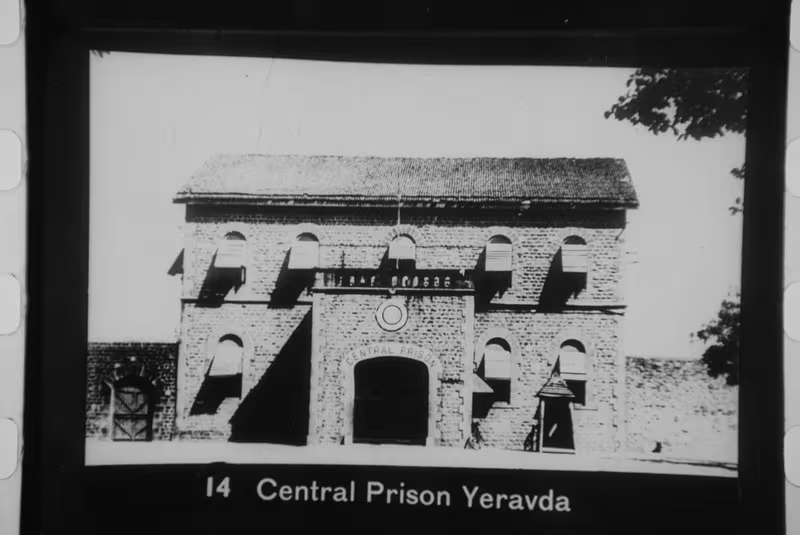
At 5 p.m. on 24 September 1932, an agreement was signed at Yerwada Central Jail in Poona between representatives of Hindus and the Depressed Classes, then the official term for communities now generally referred to as Scheduled Castes. Known as the Poona Pact, it settled a fierce dispute over how these communities should be represented in British India's legislatures.
The agreement rejected separate electorates for the Depressed Classes, a system under which they would have elected their representatives independently of the wider electorate. Instead, it established reserved seats within joint electorates. The pact also provided for primary elections, safeguards against discrimination, and educational support.
Its immediate political compromise concealed a deeper disagreement. Gandhi viewed caste reform primarily through social and spiritual change and opposed what he believed would be a political division of Hindu society. B. R. Ambedkar treated caste as a political problem and argued that the Depressed Classes required the power to select leaders who genuinely represented them.
Background
Political representation based on community identity had entered legislative arrangements with the Indian Council Act of 1909. The Depressed Classes received some representation in 1919, followed by a further increase in 1925. These earlier measures did not resolve the central question: should members of these communities vote together with other Hindus, or should they elect their representatives through a separate political system?
The issue became especially urgent during the constitutional discussions associated with the Round Table Conferences. The British government considered separate electorates for several communities, including Muslims, Sikhs, Indian Christians, and the Depressed Classes. During the Second Round Table Conference, Ambedkar argued that upper-caste reformers could not adequately speak for the Depressed Classes. Their political rights, in his view, required leaders chosen by their own communities.
Gandhi opposed separate electorates for the Depressed Classes, although the debate involved separate arrangements for other groups. He believed that creating a distinct electorate would “vivisect and disrupt” Hinduism. To Gandhi, the arrangement risked making caste separation a permanent political structure rather than encouraging reform within Hindu society.
Prelude
The immediate background was the Communal Award announced in August 1932 by Ramsay MacDonald, the British prime minister. The award proposed separate electorates for the Depressed Classes and reserved seats for them in legislative bodies. One account of the arrangement gives the number of seats in the central legislature as 71; the pact's later comparison with the award also refers to an original figure of 80. The agreement ultimately settled on 148 reserved seats in provincial legislatures.
Gandhi, who was imprisoned by the British at Yerwada, began a fast unto death in protest against the separate-electorate provision. His fast transformed the constitutional disagreement into an urgent political and moral crisis. Ambedkar faced intense pressure to reach an agreement, but he did not abandon his central concern: political safeguards had to give the Depressed Classes a meaningful voice rather than leave their representation dependent entirely on dominant groups.
Negotiations therefore became unavoidable. The eventual settlement preserved reserved representation while abandoning separate electorates. It was signed by 23 people, including Madan Mohan Malaviya on behalf of Hindus. Gandhi himself was not a signatory, although his son Devdas Gandhi signed the pact.
The Event
The Poona Pact was signed on 24 September 1932 at Yerwada Central Jail. Its most important provision was the replacement of separate electorates with joint electorates. Members of the Depressed Classes would vote in the same general elections as other voters, but specific seats would be reserved for their representatives.
The agreement allocated reserved seats in provincial legislatures as follows:
- Madras: 30
- Bombay with Sindh: 25
- Punjab: 8
- Bihar and Orissa: 18
- Central Provinces: 20
- Assam: 7
- Bengal: 30
- United Provinces: 20
Together, these amounted to 148 seats. This was nearly twice the 71 seats associated with the Communal Award in the pact's principal comparison, though another description of the award gives the original allocation as 80.
Key Phases
The first phase was the constitutional dispute over separate electorates. Ambedkar regarded them as a means by which the Depressed Classes could choose independent leaders. Gandhi regarded them as a threat to social unity and a British attempt to divide Hindus.
The second phase began with Gandhi's fast in Yerwada Jail. His action gave the disagreement immediate urgency and brought representatives of the different positions into negotiations.
The final phase was the settlement itself. The pact retained reserved seats but placed them within a joint electorate and added a primary-election procedure intended to give Depressed Class voters an important role in selecting candidates.
Turning Points
The principal turning point was the compromise between separate electorates and joint electorates. Ambedkar did not secure the independent electorate he had advocated, but the number of reserved seats was substantially increased. Gandhi did not secure a simple return to unrestricted joint representation, since the pact guaranteed reserved seats and a special selection process.
The agreement also established a time limit for the primary-election system. The system would end after the first ten years unless the communities concerned agreed to end it earlier. The broader arrangements were to continue until changed by mutual agreement.
Participants
Mahatma Gandhi and Hindu Representatives
Gandhi's opposition rested on his fear that separate electorates would permanently institutionalise division within Hindu society. He believed caste reform should be pursued through social and spiritual means. Imprisoned at the time, he used a fast unto death to oppose the Communal Award's provision for the Depressed Classes.
Madan Mohan Malaviya signed on behalf of Hindus. Gandhi was not among the pact's signatories; Devdas Gandhi, his son, was one of the 23 people who signed it.
B. R. Ambedkar and the Depressed Classes
Ambedkar insisted that political democracy could not be meaningful without the equal participation of the Depressed Classes. He maintained that upper-caste reformers could not automatically represent communities that had experienced social exclusion. Their representatives had to be selected through arrangements that gave the Depressed Classes a real political role.
Although Ambedkar had supported the principle of separate electorates, he accepted the Poona Pact. The settlement increased reserved seats and formally recognised the need for political representation and safeguards for the Depressed Classes.
Provisions of the Pact
The primary elections were to be conducted by an electoral college made up of all members of the Depressed Classes listed on the general electoral roll of a constituency. Through a single-vote procedure, this electoral college would select a panel of four candidates for each reserved seat. The four leading candidates would then stand before the general electorate in the final election.
The same principle applied to representation in the central legislature. Eighteen percent of the seats allotted to the general electorate for British India were reserved for the Depressed Classes.
The pact also aligned the franchise of the Depressed Classes in central and provincial legislatures with recommendations associated with the Lothian Committee Report. It stated that membership of the Depressed Classes should not create disabilities in elections to local bodies or in appointments to public services. Efforts were to be made to secure fair representation, while taking educational qualifications into account.
Education was another part of the settlement. Each province was to earmark a portion of its educational grant for adequate educational facilities for members of the Depressed Classes.
Aftermath
The pact ended the immediate confrontation created by Gandhi's fast and the Communal Award. It gave the Depressed Classes more reserved seats than the allocation associated with the award, but it did not grant them separate electorates. The arrangement therefore represented both an expansion of political representation and a limitation on the form that representation could take.
On 8 January 1933, “Temple Entry Day” was observed, linking the political settlement with the wider campaign against caste exclusion. The pact thus operated within a broader debate about social reform, access, public rights, and the place of the Depressed Classes in Hindu society and Indian politics.
Historical Significance
The Poona Pact brought two contrasting approaches into a single agreement. Gandhi emphasised social and spiritual reform and the preservation of a common Hindu political framework. Ambedkar emphasised political power, independent leadership, and institutional safeguards. The pact did not erase that disagreement, but it created a constitutional mechanism for reserved representation within joint electorates.
Its long-term legacy can be seen in the continuation of reserved seats for Scheduled Castes in legislatures. These seats are allocated with reference to the population of Scheduled Castes and are intended to ensure their political presence. The system has also attracted criticism because Dalit representatives may be elected from constituencies where Dalits form a minority, potentially limiting their independence and influence.
Legacy
The Poona Pact remains central to discussions of representation, caste, and democratic participation in India. Supporters view the reserved-seat arrangement as an important recognition of Dalit politics. Gitanjali Surendran has described the acceptance of reserved seats as a major step in that recognition.
At the same time, writers and scholars including Perry Anderson and Arundhati Roy have questioned whether the pressure created by Gandhi's fast compromised the freedom of Ambedkar's choice. The debate continues because the pact was both a negotiated constitutional settlement and the product of a highly unequal political and moral confrontation.
Historiography
Interpretations of the pact differ chiefly over the character of the negotiations. One perspective stresses the increase from the seats associated with the Communal Award to 148 reserved provincial seats and treats the agreement as a substantial gain for the Depressed Classes. Another focuses on the loss of separate electorates and asks whether joint electorates diluted the ability of Dalit voters to choose wholly independent representatives.
The controversy over coercion reflects this difference. Critics argue that Gandhi's fast placed extraordinary pressure on Ambedkar. Other interpretations emphasise Ambedkar's political judgment: despite preferring separate electorates, he accepted a settlement that significantly expanded reserved representation and established additional safeguards.