Santali Language: The Munda Language of the Santal People
In 1925, Santal writer Raghunath Murmu developed Ol Chiki, an indigenous alphabetic script created specifically for Santali. Its later publicisation in 1939 marked a major turning point in the written history of a language that had remained largely non-literary until the middle of the nineteenth century. Santali is spoken natively by the Santal people and belongs to the Kherwarian branch of the Munda family within the Austroasiatic language family. It is the most widely spoken Munda language and is used across broad parts of eastern and central South Asia.
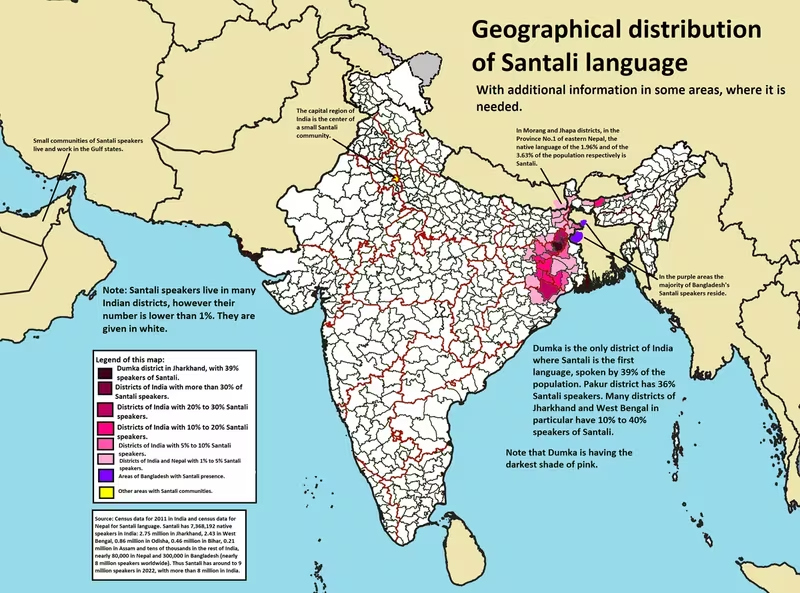
Around 7.6 million people speak Santali in India, Bangladesh, Bhutan, and Nepal. India contains the largest number of speakers, especially in Jharkhand, West Bengal, and Odisha. Santali is also one of the 22 languages listed in the Eighth Schedule of the Constitution of India and is an additional official language of Jharkhand and West Bengal.
The language combines a distinctive phonology, complex verbal morphology, topic-prominent clause structure, and a strong tradition of oral performance. It is written in Ol Chiki as well as Bengali-Assamese, Odia, Devanagari, and Latin writing systems. Its historical record includes dictionaries, grammars, folk-tale collections, songs, magazines, poetry, and modern educational and institutional use.
Origins and Classification
Linguistic Family
Santali is a Kherwarian Munda language within the Austroasiatic family. It is related to Ho and Mundari and is the most widely spoken language of the Munda subfamily. Austroasiatic languages are represented in South Asia and Southeast Asia; Santali is the third-most spoken Austroasiatic language after Vietnamese and Khmer.
Within the Munda branch, linguists describe Santali as phonologically conservative. Unlike several Munda languages whose vowel systems have been restructured and reduced to five vowels, Santali retains a larger inventory of cardinal vowels in many varieties. Its structure also preserves features associated with Kherwarian languages, including vowel harmony in morphology, suffixing agglutination, complex verbal templates, and flexible lexical categories.
Santali and Sora are considered less restructured than other Munda languages in respect of their morphosyntax. They have experienced less influence from Indo-Aryan and Dravidian languages than some other Munda languages, although contact with surrounding languages has affected vocabulary, pronunciation, and certain grammatical patterns.
Origins
According to linguist Paul Sidwell, speakers of the proto-Munda language ancestral to Santali probably arrived on the coast of Odisha from Indochina about 4000–3500 years ago. These communities spread before the Indo-Aryan migration to the Chota Nagpur Plateau and adjoining areas.
The early history of Santali is therefore connected with the wider prehistoric movement of Munda-speaking populations in eastern South Asia. The available account describes the ancestral language as proto-Munda rather than assigning Santali to a single historically documented ancestor. Santali later developed within the Kherwarian branch, alongside related languages such as Ho and Mundari.
For much of its history, Santali was transmitted without a widely established literary script. Oral communication, songs, stories, folktales, and performance traditions played a central role. Written documentation began much later, especially from the mid-nineteenth century.
Name Etymology
Santals refer to themselves as hɔɽ, meaning “man,” and call their language hɔɽ rɔɽ, or “language of the Santals.” The language is also called mãjhi bhasa, meaning “language of the Majhis.” When asked about their caste, Santals may use maɲjhi or mãjhi, terms associated with a village headman or chief.
The language has several regional names. In North Bengal it is known as jaŋli or pahaɽia. In Bihar it is called parsi, meaning “foreign.” In Nepal it is known as Satar.
The name Santal itself has more than one proposed explanation. It was derived by Bengalis from Sāmanta-pāla, interpreted as “dwellers of the frontiers.” L. O. Skrefsrud proposed another explanation: that the name came from Sãot, a place in the Midnapore region of West Bengal where Santals were believed to have settled in remote antiquity.
Historical Development
Proto-Munda and Early Kherwarian Background
The deep history of Santali is reconstructed through linguistic comparison rather than through early written records. Proto-Munda speakers ancestral to Santali probably reached the Odisha coast approximately 4000–3500 years ago after arriving from Indochina. They subsequently spread toward the Chota Nagpur Plateau and nearby regions.
Santali belongs to the Kherwarian group of Munda languages. Its relationship to Ho and Mundari is visible in several structural characteristics, including suffixing morphology, vowel harmony, expressive formations, and patterns of verbal indexing. Comparative work also connects Santali vocabulary with other Austroasiatic languages.
The early stages of the language are not represented by a continuous written record. Santali remained non-literary until the nineteenth century, so the historical development of its earliest forms must be approached through comparative linguistics, regional distribution, and later documentation.
Pre-Literary Santali
Before the development of modern written traditions, Santali was primarily an oral language. Its oral character did not imply an absence of cultural complexity. Santali expressives, storytelling, songs, folktales, and performance traditions preserved detailed systems of imagery, emotion, sound symbolism, and social knowledge.
Expressives are especially important in Santali cultural life. They may depict sounds, sensations, emotions, attitudes, and visual impressions. Santals describe these forms as benta katha, or “twisted speech,” a mode of discourse characterized by metaphorical depth. Expressives occur prominently in music, storytelling, folktales, and poetry.
Early Documentation in the Nineteenth Century
Santali began to be documented more systematically during the middle of the nineteenth century, when European interest in the languages of India produced primers, dictionaries, grammatical descriptions, and collections of oral literature.
Jeremiah Phillips published an A Santali Primer in 1845 and An Introduction to the Santali Language in 1852. Later work by A. R. Campbell, Lars Skrefsrud, Paul O. Bodding, and others recorded Santali vocabulary, grammar, folk tales, and sound patterns.
The language was initially written with the Latin alphabet. Bengali, Devanagari, and Odia scripts were also used by European-American anthropologists, folklorists, and missionaries. These efforts produced important records of Santali morphology, syntax, phonetics, and oral literature.
Among the major early works were:
- F. T. Cole’s Glossary of Santali, published in 1879.
- Lars O. Skrefsrud’s A Grammar of the Santhal Language, published in 1873.
- A. R. Campbell’s A Santali-English Dictionary, published in 1899.
- Paul O. Bodding’s A Santal Grammar for the Beginners, first published in 1929.
- Paul O. Bodding’s A Santal dictionary, published in 1929.
- Santali Folk Tales, edited by Bodding and issued in three volumes between 1923 and 1929.
By the late nineteenth century, Santal intellectuals also began using several scripts to write books, stories, and poems in Santali.
Magazines and Written Public Culture
The development of magazines expanded the written public sphere of Santali. The first Santali weekly magazine in the Latin alphabet, Pera Ho̠ṛ, was established in 1922. It was followed by Marshal Tabon in 1946.
Other publications used different writing systems:
- Ho̠ṛ So̠mbad, a Bihar-run Devanagari publication, appeared in 1947.
- Pachim Bangla, written in Bengali script, began in 1956.
- Jug Siriro̠l, written in Latin script, has appeared since 1971.
- Bangladesh-based monthly magazines Aboak’ kurumuTureak’ Kurai and GoDet’ are written in Bengali script and published from Rangpur and Dhaka.
These publications demonstrate that Santali literary and journalistic activity developed through several scripts rather than through a single writing system from the beginning.
The Development of Ol Chiki
In 1922, Sadhu Ramchand Murmu from the Jhargram district of West Bengal attempted to create a Santali script called Monj Dander Ank. It did not gain wide popularity.
In 1925, Raghunath Murmu from the Mayurbhanj district of Odisha developed Ol Chiki. The script was first publicised in 1939 and eventually became widely adopted. It is now regarded as the official script for Santali literature and language across West Bengal, Odisha, and Jharkhand.
The creation of Ol Chiki was significant because it provided an indigenous writing system associated directly with Santali language and literary expression. Santali continues, however, to be written in other scripts. Bengali script is particularly used by Santali writers in Bangladesh.
Constitutional Recognition
Santali was added to the Eighth Schedule of the Constitution of India in 2003 through the 92nd Amendment Act. This gave the language official recognition and the right to be used in government communication, education, and competitive examinations.
In December 2013, the University Grants Commission introduced Santali as a subject in the National Eligibility Test. This enabled Santali to be used for lectureship and as a medium of instruction in colleges and universities.
Scripts and Writing Systems
Ol Chiki
Ol Chiki is an indigenous alphabetic writing system developed by Raghunath Murmu in 1925. It was publicised in 1939 and later became widely adopted for Santali literature and language in West Bengal, Odisha, and Jharkhand.
The script is closely associated with modern Santali literary identity. Its development followed earlier attempts to represent Santali through Latin, Bengali, Devanagari, and Odia writing systems. Ol Chiki is now considered the official script for Santali literature and language in the principal Indian regions where it is used.
Santali written in Ol Chiki appears in literary works, educational materials, magazines, and translations. The Universal Declaration of Human Rights has also been presented in Santali using Ol Chiki.
Bengali-Assamese Script
The Bengali-Assamese script was among the earliest systems used to record Santali. European and American missionaries, anthropologists, and folklorists used it alongside Latin, Devanagari, and Odia.
Bengali script remains especially important in Bangladesh. The Bangladesh-based Santali monthly magazines Aboak’ kurumuTureak’ Kurai and GoDet’ are written in Bengali script. Santali-speaking communities in parts of West Bengal and other eastern regions have also used Bengali script for publications.
Odia Script
Odia was another early regional writing system used for Santali documentation. Its use is associated especially with Odisha, where Santali has a substantial speaker population and where Raghunath Murmu, the creator of Ol Chiki, came from Mayurbhanj district.
Devanagari
Devanagari was used in early documentation and later publication. Ho̠ṛ So̠mbad, a Bihar-run Santali publication, appeared in Devanagari in 1947.
Latin Alphabet
The Latin alphabet was used in the earliest stages of modern Santali documentation. It appears in primers, dictionaries, grammatical works, and literary publications. Pera Ho̠ṛ, established in 1922, was the first Santali weekly magazine in the Latin alphabet. Jug Siriro̠l, published since 1971, is another Latin-script publication.
Script Evolution
Santali’s script history reflects both regional multilingualism and the development of indigenous literary institutions. In the nineteenth century, the language was written with scripts already used by missionaries and neighboring language communities. Latin, Bengali, Devanagari, and Odia were all used for documentation and publication.
The creation of Ol Chiki in 1925 introduced a script designed specifically for Santali. Its later spread did not eliminate other writing systems. Instead, Santali writing remains plural: Ol Chiki is prominent in India, Bengali is used by Santali communities in Bangladesh, and Bengali-Assamese, Odia, Devanagari, and Latin continue to have historical or regional roles.
Geographic Distribution
Historical Spread
Santali is native to India and is spoken across eastern and central parts of South Asia. According to the historical account of its development, proto-Munda speakers ancestral to Santali arrived on the Odisha coast from Indochina about 4000–3500 years ago. They spread before the Indo-Aryan migration into the Chota Nagpur Plateau and adjacent areas.
The scattered distribution of Santali communities has contributed to the development of regional differences. The language is spoken in many separate pockets within one of the most densely populated parts of India. As a result, dialects have become increasingly distinct in phonology, morphology, and lexicon.
Modern Distribution in India
The 2011 census recorded 7,368,192 Santali speakers in India, including 358,579 Karmali and 26,399 Mahli speakers in the reported total.
The largest state-level concentrations are:
- Jharkhand: approximately 2.75 million speakers.
- West Bengal: approximately 2.43 million.
- Odisha: approximately 0.86 million.
- Bihar: approximately 0.46 million.
- Assam: approximately 0.21 million.
A few thousand speakers are also found in Chhattisgarh and in northeastern states including Tripura, Arunachal Pradesh, and Mizoram.
The highest concentrations occur in:
- The Santhal Pargana division of Jharkhand.
- East Singhbhum and Seraikela Kharsawan districts of Jharkhand.
- The Jangalmahals region of West Bengal, including Jhargram, Bankura, and Purulia.
- Mayurbhanj district of Odisha.
Smaller communities are found across the northern Chota Nagpur Plateau, including Hazaribagh, Giridih, Ramgarh, Bokaro, and Dhanbad. In Odisha, smaller pockets occur in Balesore and Kendujhar. In West Bengal, Santali is spoken in districts including Birbhum, Paschim Medinipur, Hooghly, Paschim Bardhaman, Purba Bardhaman, Malda, Dakshin Dinajpur, Uttar Dinajpur, Jalpaiguri, and Darjeeling.
In Bihar, speakers are found in Banka district and the Purnia division, including Araria, Katihar, Purnia, and Kishanganj. In Assam, Santali communities occur in tea-garden regions including Kokrajhar, Sonitpur, Chirang, and Udalguri.
Santali Outside India
Santali is spoken by communities in Bangladesh, Bhutan, and Nepal. Outside India, important concentrations include the Rangpur and Rajshahi divisions of northern Bangladesh and the Morang and Jhapa districts in the Terai of Nepal’s Koshi Province.
India remains the native country of Santali and has the largest number of speakers among the four countries where it is spoken. Across India, Bangladesh, Bhutan, and Nepal, the total speaker population is around 7.6 million.
Northern and Southern Dialect Spheres
Santali has at least two major dialect spheres: Northern Santali and Southern Santali. George Campbell identified these as the two principal dialects, and later data gathered by Ghosh and Kobayashi and colleagues supports this distinction.
Northern Santali speakers are concentrated in:
- Santhal Pargana division, including Godda, Deoghar, Dumka, Jamtara, Sahibganj, and Pakur.
- Hazaribagh and the wider North Chota Nagpur division.
- Purnia and Bhagalpur divisions in Bihar.
- Malda division, Birbhum, Bankura, Murshidabad, Cooch Behar, and Jalpaiguri in West Bengal.
Southern Santali speakers predominantly live in:
- Southern Bankura, Purulia, and Paschim Medinipur in West Bengal.
- Gumla, Simdega, and the Singhbhum districts of Jharkhand.
- Balesore, Kendujhar, and Mayurbhanj in Odisha.
The dialects differ in their phoneme inventories, vocabulary, and, to some extent, morphology. Southern Santali has six phonemic vowels, while Northern Santali has eight or nine. Borrowing from neighboring languages has contributed to lexical differences. Ghosh observed that the local borrowings in the two dialects can be so extensive that one variety may sometimes be difficult for speakers of the other to understand.
Literary Heritage
Oral Literature
Santali literary culture has deep roots in oral performance. Before the development of modern writing systems, songs, folktales, storytelling, and poetry carried language, cultural knowledge, imagery, and social memory.
Santali expressives have a particularly prominent role in oral genres. Their meanings may involve sound, movement, emotional state, sensory experience, visual appearance, or manner of action. They occur frequently in music, storytelling, folktales, and poetry.
Early collectors documented this oral heritage in print. J. Murray Mitchell published Santali songs with translations and notes in 1875. F. T. Cole published Santali folklores in the same year. A. Campbell published Santal folk tales in 1891. Paul O. Bodding later edited the three-volume Santali Folk Tales, published between 1923 and 1929.
Santali Songs and Poetry
Songs and poetry form an important part of Santali literary history. The early publication of Santali songs with translations and notes helped place the language’s oral traditions into a documented literary record.
Santali poetry also demonstrates the importance of expressives. Such forms are not merely decorative words: they convey detailed metaphorical and sensory meanings. Their presence in poetry reflects the connection between language structure and performance traditions.
The literary record includes the work associated with Raghunath Murmu and Sadhu Ramchand Murmu, as well as later publications in Ol Chiki, Latin, Bengali, Devanagari, and other scripts. The source record also identifies Santali Genesis Translation and the newspaper The Dishom Beura, described as India’s first Santali daily newspaper.
Folk Tales
Folk tales are among the best-documented forms of early Santali literature. Bodding’s three-volume collection, issued between 1923 and 1929, represents a major contribution to the preservation of Santali oral narratives. Campbell’s Santal folk tales and Cole’s folklore publications belong to the earlier period of collection and documentation.
A later example is the story Kɔki gɔ, meaning “Stepmother.” It was narrated by a forty-year-old Santal man from Jitpur village in Jamtara, Santal Parganas, Jharkhand, and was collected, translated, and annotated by Ghosh in 2008.
Grammars, Primers, and Dictionaries
Santali’s written tradition includes a considerable body of linguistic and educational work. Jeremiah Phillips published an early primer in 1845 and an introduction to the language in 1852. F. T. Cole published a Santali primer in 1896. Skrefsrud published a grammar in 1873, and Bodding produced a grammar for beginners in 1929.
Dictionaries include:
- A Santali dictionary, by Paul O. Bodding.
- A Santali-English dictionary, by A. R. Campbell.
- English-Santali dictionary, by W. Martin.
- An Introduction to Santali, by R. M. Macphail.
- Santali basic lexicon with grammatical notes, by Minegishi and Murmu.
These works document both vocabulary and grammatical structure, including the language’s distinctive sound system, morphology, and verbal patterns.
Magazines and Newspapers
Santali magazines and newspapers have been published in several scripts. The history of periodicals includes Pera Ho̠ṛ, Marshal Tabon, Ho̠ṛ So̠mbad, Pachim Bangla, and Jug Siriro̠l.
Bangladesh-based monthly magazines Aboak’ kurumuTureak’ Kurai and GoDet’ are written in Bengali script. The development of Santali journalism illustrates the language’s continued use in public communication across national and regional boundaries.
Grammar and Phonology
Agglutinating Morphology
Santali is a suffixing agglutinating language. Nouns are inflected for number and case, while verbs may express tense, aspect, mood, voice, and the person and number of the subject and sometimes the object.
Three numbers are distinguished:
- Singular.
- Dual.
- Plural.
The case suffix follows the number suffix. Santali also has possessive suffixes used specifically with kinship terms:
- First person: -ɲ
- Second person: -m
- Third person: -t
These possessive suffixes do not distinguish the number of the possessor.
Definiteness is marked morphologically. The suffix -tɛˀt is used with nouns, while -ʈaˀk is used with pronouns.
Flexible Lexical Categories
The classification of Santali words into nouns, verbs, adjectives, and other parts of speech is the subject of significant linguistic debate. Traditional descriptions identify forms that take case as nominal and forms that take tense-aspect-mood, person, and number as verbal. More recent analyses describe Santali as a flexible language.
Under this analysis, many lexemes are not permanently assigned to a single lexical category. A lexeme may function in a referential role, a predicative role, or an attributive role. Nominal-looking forms may appear as predicates, while words with meanings usually associated with verbs may function in other syntactic positions.
Neukom estimated that about one-third of Santali contentives are rigid, underived verbs restricted to predicative use. Other lexemes, including nominals, proforms, adpositions, and derived forms, may be syntactically flexible. The Oxford Handbook of Word Classes classifies Santali as a Type I flexible language.
This flexibility extends to proper names, interrogatives, indefinites, adjective-like words, mimetic sounds, postpositional phrases, and other complex expressions. Nominal roots can take verbal inflection without requiring a separate lexical derivation. The result is a system in which the predicative role is often determined by syntactic configuration rather than by a fixed noun–verb distinction.
Gender and Animacy
Santali does not have a true grammatical gender distinction on nouns and verbs comparable to the gender systems of Sanskrit, Hindi, other Indo-Aryan languages, or Dravidian languages.
Animacy and inanimacy may be distinguished through peripheral markers such as genitive and locative markers, nominalizers, and verbal agreement. Lexical gender can be expressed in several ways.
Some gender contrasts use modifiers borrowed from Indo-Aryan, such as -i for feminine and -a for masculine. Examples include:
- kuɽa “boy” – kuɽi “girl”
- bhola “dog” – bholi “bitch”
- mama “maternal uncle” – məni “maternal aunt”
- bheɖa “ram” – bheɖi “sheep”
Other words are inherently sex-based:
- dʒãwaj “husband” – bəhu “wife”
- bɔeha “brother” – misɛra “sister”
- ənɖiə “ox” – gəi “cow”
- kaɖa “male buffalo” – bitkil “female buffalo”
Gender can also be expressed through compounds. Masculine compounds may use words such as ənɖiə, sanɖi, pɛ̄ʈhar, and kuɖu, while feminine compounds may use ɛŋga, bətʃhi, and pəʈhi.
Pronouns
Santali personal pronouns distinguish inclusive and exclusive first-person forms. Third-person forms distinguish anaphoric and demonstrative uses.
Interrogative pronouns distinguish animate “who?” from inanimate “what?” They also distinguish referential “which?” from non-referential forms.
Demonstratives distinguish three degrees of deixis:
- Proximate.
- Distal.
- Remote.
They also distinguish simple forms such as “this” and “that” from particular forms meaning “just this” or “just that.”
Dual forms may be used honorifically. In contemporary usage, speakers increasingly use pronominal duals to express respect toward senior, highly regarded, or unfamiliar people.
Verb Systems
Santali verbs inflect for tense, aspect, mood, voice, and person and number. Transitive verbs may also index pronominal objects through infixes. In applicative constructions, inanimate objects may be represented by a checked pronominal suffix -ˀk.
The tense-aspect-mood system is highly complex. Tense, aspect, and voice are fused into interlocking verbal subtemplates, making it difficult to isolate a single morpheme corresponding to a single grammatical category.
Two broad voice sets are especially important:
- Active forms are associated with unmarked, transitive, volitional, and outwardly directed meanings.
- Middle forms are associated with intransitive, self-directed, and avolitional meanings.
The system includes non-past and past categories. The past is further divided into anterior and aorist forms. Imperfective and perfective forms have separate subtemplates, while imperative and prohibitive forms follow their own patterns.
Santali has applicative forms in the future, imperfective, past 1, and perfect tenses, with an additional and rare past 2 form in cases involving inanimate objects.
Existential and Possessive Verbs
The lexemes mena, “to be,” and hena, “to have,” have irregular templates. Their subject pronominal markers occur as suffixes in the position normally associated with object markers.
Constructions involving these verbs are conjugated in the middle voice to express existence, possession, and location. The verb mena appears to derive from originally middle, intransitive predicate bases with an unusual pronominal pattern. Other inherently intransitive and non-volitional predicates may show related irregular behavior.
Derivation
Santali forms new nominals through affixation, reduplication, compounding, and infixation.
Two nominalizing suffixes include:
- -iˀtʃ for animate referential nominals.
- -aˀk for inanimate referential nominals.
Examples include:
- dʒɔm “eat” → dʒɔmaˀk “food”
- ponɖ “white” → ponɖaˀk “white thing” or ponɖiˀtʃ “white one”
- ɔl-tɛ “write-INSTRUMENTAL” → ɔltɛaˀk “that with which is written,” or “pen”
Infixation is described as the most productive derivational method. Infixes include -tV-, -nV-, -mV-, -ɽV-, and -pV-:
- ɛhɔˀp “begin” → ɛtɔhɔˀp “beginning”
- rakaˀp “rise, ascend” → ranakaˀp “development”
Prefixation has been reduced in North Munda to a small number of restricted exceptions. One example is:
- tʃɛt “teach” → matʃɛt “teacher”
Causative, Reciprocal, and Voice Formation
Santali has two causative markers, a- and -otʃo. The suffix -otʃo attaches to all types of verb stems, while a- is restricted to the transitive verbs jɔm, “eat,” and ɲu, “drink.”
The infix -pV- forms reciprocal meanings from transitive and ditransitive roots. It may also express an action performed together:
- dal “beat” → dapal “beat each other”
- landa “laugh” → lapanda “laugh together”
The benefactive is -ka in Northern Santali and -ka-k in Southern Santali. Southern forms replace the final -k with pronominal clitics when the object is animate.
The medio-passive uses -jɔn. Passive stems are formed with -ok, while attaching -ok to transitive verbs may create reflexive meanings:
- ɲɛl “see” → ɲɛlok “be seen”
- ranotʃo “cause to medicate” → ranotʃok “be caused to medicate”
- mak “cut” → makok “cut oneself”
Santali does not have noun incorporation.
Serial and Auxiliary Verb Constructions
Two or more verbs and modifiers may combine to create compound verbs. Common combinations include two transitive verbs or two intransitive verbs, with more limited transitive–intransitive and intransitive–transitive combinations.
Complex predicates are widespread. Simple verbs such as “go,” “become,” “finish,” “come,” and “try” may function as auxiliaries, adding meanings of modality, aspectual action, aktionsart, or orientation.
The verb gɔt, “pluck,” may serve as an auxiliary expressing telicity, including a quick, sudden, or intense action. Santali auxiliary verb constructions can show a split-doubled pattern in which the lexical verb indexes the object and the auxiliary indexes the subject.
Two frequently used auxiliary verbs are daɽe, “can,” and lega, “try.” The former often occurs with an active applicative suffix, while the latter is generally associated with middle tense-aspect-mood forms.
Negation
Santali has three principal negative particles:
- baŋ and its shortened form ba, used with interrogative and declarative sentences.
- ɔhɔ, an emphatic declarative negative.
- alo, the prohibitive negative used with imperatives.
Negative particles remove the subject marker from the verb. Existential and locative copular constructions have distinct negative patterns in the present and past. In negative past copular constructions, ban encodes the subject, while past tense is expressed by the separate copula taheken.
Syntax
Santali is strictly head-last. A typical simple noun phrase has the order:
(Demonstrative) (Quantifier) (Adjective) (Adjective) Noun
An example is noa əɖi maraŋ bir, “that very big forest.”
The usual unmarked clause order is subject–object–verb. Intransitive monovalent clauses commonly have subject–verb order. However, Santali is topic-prominent by default, and word order changes according to discourse context and pragmatic emphasis.
If the subject or agent is less topical than the object or patient, the clause may be reduced to object–verb. If no argument is topical, still more material may be omitted. Pronominal clitics indexing arguments may therefore play an important role in identifying the participants of a clause.
Santali has nominative–accusative alignment in person indexing. The subject clitic agrees with the person and number of the nominative argument, while an object infix agrees with the person and number of the accusative argument. Noun phrases themselves do not carry overt marking that directly shows their syntactic relation.
Coordinative particles express conjunctive, disjunctive, and adversative meanings. The particle mɛnkhan, “but,” may also mark switch reference in a second clause.
Subordinate clauses may be linked with:
- The converb katɛ.
- The ablative khɔn.
- The place marker ʈhɛn.
- The temporal marker khan.
- The purposive jɛmon.
Relative clauses may be linked with indefinite pronouns such as jãhã, “any,” and jãhãe, “anyone.” Correlative constructions use pronouns, interrogative pronouns, and particles including jodi, “if,” tahle, “then,” tobe, “then,” dʒɛmɔn, “as,” and tɛmɔn, “so.”
Sound System
Santali has 21 consonants, excluding ten aspirated stops that occur primarily, though not exclusively, in Indo-Aryan loanwords. The sound ɳ occurs only as an allophone of /n/ before /ɖ/.
Native word-final stops show a neutralization between voiceless and voiced stops. Word-final stops are “checked”: they are glottalised and unreleased. Underlyingly, stops in coda position are voiced, but they are normally preglottalized and devoiced. Voicing may optionally reappear before vocalic suffixes.
No Santali lexemes begin with /ɽ-/ or /ŋ-/. Prenasalized stops have also been proposed, occurring mostly in medial and coda positions.
Santali has two types of /j/. One is a hardened fricative sound produced by forcing air through a narrow gap between the front of the tongue and the hard palate. The other is an intervocalic semivowel occurring between level diphthongs in speech.
Vowels
Santali has eight oral and six nasal vowel phonemes. Except for /e/ and /o/, all oral vowels have nasalized counterparts. Nasalization is phonemic, as in:
- aɽɔt, “dense”
- aɽɔ̃t, “unsympathetic, filthy”
Southern Santali, particularly the Singhbhum variety, has a smaller six-vowel inventory: /a, i, e, o, u, ə/.
The vowel system varies geographically. Northern varieties in Jharkhand and West Bengal preserve older contrasts, while southern and peripheral varieties show greater leveling toward a symmetrical five-vowel system. The Assam Santali dialect has achieved a non-harmonic five-vowel system, and vowel harmony appears to have disappeared entirely in the Odisha dialect.
Santali has numerous diphthongs and triphthongs. A form such as kɔeaeae, meaning “he will ask for him,” contains six consecutive vowels. In level diphthongs such as /ea, ia, io, iu, oa, ua/, semivowels /w/ and /j/ are often inserted in speech, separating the sequence into two syllables.
Stress and Vowel Harmony
Santali prosody is generally iambic. In most disyllabic words, stress is released on the second syllable. Loanwords from Hindi, Bihari, Bengali, and Assamese may follow different patterns.
In trisyllabic words, a process called V2 deletion may remove the second vowel, converting an apparent trisyllable into two heavy syllables. Stress nevertheless remains on the second syllable. The example /hapaɽam/, “ancestor,” may be realised as [hapˈɽám].
Vowel harmony is a morphological process found across Kherwarian languages. In Santali it is based on vowel height, although its strength varies by region. Sonitpur Santali in Assam has lost vowel harmony, whereas the process remains active in neighboring Udalguri.
Important restrictions include:
- /e/ and /o/ do not co-occur with /u/ in the same stress unit.
- /ɛ/ and /ɔ/ do not co-occur with /e/ and /o/.
- Syllables containing /i/ and /u/ co-occur with /ə/ but not /a/.
- /a/ can co-occur with /e, o, ɛ, ɔ/, whereas /ə/ cannot.
- /e/ may alternate with /i/ after a syllable ending in /u/ or /ə/.
These patterns are not uniform across all words or dialects. Longer structures, including trisyllabic and tetrasyllabic forms, do not always follow the restrictions consistently.
Expressives
Santali expressives form a distinctive part of the language. They can communicate complex sound symbolism, emotional states, attitudes, sensory images, and manner of action. Their formation includes reduplication, consonant augmentation, and vowel mutation.
One pattern simply repeats the first element:
- ahal ahal, “distressed”
- atrɔm atrɔm, “incompletely”
- baɖgɔˀt baɖgɔˀt, “rough”
- dʒeleˀp dʒeleˀp, “flashing”
- məkur məkur, “sound of crunching”
Another pattern adds a consonant to the repeated element:
- əbuˀk tʃəbuˀk, “here and there”
- abɛ tabɛ, “just at the time of”
- adha padha, “unfinished”
- albaʈ salbaʈ, “contradictory”
Vowel mutation produces forms such as:
- adha padhə, “half”
- agaɽ bigəɽ, “topsy-turvy”
- əhir kuhir, “fix the eyes upon”
- batʃaˀk botʃoˀk, “nonsensical”
- bhaɽ bhuɽ, “crashing noise”
- tʃaʈa tʃuʈu, “crackle”
The initial and medial consonants of the first element may also alternate, as in:
- kadar kapar, “rubbish”
- hadraˀk gasraˀk, “stumblingly”
Expressives are not tightly constrained by ordinary syntactic rules. Their importance in music, folktales, storytelling, and poetry makes them a central part of Santali communicative and cultural practice.
Influence and Legacy
Languages Influenced
Santali has contributed words to several neighboring Indo-Aryan languages, including Sadri, Khortha, and Kurmali.
Examples include:
- Khortha gidʌr, “child,” from Santali gidrə.
- Kurmali nisʈai, “exactly, truly,” from Santali niʈsahi.
These borrowings show that influence has not moved only toward Santali. Santali has also shaped the vocabularies of neighboring regional languages.
Languages and Contact Influences
Santali has borrowed vocabulary from Hindi, Sadri, Khortha, Angika, Maithili, Assamese, Bengali, Nepali, Odia, and English. Persian vocabulary has also entered through Indo-Aryan languages.
Words from neighboring languages may account for almost 20 percent of the lexemes used for daily needs. Younger speakers with opportunities for higher education are more likely to encounter lexical influence from neighboring languages and English.
Examples include:
- rəskə, “joy,” from Hindi rasika.
- haʈ, “market,” from Hindi hāʈ.
- kagodʒ/kagotʃ, “paper,” from Persian kāgaz through Indo-Aryan.
- kuʈəm/kutɨsi, “hammer,” from Sadri kuʈasi.
- rəs, “heap,” from Bengali raʃi.
- bhəgnə, “nephew,” from Bengali bhagina/bhagna.
A limited number of words are shared between Santali and Kuṛux, but their historical relationship is difficult to establish because similar forms occur across other Munda and Indo-Aryan languages. A few lexical similarities also occur between Munda and Tibeto-Burman languages, possibly reflecting earlier contact.
Austroasiatic Connections
Many Santali terms share origins with words in other Austroasiatic languages. Comparative examples include:
- Santali kʰɛt, “rice,” and Khasi khaw, from proto-Austroasiatic *rŋkoːˀ, “husked rice.”
- Santali tʃʰal, “tree bark,” and Wa hak, “skin,” from proto-Austroasiatic *saːkˀ, “skin.”
- Santali bir, “forest,” and U qí, “forest,” from proto-Austroasiatic *briːˀ, “wilderness, forest.”
- Santali dʒʱik, “porcupine,” and Khasi dŋkʰiet, “porcupine,” from related proto-Austroasiatic forms.
These comparisons place Santali within a wider Austroasiatic history while also showing the distinct phonological and lexical developments of the Santali branch.
Cultural Impact
Santali’s cultural influence is strongly connected with its oral and performance traditions. Expressives, songs, storytelling, folktales, and poetry remain central to the language’s cultural life. The development of Ol Chiki provided an indigenous script for these traditions and supported the growth of modern Santali literature.
Santali’s influence also appears in neighboring languages through lexical borrowing. Its constitutional recognition and appearance in education and competitive examinations have expanded its role beyond home and community use into formal communication, higher education, and public institutions.
Royal and Religious Patronage
Community and Literary Institutions
The historical record does not identify a royal dynasty as the principal patron of Santali. Its written development instead involved Santal writers, intellectuals, missionaries, folklorists, anthropologists, magazines, literary boards, and educational institutions.
Raghunath Murmu’s creation of Ol Chiki, the publication of Santali magazines, and the work of dictionary and grammar writers were central to the language’s literary development. The Santali Literature Board and the Santali Christian Council are associated with published language-learning and literary materials.
Religious and Missionary Documentation
Missionaries played an important role in the early written documentation of Santali. Jeremiah Phillips, Lars Skrefsrud, A. R. Campbell, and Paul O. Bodding produced primers, grammars, dictionaries, and collections of folk tales.
This work recorded Santali vocabulary, morphology, syntax, phonetics, and oral literature. It also established some of the earliest sustained written descriptions of the language.
Institutional Recognition
The constitutional recognition of Santali in 2003 gave it a formal place in government communication, education, and competitive examinations. The introduction of Santali as a subject in the National Eligibility Test in 2013 further supported its use in lectureship and as a medium of instruction in higher education.
Modern Status
Current Speakers
Santali is a living language spoken by around 7.6 million people in India, Bangladesh, Bhutan, and Nepal. The 2011 Indian census recorded 7,368,192 Santali speakers, including the Karmali and Mahli figures reported in the census total.
India has the largest Santali-speaking population. Jharkhand and West Bengal contain the largest state-level concentrations, followed by Odisha, Bihar, and Assam.
Official Recognition
Santali is one of India’s 22 scheduled languages. It was included in the Eighth Schedule of the Constitution through the 92nd Amendment Act in 2003.
It is also recognized as an additional official language of Jharkhand and West Bengal. Its scheduled status gives it the right to be used in government communication, education, and competitive examinations.
Writing and Education
Santali is primarily written in Ol Chiki in West Bengal, Odisha, and Jharkhand. Bengali script is used by Santali communities in Bangladesh. Bengali-Assamese, Odia, Devanagari, and Latin writing systems also have historical and regional roles.
The University Grants Commission introduced Santali as a subject in the National Eligibility Test in December 2013. This enabled Santali to serve as a subject for lectureship and as a medium of instruction in colleges and universities.
Contemporary Linguistic Change
Santali dialects are becoming increasingly distinct because speakers are distributed among many separate communities. Differences appear in phonology, morphology, and vocabulary.
The strongest contrast is between Northern and Southern Santali. Southern Santali has a smaller vowel inventory, while northern varieties preserve more contrasts. Assam and Odisha varieties show substantial reduction or loss of vowel harmony, while northern varieties in Jharkhand and West Bengal preserve older oppositions.
Contact with neighboring languages continues to affect vocabulary and pronunciation. At the same time, the language retains a substantial native Austroasiatic and Munda vocabulary and remains structurally distinctive within the South Asian linguistic area.
Learning and Study
Academic Study
Santali has been studied through grammars, dictionaries, primers, comparative works, phonological descriptions, and research on syntax and word classes.
Important areas of study include:
- Its classification within the Munda and Austroasiatic families.
- Northern and Southern dialect differences.
- Its large and geographically variable vowel system.
- Vowel harmony and its regional decline.
- Checked word-final stops.
- Flexible lexical categories.
- Complex tense-aspect-mood and voice systems.
- Person indexing and animacy.
- Expressives and oral performance.
- Contact with Indo-Aryan and neighboring languages.
The language has also been discussed in research on flexible word classes, Munda verb typology, argument marking, language contact in Jharkhand, relative clauses, expressive forms, and Kherwarian negation and tense-aspect-mood systems.
Dictionaries and Grammars
Learners and researchers can draw on a long tradition of language description, including:
- Jeremiah Phillips, A Santali Primer.
- Jeremiah Phillips, An Introduction to the Santali Language.
- Lars O. Skrefsrud, A Grammar of the Santhal Language.
- F. T. Cole, Santạli primer.
- Paul O. Bodding, A Santal Grammar for the Beginners.
- Paul O. Bodding, A Santal dictionary.
- A. R. Campbell, A Santali-English dictionary.
- W. Martin, English-Santali dictionary.
- R. M. Macphail, An Introduction to Santali.
- Minegishi and Murmu, Santali basic lexicon with grammatical notes.
- Jagneswar Saren, Ranakap Santali Ronor, or Progressive Santali Grammar.
These materials reflect the evolution of Santali study from early missionary documentation to modern linguistic analysis.
Digital and Archival Resources
Santali is represented in language-resource and archival projects, including the OLAC resources for the Santali language and the RWAAI Repository and Workspace for Austroasiatic Intangible Heritage. Santali is also represented in the RWAAI Digital Archive.
The existence of these resources reflects the continuing documentation of Santali language, literature, and intangible cultural heritage.
Conclusion
Santali’s history connects deep Munda and Austroasiatic origins with a vigorous modern literary and institutional life. Its ancestral speakers probably reached the Odisha coast from Indochina about 4000–3500 years ago, while the language itself remained largely oral until nineteenth-century documentation began. Primers, grammars, dictionaries, folk-tale collections, songs, magazines, and newspapers then created a durable written record.
The development of Ol Chiki by Raghunath Murmu in 1925 gave Santali an indigenous script that became widely adopted in India. Yet Santali’s writing tradition remains multilingual, using Bengali-Assamese, Odia, Devanagari, and Latin systems as well. Its distinctive vowel system, vowel harmony, flexible word classes, complex verbal morphology, topic-prominent syntax, and expressive vocabulary make it a major subject of linguistic study.
With around 7.6 million speakers and constitutional recognition in India, Santali remains a living language of community, literature, education, public communication, and performance.