Overview
The history of Buddhist councils begins with a problem created by the Buddha's death: how could a teaching transmitted primarily through speech remain accurate after its teacher was no longer present to clarify it? Buddhist monastic communities, known as the sangha, responded by gathering to recite teachings together, examine disciplinary rules, settle disagreements, and preserve the memory of the Dharma.
These gatherings are commonly called Buddhist “councils,” but the Buddhist terms saṅgīti in Pali and Sanskrit carry a somewhat different emphasis. They mean “reciting together,” “joint rehearsal,” or communal recitation. The idea of shared recitation expressed harmony and unity within the monastic community. Deliberation was important, but it served the larger purpose of agreeing on a common body of teaching and discipline.
Traditions from different Buddhist schools preserve accounts of several councils. The First Council is traditionally said to have taken place soon after the Buddha's final nirvana at a cave near Rajagriha, modern Rajgir. The Second Council is placed roughly a century later at Vaishali, where a dispute about ten monastic practices became associated with the first schism in the Buddhist community. Theravada accounts describe a Third Council under the Mauryan ruler Ashoka, while Sarvastivada traditions remember a different Fourth Council under the Kushan ruler Kanishka.
Later Theravada traditions count additional councils. One was associated with the writing down of the Pali canon in Sri Lanka in the first century BCE. Another, held in Mandalay in 1871, was associated with the inscription of the Tipitaka on hundreds of marble tablets. The Sixth Council, held in Yangon from 1954 to 1956, brought together monks from several Theravada countries to compare, correct, and publish a standardized edition of the canon.
These accounts cannot be treated as a single uncontested historical sequence. Different schools describe the same disputes differently, and modern scholars have questioned the historicity of some councils or the accuracy of their preserved descriptions. Yet the traditions remain historically important. They show how Buddhist communities understood authority, textual continuity, discipline, sectarian identity, and the relationship between monastic institutions and political power.
Background
Oral transmission and communal memory
Early Buddhist teaching was preserved through oral recitation. Monks learned portions of the teaching and discipline, remembered them, and transmitted them within established reciting lineages. This system required more than individual memory. It depended on communal performance, repeated rehearsal, and agreement about the wording and arrangement of the material.
The Buddhist canon is traditionally divided into three major collections, often called the Tipitaka or Tripitaka, meaning “Three Baskets.” The Sutta Pitaka preserves discourses attributed to the Buddha and other important figures. The Vinaya Pitaka preserves rules and procedures governing monastic life. The Abhidhamma Pitaka presents more systematic analytical treatments of Buddhist doctrine.
The place of the Abhidhamma in the earliest councils is disputed. Theravada tradition holds that it was included in the first council under the category of the Sutta, and that it was associated with Sariputta. Modern academic scholarship generally places the composition of the Abhidhamma at a later date, pointing to differences in language, style, and content. This disagreement illustrates a broader problem: accounts of the councils often reflect the later doctrinal positions of the communities that preserved them.
The use of oral transmission did not mean that Buddhist communities lacked concern for textual precision. On the contrary, the very existence of specialist reciters and communal rehearsals shows the importance attached to preserving the teaching. At the same time, oral traditions could develop in different environments. Once Buddhist communities were separated by geography, language, institutional affiliation, and doctrinal interpretation, their recitations could differ.
The meaning of a saṅgīti
The English word “council” suggests a formal assembly that debates and votes on issues. Buddhist saṅgīti had a related but distinct character. The central act was collective recitation. The purpose was not simply to make a decision, but to create a shared performance through which the community affirmed its unity.
This distinction matters when interpreting the First Council. The traditional narrative includes deliberations about the monastic rules, criticism of Ananda, and the selection of senior monks. Yet these discussions are presented as preparation for the central act of recitation. The council's lasting authority comes from the communal rehearsal of the teachings and discipline.
The same term could also be used by communities with different doctrinal commitments. There was no single institution that controlled every Buddhist group. As Buddhist schools emerged, each could preserve its own account of the past and identify its own recitations as authoritative.
The First Buddhist Council
The traditional setting
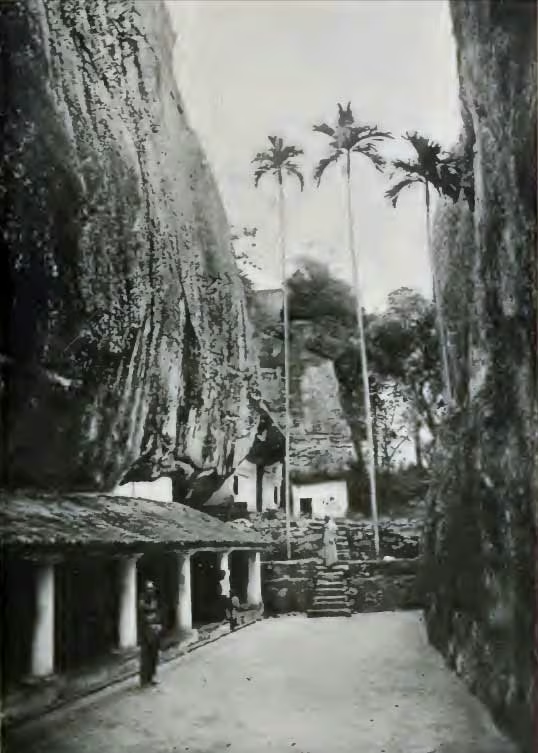
The First Buddhist Council is traditionally said to have been held shortly after the Buddha's final nirvana. Its location was a cave near Rajagriha, modern Rajgir, with the support of King Ajatashatru. Mahakasyapa, one of the Buddha's senior disciples, is said to have presided.
The purpose of the gathering was to preserve two central aspects of the Buddha's legacy: the spoken discourses, or suttas, and the monastic discipline, or Vinaya. Ananda, who had spent many years close to the Buddha, recited the discourses. Upali, remembered as an authority on monastic discipline, recited the Vinaya.
Some traditional accounts state that 499 senior monks who were arhats were chosen to attend. Ananda was not yet an arhat when the preparations began. He is said to have trained throughout the night before the council and attained arahantship by dawn, allowing him to participate.
The narrative presents the gathering as an effort to establish continuity after the Buddha's death. The Buddha would no longer be present to settle disputes or correct recitations. The authority of the community therefore rested on the memory of senior disciples and on the agreement of the assembled monks.
The question of the minor rules
A major issue concerned the Buddha's instruction that the sangha could abolish the minor rules after his passing. The council is traditionally said to have decided unanimously to retain all the rules instead.
The accounts also preserve disagreement about what counted as a minor rule and whether any rules should be removed. Some monks argued that all minor rules could be abolished. Others preferred to preserve the complete disciplinary code. The decision to retain the rules avoided the need to determine which rules were “minor,” but it also established a conservative principle: the inherited discipline would remain intact.
Several Vinaya traditions depict disagreements during the council. They also describe criticism directed at Ananda. In one Chinese parallel to the Mahaparinibbana Sutta, Mahakasyapa is portrayed as fearing that Ananda, described in the passage as resembling a layperson, might fail to recite the discourses completely because of attachment. Such passages may reflect tension between different tendencies within the early monastic community.
Bhikkhu Anālayo has suggested that these accounts could preserve memories of an actual conflict between contending factions after the Buddha's death. In this interpretation, an ascetically inclined group may have emerged as the victorious party in the stories of the First Council. The traditional narrative is therefore not only about textual preservation; it may also encode a struggle over authority and the proper character of monastic life.
What was recited?
The traditional claim that the entire Sutta and Vinaya collections were recited in their present form at the First Council is difficult to sustain without qualification. The Pali commentarial tradition itself recognizes that the Bakkula Sutta was included in the Pali discourse collections only at the Second Council. Its protagonist says that he had been a monk for eighty years, a period that exceeds the forty years usually associated with the Buddha's teaching activity. The discourse could therefore only have been spoken decades after the Buddha's funeral.
This example conflicts with the idea that the whole collection, exactly as preserved in later form, was recited at the First Council. It is possible that early versions of material now known as the Sutta Pitaka and Vinaya Pitaka were recited. The surviving accounts, however, should not automatically be read as descriptions of a complete canon identical to later editions.
The Abhidhamma presents an even clearer chronological question. Modern scholarship generally considers it a later composition because of its language, style, and systematic character. Theravada tradition places it within the first council's inheritance, while other interpretations see its development as part of a later period of scholastic organization.
Alternative recitations
The Vinayas also preserve the memory of monks who did not rely entirely on the council's textual collection. The Cullavagga tells of the arhat Purana, who said that he and his followers preferred to remember the Buddha's teaching as they had heard it. They therefore did not depend on the council's recited collection.
Related accounts appear in the Ashokavadana, the Tibetan Dulva Vinaya, Chinese versions of the Dharmagupta and Mahisasaka Vinayas, and the Vinayamatṛka Sutra. Some of these accounts mention Purana and Gavampati, who were said not to have attended the council and who worried about the future of the Dharma after the Buddha's death. Gavampati is also associated with a set of eight rules concerning food preserved by the Mahisasaka Vinaya.
Chinese sources connected with Paramartha, Jizang, and the pilgrim Xuanzang describe another alternative canon. According to these accounts, an arhat named Baspa and his followers compiled the Mahasamghikanikaya, or “Collection of the Great Assembly.” Xuanzang reported seeing a stupa near Rajgir that marked the site of this alternative council.
These stories are important because they challenge the image of one universally accepted first recension. They suggest that early Buddhist communities remembered the Buddha's teaching through more than one line of transmission.
The Historicity of the First Council
Modern scholars have not reached a single conclusion about the First Council. All six surviving Vinaya traditions of different early Buddhist schools contain accounts of the first and second councils, either in full or in part. This broad distribution has been taken by some scholars as evidence that the traditions preserve an early historical memory.
The account of the First Council also appears to continue the narrative of the Buddha's final days and death found in the Mahaparinibbana Sutta and corresponding texts in the Agamas. Louis Finot argued that the two narratives originated as a single account that was later divided between the Sutta and Vinaya collections. In many schools, the story of the First Council appears near the end of the Skandhaka section of the Vinaya, before appendices.
Other scholars have been more skeptical. Louis de La Vallée-Poussin and D. P. Minayeff considered it possible that assemblies were held after the Buddha's death, but believed that only the principal characters and some events before or after the council could be treated as historical. André Bareau and Hermann Oldenberg regarded it as possible that the account of the First Council was composed after the Second Council and modeled on it. They argued that there may not have been a major problem requiring a formal council immediately after the Buddha's death.
Other scholars have defended the account more strongly. Louis Finot, E. E. Obermiller, and, to some extent, Nalinaksha Dutt pointed to correspondences between Pali and Sanskrit traditions as evidence for an authentic historical core. Richard Gombrich has argued that large portions of the Pali Canon date back to the First Council.
The debate therefore involves two separate questions. The first is whether a gathering of senior monks took place after the Buddha's death. The second is whether the later narrative accurately describes its participants, procedure, and textual achievements. A historical assembly may have existed even if the later claim that the entire canon was recited in its final form is an exaggeration.
The Second Buddhist Council
Vaishali and the ten points
The Second Buddhist Council is traditionally placed about one hundred years after the Buddha's parinirvana. It was held at Vaishali, in the Valukarama, under the patronage of King Kalashoka.
The historical records for the council come primarily from the canonical Vinayas of different schools. These accounts differ in detail but agree that monks at Vaishali were accused of accepting money and following lax practices. The controversy was brought to a head when the monk Yasa Kakandakaputta challenged the practices publicly.
The ten disputed points in the Theravada Cullavagga were:
- Storing salt in a horn.
- Eating after noon when the sun's shadow had passed two finger-widths beyond midday.
- Eating once and then returning to the village for alms.
- Holding the uposatha separately when monks lived in the same district.
- Conducting an official act when the assembly was incomplete.
- Following a practice because it had been followed by one's teacher.
- Eating sour milk after having taken the midday meal.
- Drinking a strong beverage before it had fermented.
- Using blankets with an unstitched hem.
- Accepting gold and silver.
The last point, the acceptance of money, was especially important because it touched the relationship between monastic renunciation and lay patronage. The rules were not simply technical regulations. They expressed a broader question about how strictly the monastic community should separate itself from ordinary economic practices.
The investigation and the council
After condemning the practices, Yasa is said to have left Kosambi and sought support from monks in different regions. He summoned elders from Pava in the west and Avanti in the south, consulted Sambhuta Sanavasi in Ahoganga, and then sought the advice of Revata and Sabbakami at Valikarama.
The council that followed declared the ten points invalid. A recital of the Dharma then took place, involving seven hundred monks under the leadership of Soreyya-Revata. According to the Theravada account, the recital lasted eight months.
The Vaishali dispute is traditionally associated with the first schism in the Buddhist community. The monks who rejected the ten practices are presented as the orthodox side in Theravada accounts. The Vajiputtakas, who refused to accept the council's decision, are said to have formed the Mahāsāṃghika school, numbering ten thousand monks, and to have held a separate recital.
This description is not accepted by all traditions. Mahāsāṃghika accounts reverse the accusation. They claim that the Sthaviras, or “Elders,” wanted to add rules to the Vinaya. The Mahāsāṃghika Prātimokṣa contains sixty-seven rules in the śaikṣa-dharma section, while the Theravada version contains seventy-five. The Mahāsāṃghika Vinaya describes the disagreement as a dispute over additions made by the Sthaviras.
The Śāriputraparipṛcchā, a Mahāsāṃghika text, tells of an old monk who copied, rearranged, developed, and augmented the Vinaya associated with Mahakasyapa. According to the account, the king judged that both parties preserved teachings attributed to the Buddha but that their preferences differed. The larger group studying the old Vinaya became known as the Mahāsāṃghikas, while the smaller group studying the revised Vinaya became known as the Sthaviras.
Because the surviving traditions make conflicting claims, no clear conclusion can be reached about which Vinaya was original or which group altered it. The dispute itself, however, appears to preserve an important memory: Buddhist communities were already debating the authority of inherited disciplinary rules and the legitimacy of textual revision.
The First Schism and the Five Points of Mahādeva
A different explanation for the first schism appears in several Sthavira sources, including the Theravada Dipavamsa. According to this version, another meeting took place at Pataliputra about thirty-five years after the Second Council. Its subject was a set of five points associated with a figure named Mahadeva.
The five points presented the arhat as capable of imperfection or fallibility. They held that an arhat could still be affected by nocturnal emissions, ignorance, and doubt; could reach enlightenment through the guidance of another person; and could speak about suffering while in samadhi. In the Sthavira narrative, Mahadeva is portrayed negatively, and the majority sided with him while a minority of righteous elders opposed him. The majority became the Mahāsāṃgha, while the opposing elders were called Sthaviras.
Mahāsāṃghika sources do not identify Mahadeva as their founder and do not accept this account. For this reason, many scholars consider the Mahadeva episode a later development rather than the original cause of the first schism.
The Sarvastivada Samayabhedoparacanacakra also attributes the Pataliputra dispute to Mahadeva's five points. The Theravada Kathavatthu discusses and condemns the same ideas. The later Sarvastivada Mahavibhasha expands the story and presents the Sarvastivadins of Kashmir as descended from arahants who fled Mahadeva's persecution and established themselves in Kashmir and Gandhara under Upagupta.
The Samayabhedoparacanacakra also refers to a different Mahadeva, described as the founder of the Caitika sect more than two centuries later. This duplication has led some scholars to argue that the association between Mahadeva and the first schism was a later sectarian interpolation.
Jan Nattier and Charles Prebish have argued that the five points were unlikely to have caused the original schism. In their view, the episode emerged in a considerably later period and represented an internal division within an already existing Mahāsāṃghika movement.
The competing accounts show how Buddhist schools used narratives of origins to defend their own doctrinal authority. The same division could be explained as a dispute over lax discipline, an attempt to add rules, or a disagreement about the spiritual perfection of arhats.
The Theravada Third Council
Ashoka and Pataliputra
Theravada commentaries and chronicles describe a Third Buddhist Council held at Pataliputra, the capital of the Mauryan ruler Ashoka. It was led by the elder Moggaliputta Tissa and involved one thousand monks.
According to these accounts, Ashoka's royal support attracted large numbers of opportunistic or non-Buddhist individuals into the monastic order. Some joined because they were attracted by royal patronage rather than committed to the Dharma. Their presence created divisions and introduced what the Theravada tradition regarded as heretical views.
Ashoka is said to have questioned suspect monks about the Buddha's teaching. They gave answers associated with wrong views such as eternalism, which is condemned in the Brahmajala Sutta. When the virtuous monks were asked the same question, they described the Buddha as a “Teacher of Analysis,” or Vibhajjavadin. Moggaliputta Tissa confirmed this answer.
The council's stated objective was therefore purification: it sought to distinguish the genuine monastic community from those who had joined for improper reasons and to clarify the doctrinal position of the community.
The Kathavatthu
Theravada accounts say that the council recited the scriptures and added Moggaliputta Tissa's Kathavatthu. This work discusses a range of disputed Buddhist views and presents the responses of the Vibhajjavadin tradition.
Only Theravada sources mention the Kathavatthu as an addition made at this council. The text is associated with debates over the nature of doctrine and the identity of the correct school. Its inclusion in the council narrative helped establish the Theravada position as the result of an authorized process of examination.
The relation between the Theravada Vibhajjavadin lineage and the Sarvastivada school remains debated. Theravada accounts associate the Third Council with a division between Sarvastivada and Vibhajjavada over the existence of the three times. The Sarvastivada position is described as a form of temporal eternalism and is linked with Katyayaniputra. K. L. Dhammajoti, however, has argued that both lineages were already present during Ashoka's time, rather than emerging from this council.
As with earlier councils, the narrative is preserved primarily by one tradition and should therefore be read alongside the interests of that tradition.
The Ashokan missions
Theravada sources assign another major function to the Third Council: the dispatch of Buddhist missionaries to different regions. The missions are said to have reached areas within India, Sri Lanka, Southeast Asia, and the Hellenistic world.
The Mahavamsa lists the following missions:
- Majjhantika led a mission to Kashmir and Gandhara.
- Mahadeva led a mission to Mahisamandala, identified in the account with Mysore and Karnataka.
- Rakkhita led a mission to Vanavasi, identified with Tamil Nadu.
- The Greek elder Dharmaraksita led a mission to Aparantaka, the western border, including northern Gujarat, Kathiawar, Kachch, and Sindh.
- Mahadharmaraksita led a mission to Maharashtra.
- Maharakkhita led a mission to the country of the Yonas, probably referring to the Greco-Bactrian world and perhaps the Seleucid realm.
- Majjhima led a mission to the Himavant region, including northern Nepal and the Himalayan foothills.
- Sona and Uttara led missions to Suvannabhumi, located somewhere in Southeast Asia, possibly in the region of Myanmar or Thailand.
- Mahinda, together with his disciples Utthiya, Ittiya, Sambala, and Bhaddasala, went to Lankadipa, or Sri Lanka.
The archaeological evidence supports the broad picture of Buddhist missionary activity during Ashoka's period. Indian inscriptions correspond with the claim that Buddhist communities were active across a wide geographic area.
Some missions are remembered as particularly successful. Buddhism became deeply established in Afghanistan, Gandhara, and Sri Lanka. Gandharan Buddhism, Greco-Buddhism, and Sinhalese Buddhism remained influential for generations.
The missions to the Mediterranean kingdoms appear to have been less successful. Some scholars have nevertheless suggested that Buddhist communities may have existed for a limited period in Alexandria. Ullrich R. Kleinhempel has argued that Buddhism is the most likely religious identity of the Therapeutae mentioned by Philo of Alexandria. This remains an interpretive proposal rather than an uncontested conclusion.
The Two Fourth Councils
By the time traditions began describing Fourth Councils, Buddhism had developed into multiple schools with different regional centers and textual lineages. The designation “Fourth Council” therefore does not identify one universally recognized event.
David Snellgrove has described the Theravada account of the Third Council and the Sarvastivada account of the Fourth Council as equally tendentious. The difference in numbering reflects the separate historical memories of different Buddhist communities.
The Theravada council in Sri Lanka
The Southern Theravada tradition associates a Fourth Council with Sri Lanka during the reign of King Vattagamani-Abhaya, also known as Valagamba. The council is placed at Alu Vihara, or Aloka Lena, in the first century BCE.
According to the Dipavamsa, during Valagamba's reign the monks who had previously memorized the Tipitaka and its commentaries wrote them down because famine and war threatened the continuity of oral transmission. The Mahavamsa also briefly refers to the writing of the canon and commentaries at this time.
The dating contains a discrepancy. K. R. Norman notes that some accounts place Valagamba's death in 77 BCE, while his supposed patronage of the writing project is dated to 29–17 BCE. The chronology is therefore not straightforward.
The decision to write the canon was connected to the vulnerability of oral transmission. The Pali texts had been maintained in several recensions by specialist reciters. If famine, war, or the death of monks responsible for particular portions of the canon caused those reciters to disappear, the teachings could be lost. Writing the canon offered a way to preserve the material beyond the limits of individual memory.
Valagamba is also associated with patronage of Abhayagiri and the construction of its stupa. His relationship with Kuppikala Mahatissa is said to have contributed to a dispute between Abhayagiri and the monks of the Mahavihara, the older Theravada lineage.
In the Thai tradition, this Sri Lankan writing of the canon is counted as the Fifth Council rather than the Fourth. The difference illustrates again that Buddhist traditions do not share a single system for numbering the councils.
The Sarvastivada council in Kashmir
Another Fourth Council is associated with the Sarvastivada school and the Kushan ruler Kanishka. It is said to have been held at Kundalvana Vihara in Kashmir. The location is often placed near Harwan, close to Srinagar, although another theory identifies the site with the Kuvana monastery in Jalandhar.
According to the tradition, Kanishka was troubled by conflicting doctrines and consulted the elder Parsva. Parsva organized an assembly of theologians at Kundalvana. Five hundred members, all associated with the Sarvastivada school, participated. Vasumitra was elected president and Ashvaghosha vice-president.
The assembled scholars examined ancient theological literature and produced detailed commentaries on the three major divisions of the canon. These commentaries were said to have been inscribed on copper sheets and stored in a stupa built by Kanishka.
The council is also associated with the formation of the Abhidharma Mahavibhasha Shastra, the “Great Abhidharma Commentary.” This enormous work became central to the Vaibhashika tradition in Kashmir. The Sarvastivada canon was said to have been translated from earlier Prakrit vernaculars, including Gandhari, into Sanskrit.
The Sarvastivada council is not recognized as authoritative by Theravada Buddhists. Its accounts survive in texts preserved through Mahayana traditions. The Sarvastivada school no longer exists as an independent tradition, but its Abhidharma heritage was inherited by later Mahayana thinkers.
The new Vaibhashika orthodoxy was not accepted by all Sarvastivadins. Western masters from Gandhara and Bactria held divergent views. These disagreements are visible in later works such as the Tattvasiddhi-Shastra, the Abhidharmahrdaya, and Vasubandhu's Abhidharmakosakarika. The council thus represents not the end of debate, but a moment in the continuing production of Buddhist scholastic traditions.
The Fifth Buddhist Council in Mandalay
The royal project of 1871
A Theravada council was held in Mandalay in 1871 during the reign of King Mindon. In the Burmese tradition it is commonly called the Fifth Council.
Its principal objective was to recite the teachings of the Buddha and examine them closely to determine whether anything had been altered, distorted, or lost. Three elders presided: Mahathera Jagarabhivamsa, Narindabhidhaja, and Mahathera Sumangalasami. Around 2,400 monks participated.
The joint recitation lasted five months. The council also undertook a monumental preservation project: the entire Tripitaka was inscribed on 729 marble slabs in Burmese script. Each completed slab was placed in a miniature pitaka pagoda in the grounds of King Mindon's Kuthodaw Pagoda at the foot of Mandalay Hill.
The tablets are approximately 1.5 metres tall, 3.5 feet wide, and 13 centimetres thick. They were originally decorated with gold lettering. A 730th tablet records the history of the project.
The Kuthodaw complex is often described as the “World's Largest Book.” Its importance lies not only in its scale but also in its response to the vulnerability of manuscripts. Earlier Buddhist traditions had relied on trained memory, palm-leaf manuscripts, and written copies. The Mandalay project sought to make the canon resistant to decay by fixing it in stone.
The Kuthodaw Inscription Shrines were added to UNESCO's Memory of the World International Register in 2013. The inscriptions also became an important reference for the Sixth Council held in Yangon in the twentieth century.
Textual work and religious authority
The Mandalay council shows how royal patronage continued to shape Buddhist textual preservation. King Mindon provided the political and material setting for a monastic undertaking, while monks and skilled craftsmen performed the intellectual and physical labor.
The project also expressed a particular vision of authority. By inscribing the canon in a permanent medium, the Burmese tradition presented the Tipitaka as a fixed and incorruptible inheritance. The stone tablets served as a public monument as well as a textual archive.
The Fifth Council also had connections with the revival of Buddhist learning and meditation in modern Burma. Ledi Sayadaw, who was associated with work on the Kathavatthu and Abhidhamma texts, later became a major figure in the revival of Vipassana, or insight meditation, for monks and laypeople.
The Sixth Buddhist Council in Yangon
An international Theravada gathering
The Sixth Buddhist Council, or Chaṭṭha Saṅgāyana, was held at Kaba Aye in Yangon, formerly Rangoon, from 1954 to 1956. It took place eighty-three years after the Mandalay council and was sponsored by the Burmese government under Prime Minister U Nu.
The government constructed the Maha Passana Guha, or “great cave,” an artificial cave modeled on the Sattapanni Cave traditionally associated with the First Council in India. The council first met there on 17 May 1954.
The gathering was distinctive because it brought together monks from eight countries: Myanmar, Thailand, Cambodia, Laos, Vietnam, Sri Lanka, India, and Nepal. Approximately 2,500 learned Theravada monks participated. Representatives and delegates also attended from China, Indonesia, Germany, the Chittagong Buddhist Association in East Pakistan, the Bengali Buddhist Association in India, Malaya, and the United States.
The only two Western monks counted by nationality as participants from Germany were Nyanatiloka Mahathera and Nyanaponika Thera, both invited from Sri Lanka.
The recitation and correction of the canon
The objective was to affirm and preserve the Dhamma and Vinaya while producing a carefully checked edition of the Pali canon. At the time, most participating countries had translations or renderings of the Pali Tipitaka in their own scripts, with India as the principal exception.
The recitation and examination lasted two years. Monks compared the Burmese texts with versions preserved in other countries and with older palm-leaf manuscripts. Differences were recorded, and corrections were made before the versions were collated.
The council concluded that the content of the texts did not differ greatly across the various regional traditions. Its work produced an edition of the Tipitaka and associated literature in forty volumes, including the commentaries known as the Atthakatha and the sub-commentaries known as the Tika.
The stone inscriptions from the Fifth Council served as an important reference point. In this way, the modern printed edition was connected with the earlier Burmese attempt to preserve the canon in marble.
Mahasi Sayadaw was assigned the task of asking questions about the Dhamma to Bhadanta Vicittasarabhivamsa. The latter answered in a manner judged learned and satisfactory. Their exchange reflected the traditional structure of a Buddhist recitation, in which one learned monk asks questions and another provides authoritative responses.
Political and diplomatic participation
The Sixth Council was also an international political gathering. King Bhumibol Adulyadej and Prime Minister Field Marshal Plaek Phibunsongkhram represented Thailand. King Norodom Sihanouk and Prime Minister Penn Nouth represented Cambodia. Laos sent its Crown Prince Savang Vatthana and its prime minister, while Ceylon sent ministerial representatives.
The University of Rangoon conferred an honorary doctorate on King Sihanouk. The Burmese government awarded the Order of Agga Maha Thiri Thudhamma to King Bhumibol and Prime Minister Phibunsongkhram.
Messages of commendation came from Indian Prime Minister Jawaharlal Nehru, the Prime Minister of Sikkim, the King and Prime Minister of Nepal, the Prime Minister of Japan, and the government of the Ryukyu Islands. A message from Queen Elizabeth II was read by the British Ambassador to Burma, Lord Paul Gore-Booth.
These political connections did not replace the monastic purpose of the council, but they demonstrated the continued relationship between Buddhist institutions, state patronage, and international diplomacy.
Completion and later influence
The work concluded on the evening of Vesak, 24 May 1956, according to the traditional Theravada calculation of 2,500 years since the Buddha's parinibbana. The council's edition became an important reference for Theravada Buddhists and scholars.
The gathering also helped promote a sense of transnational Theravada unity. Monks from different countries compared regional recensions and worked toward a shared text. The council therefore belonged simultaneously to the ancient tradition of communal recitation and to the modern world of printing, international travel, national states, and organized Buddhist diplomacy.
The council's wider influence can be seen in the spread of Burmese Vipassana meditation movements. Mahasi Sayadaw became particularly influential in transmitting insight meditation internationally.
Mingun Sayadaw received recognition as the first “Bearer of the Three Pitakas” for reciting all sixteen thousand pages of the canon from memory. In 1985, Guinness World Records recorded him in the human memory category. His achievement connected the ancient ideal of memorized recitation with the modern history of Buddhist preservation.
Councils in the Thai Tradition
The Thai Theravada tradition follows a different system for counting Buddhist councils. A major source is the Saṅgītiyavaṃsa, composed around 1789 by Somdet Wannarat, the abbot of Wat Pho.
The first three councils in the Thai account are the traditional Indian councils at Rajagriha, Vaishali, and Pataliputra. The fourth is associated with the reign of King Devanampiyatissa in Sri Lanka, when Buddhism was first brought to the island. It was said to have been presided over by Ariṭṭha, the first pupil of Mahinda. Other traditions do not usually count this as a council, although the Samantapasadika mentions a recital at the time.
The fifth Thai council corresponds to the writing of the Pali canon at Alu Vihara during the reign of Vattagamani Abhaya. Other Theravada traditions call this the Fourth Council.
The sixth Thai council comprises the translation of the Sinhalese commentaries into Pali. This project was led by Buddhaghosa and involved monks of the Sri Lankan Mahavihara tradition.
The seventh council is associated with King Parakkamabahu I of Sri Lanka and is dated to 1176. It was presided over by Kassapa Thera. During the council, the Atthavannana was written to explain Buddhaghosa's Pali translation of the original Sinhalese commentaries. Parakkamabahu also unified the Sri Lankan sangha into a single Theravada community.
Councils in Thailand
The Thai tradition then turns to councils held in Thailand under royal patronage.
A council was held at the Mahabodharama in Chiang Mai in 1477 during the reign of Tilokaraj, king of Lan Na. Dhammadinna of Talavana Mahavihara presided. The council corrected the orthography of the Thai Pali canon and rendered it into the Lan Na script.
A second Thai council met in Bangkok from 13 November 1788 to 10 April 1789 under King Rama I and his brother. It was attended by 250 monks and scholars, and produced a new edition of the Pali canon known as the Tipitaka Chabab Tongyai.
A third Thai council was held in 1878 during the reign of King Chulalongkorn, or Rama V. It produced copies of the Pali canon in Thai script rather than modified Khmer script and published the canon in modern book form for the first time.
Another council met in Bangkok during the reign of Rama VII between 1925 and 1935. It produced a new Thai-script edition of the Pali canon and distributed it throughout the country.
The Thai sequence reveals that a council could be understood not only as a gathering to resolve a doctrinal controversy but also as an organized project of textual correction, translation, script reform, and publication.
Aftermath and Historical Significance
The immediate result of Buddhist councils was the reaffirmation of a shared body of teaching and discipline. Their longer-term consequences were more complex. The councils did not eliminate disagreement. Instead, they often gave disagreements a formal setting and preserved competing claims about what counted as authentic Buddhism.
The disputes over the ten points at Vaishali contributed, in traditional accounts, to the separation of the Mahāsāṃghika and Sthavira communities. Later debates over Mahadeva's five points provided another explanation for the division. The existence of multiple accounts demonstrates that sectarian identity was shaped not only by doctrine but also by historical memory.
The councils also strengthened the relationship between textual preservation and institutional authority. A school that could claim to have preserved the authentic Vinaya or to have recited the genuine discourses could use that claim to define its place within the Buddhist world. This was especially important as communities became geographically separated.
Royal patronage was another recurring feature. Ajatashatru was associated with the First Council; Kalashoka with the Second; Ashoka with the Theravada Third Council; Kanishka with the Sarvastivada Fourth Council; Mindon with the Mandalay council; and the Burmese government with the Sixth Council. These associations show how political rulers supported Buddhist institutions, while Buddhist communities used royal sponsorship to organize large-scale textual projects.
At the same time, monastic authority remained central. Kings and governments provided patronage, buildings, protection, and resources, but monks performed the recitations, interpreted the discipline, compared manuscripts, and determined the textual form of the canon.
The councils also contributed to the geographical spread of Buddhism. Theravada accounts connect the Third Council with missions to Sri Lanka, Gandhara, Kashmir, South India, the Himalayan region, Southeast Asia, and the Greek kingdoms. The resulting communities developed their own textual and institutional traditions. Over time, regional differences in language, script, commentary, and ritual became central features of Buddhist history.
Legacy
The canon as a living inheritance
Buddhist councils left behind more than stories of ancient meetings. They created a model for treating the canon as a living inheritance that must be repeatedly rehearsed, checked, copied, translated, and explained.
The earliest communities relied on memory and oral recitation. Sri Lankan traditions describe the later decision to write the canon because famine, war, and the death of learned reciters threatened its survival. The Mandalay council sought permanence through stone. The Yangon council used international comparison and modern printing.
Each method responded to a different danger. Oral recitation could be threatened by the loss of specialist monks. Manuscripts could decay. Regional copies could diverge. Printed texts could reproduce errors unless checked against older versions. The history of the councils is therefore also a history of changing technologies of memory.
Monumental preservation
The Kuthodaw Pagoda complex gives physical form to the Buddhist concern with preservation. Its 729 marble tablets turn the Tipitaka into a monumental landscape. The canon is not confined to a manuscript in a library; it is distributed across a series of stone inscriptions housed in miniature pagodas.
The site's inclusion in UNESCO's Memory of the World International Register in 2013 recognizes the historical importance of this method of preservation. The tablets also show how textual authority can become visible, architectural, and public.
Modern Buddhist unity
The Sixth Council represents a modern attempt to build unity across national and regional boundaries. Monks from eight countries compared texts and produced an edition intended for the wider Theravada world. The event took place in a period when Buddhist communities were negotiating the modern nation-state, international scholarship, print culture, and the political legacy of colonialism.
Its importance was not simply that it corrected a text. It provided a shared forum in which Theravada communities could present themselves as members of one transnational tradition. The council's participants came from different countries and textual environments, yet their work was organized around a common canon.
The persistence of debate
The council tradition did not produce complete agreement about Buddhist history. The First Council remains debated. The Second Council is remembered differently by Theravada and Mahāsāṃghika sources. The Mahadeva story is treated by many scholars as a later sectarian development. The Third Council is described primarily in Theravada sources, while the Fourth Council of Kashmir belongs to the Sarvastivada tradition and is not accepted as authoritative by Theravadins.
This diversity is not merely a problem for historians. It is part of the historical legacy of Buddhism. The existence of several accounts demonstrates that Buddhist communities preserved not only teachings but also arguments about who had the right to define them.
Historiography
The modern study of Buddhist councils must distinguish between traditional authority and historical reconstruction. Buddhist traditions often present the councils as moments when the authentic teaching was purified and preserved. Modern scholars examine how those accounts were composed, transmitted, and shaped by later institutional concerns.
Three broad questions dominate the discussion.
First, did the councils take place as described? Some scholars accept that assemblies were held but question the details. Others believe that later accounts were shaped by the example of subsequent councils. The First Council is especially contested because the surviving narratives may have been composed or organized after the Second Council.
Second, what was actually recited? It is unlikely that the complete canon in the form known from later centuries was fixed at the first gathering. The example of the Bakkula Sutta shows that at least some material was recognized by Theravada commentators as belonging to a later period. The Abhidhamma's language and style also suggest a later process of composition and systematization.
Third, how should conflicting school traditions be evaluated? Theravada sources describe the Vaishali dispute in a way that supports their own disciplinary lineage. Mahāsāṃghika sources reverse the accusation and say that the Sthaviras added rules. Sarvastivada accounts give a different history of the first schism and connect it with Mahadeva's five points. No single surviving account can simply be treated as neutral.
Scholars have nevertheless identified possible historical cores. Louis Finot emphasized continuities between the narrative of the Buddha's final days and the account of the First Council. E. E. Obermiller and Nalinaksha Dutt pointed to correspondences between Pali and Sanskrit traditions. Richard Gombrich has argued that substantial portions of the Pali Canon go back to the first council. Other scholars, including André Bareau and Hermann Oldenberg, emphasized the possibility that the council narrative was shaped later.
The most cautious conclusion is that the Buddhist council tradition preserves memories of real communal concerns: the need to preserve teachings after the Buddha's death, disputes about discipline, the authority of senior monks, the impact of royal patronage, and the formation of distinct schools. The precise chronology and procedure of each council remain more difficult to establish.